
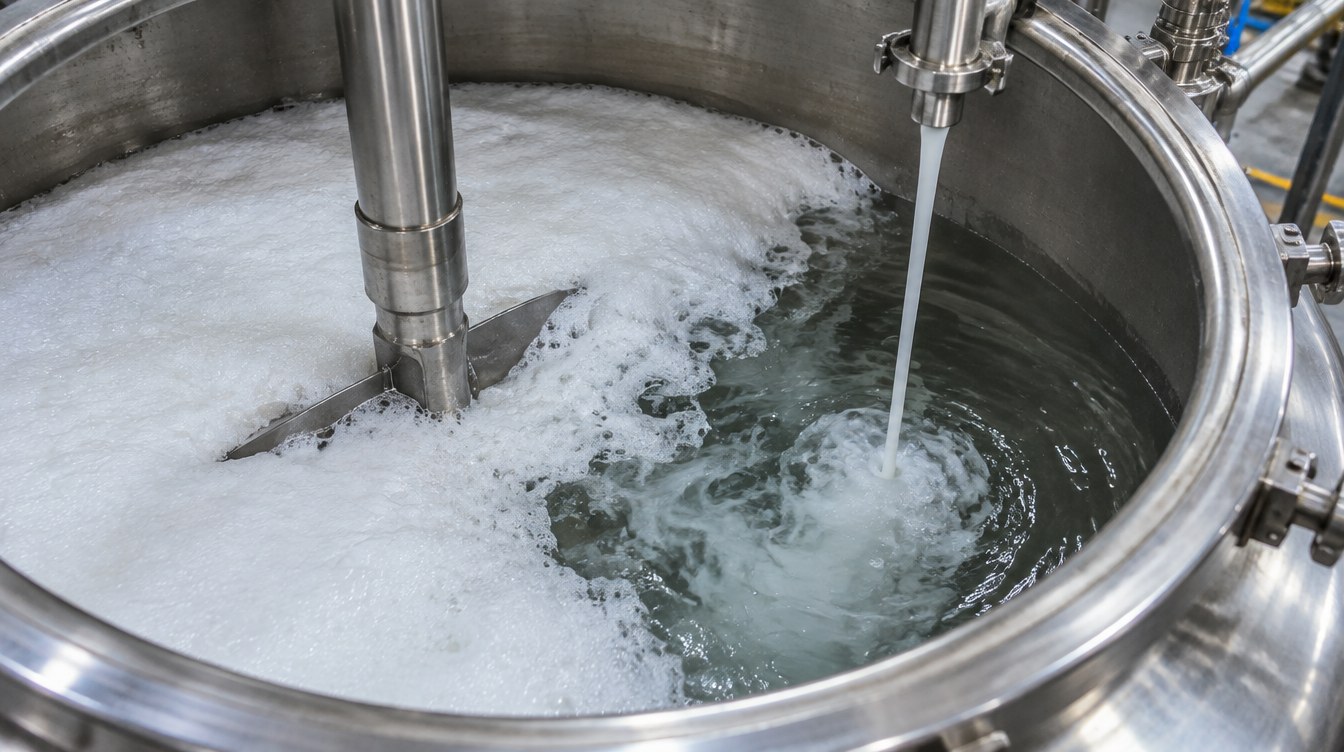
Your effluent tank has been foaming over, and purchasing has found a cheaper silicone antifoam at the same percent active and the same CAS number as the incumbent. On paper the two drums match. On the plant floor the switch can mean a higher dose, foam that returns between feeds, or craters on a paint line two buildings away. Nothing on the certificate of analysis (CoA) changed. What changed is what the paperwork does not describe: the silica, the emulsifiers and the droplet size.
What is in a silicone antifoam emulsion?
The silicone is polydimethylsiloxane (PDMS), a polymer with the formula (C2H6OSi)n: a backbone of alternating silicon and oxygen atoms, with two methyl groups on the silicon of each repeat unit. The methyl groups face outward, which gives the fluid a low surface tension and keeps it out of solution in water. Both properties matter. A droplet that does not dissolve stays in a foam film as a separate phase, and its low surface tension lets it pull that film apart.
In water-based foam, PDMS fluid alone is a weak, slow antifoam, so formulators disperse fine hydrophobic silica into it to make a fast compound. In oil-phase foams, such as hydrocarbon liquids, the fluid works without silica.
An emulsion breaks that compound into small droplets and suspends them in water with emulsifiers, often with a thickener and a preservative, so it mixes readily into aqueous foam. The catalog record for silicone antifoam emulsion (10-50% active) lists five strengths, 10%, 20%, 30%, 40% and 50% active silicone, as a Technical Grade under CAS 63148-62-9.
That registry number identifies the dimethyl silicone polymer. To cross-check the identity, run a PubChem search on CAS 63148-62-9 or on the polymer name, polydimethylsiloxane. The number does not identify the silica, how the silica was made water-repellent, the emulsifiers or the droplet size. Those four are where two drums with identical paperwork differ.
How does a silicone antifoam break a foam film?
Foam lasts because the lamella, the thin liquid wall between two bubbles, drains slowly. Surfactant crowds both faces of the wall. When the wall stretches, surfactant thins at that spot, surface tension rises there and pulls liquid back in, and the spot heals. A silicone compound defeats that self-repair in three stages.
-
Entry. The droplet first has to break through to the air side of the film. A thin layer of foaming liquid separates it from the air, held up by the same surfactant that holds up the foam. The hydrophobic silica particles pierce that layer. Without silica, many droplets stay trapped in the liquid until the film around them has drained almost dry, which is why silicone fluid alone acts slowly in water-based foam.
-
Spreading. Once a droplet sits in the surface, silicone spreads outward across the film wherever the surfactant layer allows. Spreading drags liquid away and thins the film around the droplet. It helps, but the next stage ruptures a film without it.
-
Bridging and dewetting. When the film has thinned to about the size of the droplet, the droplet touches both faces at once and forms a bridge. Water does not wet silicone, so the film pulls back from the bridge, the hole widens and the film breaks. Silica particles inside the droplet speed that pull-back.
This is a physical process, not a reaction, and it explains what a buyer sees in the plant. Dose is low because one droplet breaks film after film. Dispersion matters because a gram of silicone in fine droplets, down to the size that can still bridge a film, reaches far more films, while large drops are fewer, separate out, merge and leave deposits. And the gap in speed between a silica compound and plain fluid shows up in a simple shake test.
Why does the silica decide performance?
If the silicone alone set performance, every emulsion at the same active level would perform the same. They do not, and the reason sits in the silica. The particles must be water-repellent enough to pierce the entry layer and dewet in the bridge, small enough to sit inside a droplet, and evenly dispersed. Those are formulation choices, and the percent active reports none of them.
Durability depends on the silica too. In a system that foams continuously, droplets cycle through film after film. They break into droplets too small to bridge a film, and the silica gathers in some droplets while others are left with too little. Both changes cut activity, so fast knockdown does not prove a product holds foam down over a shift.
That wear is one reason for continuous or repeated dosing. In a flow-through tank the silicone also leaves with the liquid and sticks to suspended solids, so the feed keeps replacing it.
Put plainly: at an equal dose of silicone, two emulsions at 20% active built on different compounds can differ more in performance than a 20% grade and a 30% grade built on the same compound. The compound and its droplet size set your dose; percent active only sets how much active each drum holds. A side-by-side trial in your own liquor settles it; take dosing limits for amine units, membranes and food-contact lines from the product’s technical data sheet, its SDS and the equipment maker’s guidance.
What does percent active tell you, and what does it leave out?
| Spec line | What it tells you | What it leaves out | What to ask for |
|---|---|---|---|
| CAS 63148-62-9 | The silicone is a dimethyl siloxane polymer | Silica, emulsifiers, droplet size | Written notice before any change to the compound |
| Formula (C2H6OSi)n | The repeat unit of the chain | Chain length, so the fluid’s viscosity | The silicone’s viscosity, if the supplier will share it |
| Percent active, 10% to 50% | How much active you pay freight on | How hard that silicone works in your foam | Its basis and test method, then a test at equal silicone dose |
| Technical Grade | It is sold as a technical product | Any documentation for food or fermentation contact | A grade documented for that use |
Percent active still matters for cost. Suppliers state it as silicone content, silicone plus silica, or nonvolatile solids, which also counts emulsifier and thickener. Ask which basis and test method the figure uses; price and dose comparisons hold only on one basis.
At 10% active, nine-tenths of every drum is not the active, mostly water; at 50% active, half of it is. Compare quotes on price per kilogram of active silicone delivered, not per drum. Then check the grade against your dosing equipment: a high-active emulsion tends to be thicker and slower to disperse, and if you dilute it on site, the diluted product is less stable than the concentrate.
Where is silicone the wrong tool?
The insolubility that lets a droplet break a foam film does not stop when the foam is gone. Silicone that leaves the foaming zone coats whatever it reaches next, and sometimes that costs more than the foam did.
| System | What the silicone does downstream | What to do instead |
|---|---|---|
| Coatings and inks | Wrong grade or overdose causes craters (fisheyes) and recoat failure | Trial a coatings grade on a drawdown, or a silicone-free defoamer |
| Metalworking fluid on parts headed for paint or plating | Carryover on the metal shows up as craters and poor adhesion | A non-silicone defoamer upstream of the paint or plating line |
| Aeration basins with biological foam | Knocks foam down without touching its cause; droplets can lower oxygen transfer | Fix the biological cause; if you must dose, spray onto the foam, not into the aeration zone |
| Amine gas treating | Excess silicone can deposit on exchangers and load the carbon bed | Trial a polyglycol antifoam at the lowest dose that holds |
| Membrane systems | Silicone can coat the membrane | Check the membrane maker’s list of compatible antifoams first |
| Food and fermentation | Technical Grade says nothing about food contact | A grade documented for food use |
None of these rules silicone out of a whole industry. The catalog lists silicone antifoam emulsion (10-50% active) for chemical processing, water treatment and coatings, and in each of those the question is where the silicone ends up, not whether it breaks foam.
How should you qualify a replacement before you switch?
-
Run a shake or sparge test in your own liquor at process temperature. Dose incumbent and candidate at equal silicone on one basis, not equal product weight, and record how fast the foam collapses and how long it stays down.
-
Keep foaming the treated liquor for longer, so the test shows droplet wear and not just the first knockdown.
-
If anything downstream gets painted, coated or plated, pull a drawdown or test panel at your highest expected dose.
-
Add the emulsion to hot, salty or strongly alkaline liquor and look for oil drops or a surface skin. Salt and heat may break the emulsifiers, and hot, strongly alkaline liquor can also degrade the silicone and silica; run the test long enough to show both.
-
Write the specification around performance: percent active with its basis, test method and tolerance, the agreed test result and written notice before any change to the compound or emulsifiers.
Methodology: identity data (CAS Registry Number 63148-62-9, the (C2H6OSi)n repeat unit, the 10% to 50% active range and the Technical Grade designation) come from the product catalog record. The film-breaking mechanism is general colloid and surface chemistry, stated without figures because no test data on a specific product were used.
Frequently asked questions
Is an antifoam the same thing as a defoamer?
Why does foam come back after a dose that cleared it?
Is a 50% active emulsion better value than a 10% active one?
Can silicone antifoam emulsion be stored outdoors through a winter?
Can a technical grade silicone antifoam go into a food or fermentation process?
Sources & methodology
Figures are RawSource sourcing data unless attributed to a named source. Regulatory citations are current as of publication. Chemical identities verified by CAS number against the RawSource catalog.
Search 1,300+ industrial chemicals by name or CAS, or send us your spec — we quote by the drum, tote, or container.
Browse the Chemical Index → Request a Quote