
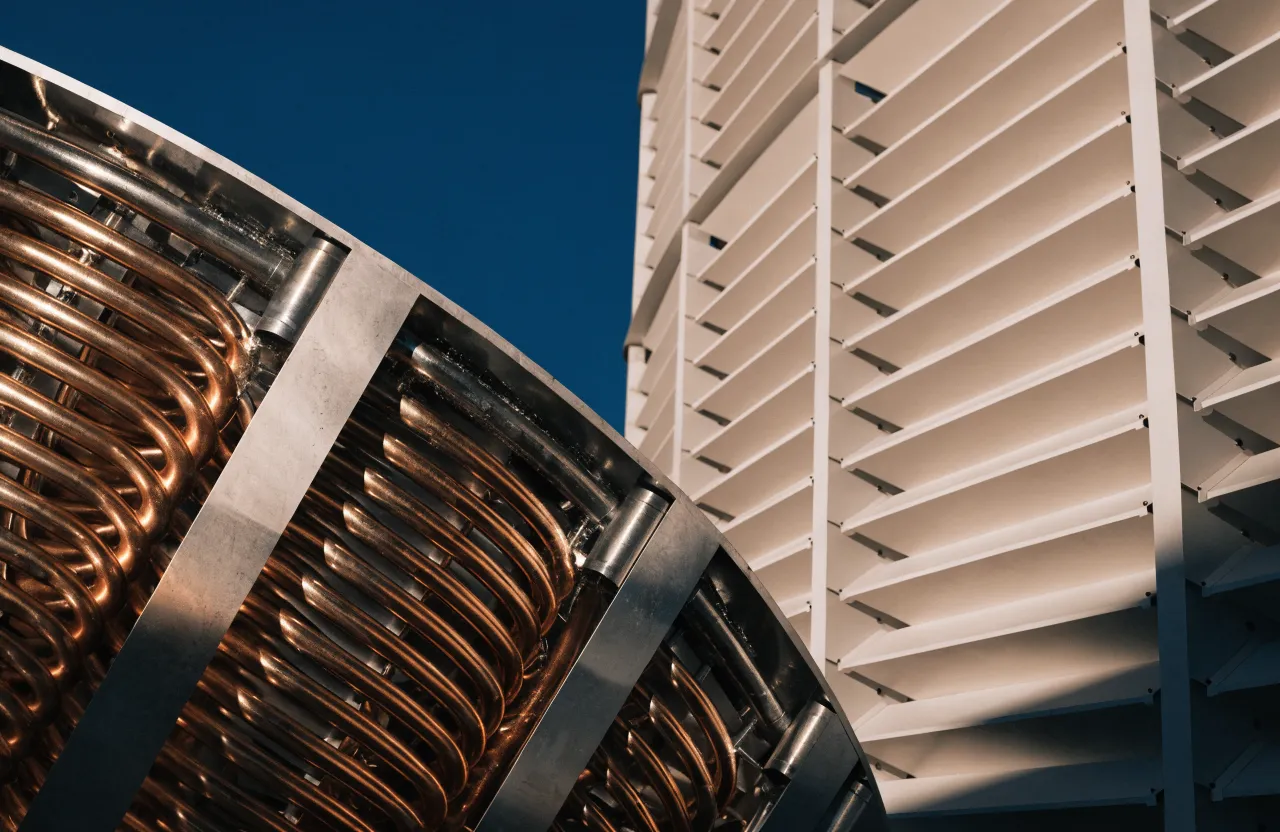
Your chiller’s approach temperature has crept up three degrees since spring, the condenser tubes feel gritty when you swab them, and the last corrosion coupon came back lightly pitted. Those are three different failures, scale, fouling, and metal loss, all happening in the same loop of recirculating water at once. A cooling tower water treatment program exists to hold them in balance, because the move that fixes one of them usually makes another worse. Run the water hard to save make-up and you concentrate the very ions that scale your tubes. Soften it too far and you can turn the loop corrosive.
The short version: Open recirculating cooling towers reject heat by evaporation, which leaves dissolved and suspended solids behind, so the circulating water steadily concentrates. That drives four interacting problems: scale, corrosion, microbiological fouling, and suspended solids. A treatment program manages all four at once. Cycles of concentration (set by conductivity and blowdown) define the operating window; scale inhibitors (phosphonates such as HEDP, PBTC, and ATMP) hold hardness in solution; corrosion inhibitors (azoles for copper alloys, molybdate for steel) film the metal; dispersants keep particulate suspended; and biocides are the antimicrobial side of the program. There is no off-the-shelf recipe. The program is tuned to your make-up water, metallurgy, and heat load, and it only works if it is monitored.
What the water is actually doing to your system
A cooling tower cools by evaporating a fraction of the recirculating water. The heat leaves with the vapor; the dissolved minerals and suspended particulate that were in that water do not. They stay in the loop and concentrate with every pass. Make-up water added to replace what evaporated brings in fresh hardness, alkalinity, silica, and chloride, so the concentrations climb until something is bled off.
That concentrating loop is why four problems show up together. Scale forms when calcium carbonate and similar salts exceed their solubility and deposit on the hottest surfaces, exactly the heat-exchanger tubes you most need clean. Corrosion attacks the steel and copper-alloy metallurgy, driven by dissolved oxygen, chlorides, and pH swings. Microbiological fouling develops because the water is warm, aerated, and often sunlit, an environment that supports biofilm. Suspended solids (airborne dust, silt, corrosion products) settle in low-flow areas and foul surfaces. The four feed each other: scale roughens metal and shelters microbes; deposits drive under-deposit corrosion; corrosion products become more suspended solids. Treat the loop as one system, not four separate chemical purchases.
Cycles of concentration: the dial that sets everything else
Cycles of concentration (COC) is the number of times the circulating water has concentrated relative to the make-up. Practically, it is the ratio of a dissolved-solids marker in the tower water to the same marker in the make-up. Because conductivity tracks dissolved solids, it is the usual control handle: if make-up runs 500 µS/cm and you hold the tower at 2,000 µS/cm, you are running four cycles. A conductivity controller opens the blowdown (bleed) valve when the setpoint is exceeded, dumping concentrated water that fresh make-up then dilutes.
Cycles are the master trade-off in the whole program. Per the U.S. Department of Energy’s cooling tower management guidance, raising cycles from three to six cuts make-up water by roughly 20% and blowdown by about 50%, which is real money and real water saved. But every added cycle concentrates the scaling and corrosive ions further and leaves the inhibitors less margin to work in. The right number is not “as high as possible.” It is the highest cycle count your make-up chemistry and inhibitor package can hold without scaling, usually found from a make-up water analysis and a scaling-index calculation, then enforced with a conductivity controller rather than guessed.
Scale control: phosphonate antiscalants
The workhorses of cooling-water scale control are organophosphonates, and they earn their place through threshold inhibition. At sub-stoichiometric doses, far below the amount needed to chelate all the hardness, phosphonates adsorb onto the first microscopic scale nuclei, occupy the active crystal-growth sites, and distort the lattice so the crystals cannot grow into adherent deposits. A few parts per million of inhibitor holds far more than its weight of hardness in solution.
Three are standard. HEDP (hydroxyethylidene diphosphonic acid) is a strong calcium-carbonate inhibitor and the common default. ATMP (amino trimethylene phosphonic acid) is an effective calcium-scale inhibitor often paired with HEDP, and it contributes to steel corrosion control. PBTC (phosphonobutane tricarboxylic acid) is the choice where oxidizing biocide is fed continuously, because its carboxylate-phosphonate structure tolerates chlorine and bromine better than the others and resists degradation at higher cycles. The honest caveat: phosphonates have a downside. Overfeed them, or run high calcium and phosphate together, and the phosphonate can hydrolyze and contribute to calcium-phosphate scale of its own, which is why dose is matched to the water rather than maximized. For the chemistry behind grade selection, see our guide to scale inhibitors and antiscalants.
Corrosion control: a different film for each metal
Most cooling systems are mixed metallurgy, with mild steel piping and tube sheets alongside copper and copper-alloy (yellow metal) heat exchangers, and the two need different chemistry. For steel, sodium molybdate is an anodic inhibitor that helps form a passivating film, and it has a useful second job: because molybdenum is easy to assay, it doubles as a tracer for confirming inhibitor dosage in the loop. The phosphonates above also contribute to steel protection, and many programs combine molybdate with a phosphonate to film the steel at a lower total dose.
Yellow metal is protected with an azole. Tolyltriazole (TTA) is the most widely used copper-alloy inhibitor in cooling water; it bonds directly to the copper surface and forms a thin protective barrier film, and it is favored over plain benzotriazole for better stability when an oxidizing biocide is present. Typical azole feed runs on the order of 1 to 3 ppm. Protecting copper matters beyond the copper itself: dissolved copper plating onto steel sets up galvanic cells that accelerate steel corrosion, so the yellow-metal inhibitor is steel protection by another route. Track results with coupons rather than assuming. Our overview of corrosion inhibitors for cooling and process water covers the metallurgy trade-offs in detail.
Dispersants and suspended solids
Inhibitors keep scale and corrosion from forming; dispersants deal with the particulate already in the water. Polymeric dispersants, the polyacrylates and polyacrylamides, adsorb onto fine particles and precipitated micro-crystals, keep them charged and repelling each other, and hold them suspended so they leave with the blowdown instead of settling on tubes and in basins. Polymeric flocculant and dispersant grades are dosed for exactly this, preventing the stagnant deposits where under-deposit corrosion and microbial growth take hold. On dusty sites, side-stream filtration is added to physically pull solids out. One related nuisance: heavy agitation and surfactant carryover can foam a tower basin, and a metered silicone antifoam emulsion knocks it down before foam interferes with level controls and water distribution.
Microbiological control and the biocide question
Microbiological management is the part of the program with the most regulatory weight, and the part where language has to be precise. Antimicrobial products used in cooling water are regulated as pesticides. Under the U.S. Federal Insecticide, Fungicide, and Rodenticide Act (FIFRA), an antimicrobial product must be registered with the EPA for its specific use and applied strictly according to its registered label. The label, not a blog and not a supplier, governs what a given biocide may be used for, at what dose, and with what claims. Treat the registration and label as the controlling document.
Biocides are grouped by chemistry into two families. Oxidizing biocides are halogen and oxidant chemistries: chlorine, bromine, chlorine dioxide. Non-oxidizing biocides are organic actives dosed as slugs; the common cooling-water examples are DBNPA (2,2-dibromo-3-nitrilopropionamide), isothiazolinone (CMIT/MIT), and glutaraldehyde. Industry guidance from the Association of Water Technologies, the Cooling Technology Institute, and ANSI/ASHRAE Standard 188 describes programs that alternate or combine an oxidizing and a non-oxidizing chemistry, the rationale being to vary the mode of attack and manage the development of microbial resistance to any single product. The choice and rotation are part of a designed program, not an off-the-shelf pick.
Microbiological control is also where the Legionella conversation lives, and it belongs there as risk-management context. Warm, aerated, recirculating cooling water is a recognized growth environment for waterborne bacteria, which is why building-water risk-management standards such as ANSI/ASHRAE Standard 188 call for a documented water management program covering assessment, control, monitoring, and recordkeeping. The framework that manages that risk is the program: engineering controls, the documented plan, registered products used per label, and verification, not any single chemical.
The program on one page
| Problem | Treatment chemistry | Example products |
|---|---|---|
| Scale (CaCO₃, hardness) | Phosphonate threshold antiscalants; chlorine-stable phosphonate where oxidant is fed | HEDP, ATMP, PBTC |
| Corrosion (steel + yellow metal) | Anodic film for steel + azole barrier film for copper alloys | Sodium molybdate, tolyltriazole (TTA) |
| Suspended solids / fouling | Polymeric dispersants; side-stream filtration | Polyacrylamide / polymer dispersant |
| Microbiological growth | Oxidizing + non-oxidizing antimicrobials, alternated; EPA-registered, used per label | DBNPA, isothiazolinone, glutaraldehyde |
| Foam in the basin | Silicone defoamer, metered | Silicone antifoam emulsion |
How the program is monitored
A treatment program is only as good as its measurements. Conductivity is read continuously by the controller to hold cycles of concentration and trigger blowdown. Corrosion coupons, pre-weighed metal samples pulled from a bypass rack quarterly to semi-annually, give a measured corrosion rate by mass loss for each metallurgy, the hard evidence that the inhibitor package is working before tube wall is lost. Microbiological monitoring uses dipslides or ATP testing (often weekly) to track planktonic bacteria, plus oxidant residual or ORP to confirm the oxidizing biocide is present at the intended level.
Set explicit control limits for each parameter, log the readings, and act on the trend rather than the single sample. A coupon drifting from a low corrosion rate toward a higher one is a treatment problem you can still fix; a leaking exchanger is one you cannot.
Why there is no off-the-shelf program
A competent program is never a single drum of “cooling tower chemical,” because the inputs vary site to site. The make-up water analysis sets your scaling and corrosion tendency and your achievable cycles. The metallurgy decides which corrosion inhibitors you need; an all-steel loop differs from one full of copper exchangers. The heat load sets how hard the hottest surfaces push scale, and the duty (process cooling, HVAC comfort cooling, seasonal versus year-round) shapes the biocide program and monitoring cadence.
A program is assembled from those facts: a phosphonate package matched to the water, a corrosion-inhibitor blend matched to the metallurgy, dispersant for the solids load, and EPA-registered biocides selected and rotated per label. Start from a water analysis, not a catalog SKU. For the wider chemistry across cooling, boiler, and process water, see our water treatment chemicals guide.
Buying cooling tower chemicals
Send us your make-up water analysis, your metallurgy, and your target cycles to qualify a package on your own system. Antimicrobial products are sold for use only as directed by their EPA-registered label.
Frequently asked questions
What chemicals go in a cooling tower?
A cooling tower water treatment program uses four chemistry types together: scale inhibitors (phosphonates such as HEDP, PBTC, and ATMP); corrosion inhibitors (an azole like tolyltriazole for copper alloys plus molybdate or phosphonate for steel); dispersants (polyacrylate or polyacrylamide polymers) to keep suspended solids mobile; and biocides (EPA-registered oxidizing and non-oxidizing antimicrobials) for the microbiological side. A defoamer is added where the basin foams. The exact blend is set by the make-up water, the metallurgy, and the heat load.
What are cycles of concentration?
Cycles of concentration is how many times the recirculating water has concentrated relative to the make-up, since evaporation removes water but leaves dissolved solids behind. It is read as the ratio of a dissolved-solids marker (usually conductivity) in the tower water to the same marker in the make-up. Running more cycles saves make-up water and blowdown but concentrates scaling and corrosive ions further, so the target is the highest cycle count your water and inhibitor package can hold without scaling, enforced by a conductivity controller.
What is the difference between oxidizing and non-oxidizing biocides?
They are two chemistry families of antimicrobial products used in cooling water. Oxidizing biocides are halogen and oxidant chemistries such as chlorine, bromine, and chlorine dioxide. Non-oxidizing biocides are organic actives such as DBNPA, isothiazolinone, and glutaraldehyde. Industry guidance (AWT, CTI, ANSI/ASHRAE 188) describes programs that alternate or combine the two families to vary the mode of attack and manage microbial resistance. All antimicrobial products must be EPA-registered for the specific use and applied per label.
How do you control scale in a cooling tower?
Scale is controlled on two fronts. First, hold cycles of concentration at a level your make-up water can support without exceeding mineral solubility, using a conductivity controller and blowdown. Second, feed a phosphonate threshold scale inhibitor (HEDP, ATMP, or PBTC), which adsorbs onto microscopic scale nuclei at low dose and distorts the crystals so they cannot grow into adherent deposits. Where an oxidizing biocide is fed continuously, PBTC is often chosen for its tolerance of chlorine and bromine.
Why do cooling water programs use both molybdate and an azole?
Because cooling systems usually contain two metals that corrode differently. Sodium molybdate (often with a phosphonate) helps passivate mild steel, and molybdenum doubles as a dosage tracer because it is easy to assay. An azole such as tolyltriazole protects copper and copper-alloy (yellow metal) heat exchangers by forming a barrier film on the copper surface. Protecting the copper also reduces galvanic corrosion of steel, since dissolved copper plating onto steel accelerates steel attack.
Do cooling tower biocides need to be EPA-registered?
Yes. In the United States, antimicrobial products that make pesticidal claims are regulated under FIFRA and must be registered with the EPA before sale and use, and applied according to their registered label. The label controls the permitted uses, dose rates, and claims for each product. Selection, dosing, and any antimicrobial claim should follow the EPA-registered label and your site’s water management program, not a generic recommendation.
Editorial note. This article is general technical guidance for water treatment and facility professionals specifying or buying cooling-water chemistry. It is not a treatment specification, a water management program, or a safety, health, medical, or environmental claim. Cooling water programs are site-specific and depend on your make-up water, metallurgy, heat load, and operating conditions, and must be designed and validated for your own system; the Certificate of Analysis governs the grade you buy. Antimicrobial products (biocides) are regulated as pesticides under FIFRA; they must be EPA-registered for the specific use and applied strictly per their registered label, which governs all permitted uses, dose rates, and claims. Nothing here is an efficacy, disinfection, or Legionella-control claim, and no product is represented as preventing, controlling, or eliminating any organism. Many of these chemicals are corrosive, oxidizing, or otherwise hazardous; review the current Safety Data Sheet (SDS) and use appropriate engineering controls and PPE before handling. Products are sold for industrial and professional use only. RawSource makes no warranty, express or implied, and assumes no liability for use of this information.
Search 1,300+ industrial chemicals by name or CAS, or send us your spec — we quote by the drum, tote, or container.
Browse the Chemical Index → Request a Quote