
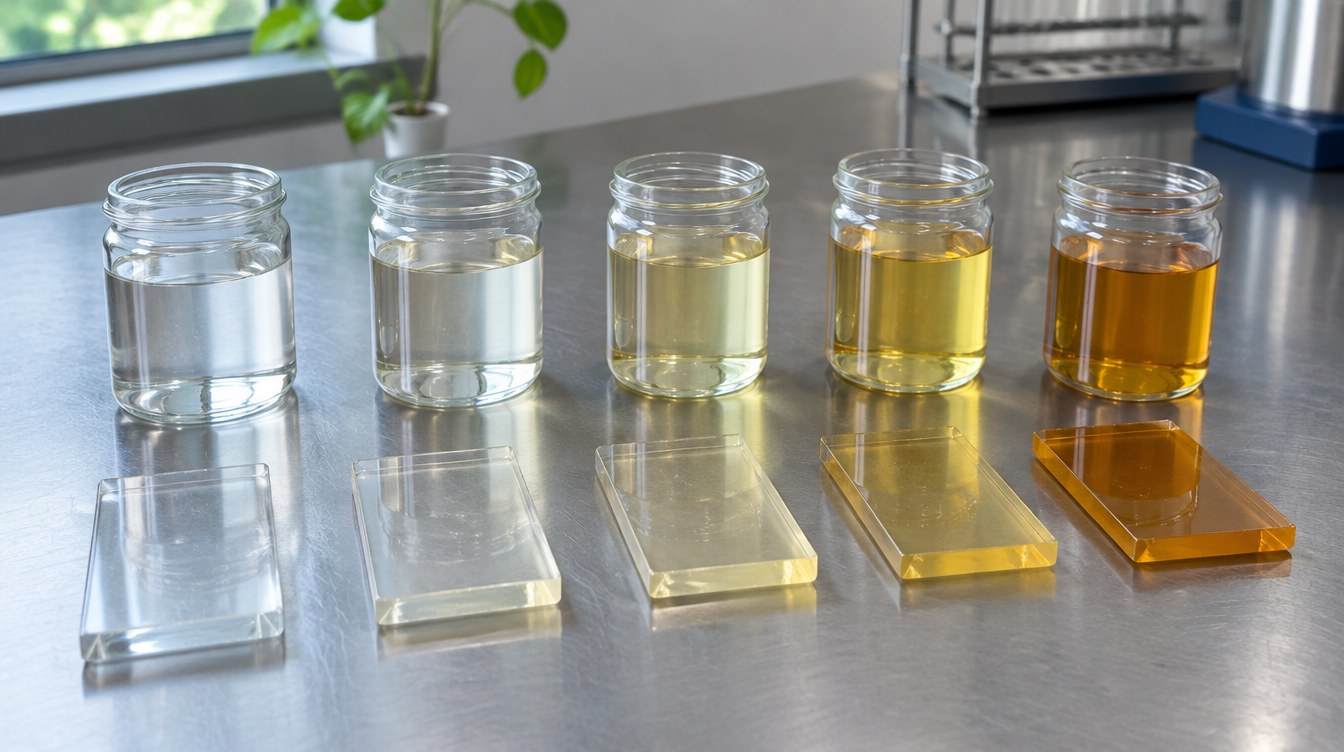
Your formulator has approved a tough, impact-resistant epoxy floor, and purchasing now has to buy the hardener behind it. The lab sample arrived under a producer’s grade code, which a second supplier cannot quote against with any certainty, and each quote will carry its own amine hydrogen equivalent weight (AHEW). Mix a new lot at the old lot’s ratio without checking that number and you can leave free amine or unreacted resin in the slab.
Two decisions sit inside that purchase. The amine chemistry decides how the system cures: gel time, working time, cure temperature, color, flexibility, glass transition temperature (Tg) and blush. The AHEW of the lot you receive decides how much of it goes in.
What does the hardener decide that the resin does not?
Each active amine hydrogen (N-H) opens one epoxide ring on the resin and forms a covalent bond, so a hardener with several N-H groups ties several resin chains together. The density and stiffness of that network are what you measure as hardness, heat resistance and chemical resistance.
That makes the hardener the bigger lever. A liquid bisphenol A diglycidyl ether resin cured with a small aliphatic amine gives a hard, rigid part. The same resin cured with a polyoxypropylenediamine gives a tougher one, because the polyether chain between the amine ends can move and absorb energy. Pick the hardener chemistry to the performance target first.
The amine classes, compared by chemistry
No class wins every column. The accelerator row sits last because it modifies a hardener instead of replacing one.
| Amine chemistry | Examples | Ambient cure | Working time | Cured film | Main trade-off |
|---|---|---|---|---|---|
| Aliphatic polyamines | Diethylenetriamine, triethylenetetramine, tetraethylenepentamine | Fast | Short | Hard, rigid, good solvent resistance | Blush in cold, humid air; brisk exotherm in mass |
| Cycloaliphatic amines | Isophorone diamine and its adducts | Moderate, often accelerated | Medium | Low yellowing, high gloss | Slow at ambient without an accelerator |
| Araliphatic amines | m-Xylylenediamine | Fast to moderate | Short to medium | Rigid, strong chemical and water resistance | Short working time |
| Polyamides | Dimerized fatty acids reacted with ethyleneamines | Slow | Long | Flexible, tough, amber | Softer film, sluggish in the cold |
| Amidoamines | Monomeric fatty acids reacted with ethyleneamines | Slow to moderate | Long | Flexible, bonds well to concrete | Lower heat resistance |
| Polyetheramines | Polyoxypropylenediamine, polyoxypropylenetriamine | Slow | Long | Tough; flexible only in the longer cuts | Lower Tg unless blended or post-cured |
| Tertiary-amine accelerators | Tris(dimethylaminomethyl)phenol | Speeds the primary hardener | Shortens it | Not a hardener at accelerator doses | Higher peak exotherm |
Aliphatic polyamines: fast, rigid, blush-prone
Diethylenetriamine (CAS 111-40-0), triethylenetetramine and tetraethylenepentamine are small, reactive molecules that cure at room temperature into a tight, rigid network. The price is a short working time, a brisk exotherm in a large mass and a tendency to blush, where surface amine reacts with carbon dioxide and moisture to leave a greasy carbamate film. Use this class warm, dry and ventilated.
Cycloaliphatic and araliphatic amines: color and gloss
Isophorone diamine (CAS 2855-13-2) carries one amine group on a cyclohexane ring and one on a methylene group beside it, and is chosen for low yellowing and good gloss among amine hardeners in clear coats and flooring, though an exterior epoxy still needs a UV-stable topcoat, since sunlight chalks and yellows the epoxy.
It cures slowly at ambient, so formulations often add an accelerator or use a pre-reacted adduct that ties up some free N-H to cut blush. m-Xylylenediamine puts aliphatic amine groups on an aromatic ring; it cures faster and resists chemicals and water well.
Polyamides and amidoamines: working time and damp tolerance
Both are reaction products of fatty acids with ethyleneamines: dimerized fatty acids give polyamides, monomeric fatty acids give amidoamines. Polyamides trade speed for long working time, flexibility and corrosion resistance, which suits maintenance and marine coatings, but turn sluggish in the cold. Amidoamines are thinner, lower in odor, tolerate humidity and bond well to concrete. Both forgive an off-ratio mix better than a straight amine does.
Polyetheramines: toughness at the cost of Tg
Polyoxypropylenediamine is a difunctional primary amine on a polypropylene glycol backbone, and the short cut discussed here has a nominal molecular weight of 230 g/mol. The polyether chain absorbs impact through segmental motion, but the 230 g/mol cut still cures rigid at room temperature; flexibility comes with the longer cuts. The cost is a lower Tg, which you raise by blending in a rigid amine such as isophorone diamine or by a heat post-cure. The trifunctional polyoxypropylenetriamine adds a third amine end and builds a tighter network.
Aromatic amines and anhydrides are a separate decision: they trade an elevated-temperature cure for heat resistance. Read the current Safety Data Sheet (SDS) for any hardener here before handling it.
Why the AHEW, not the class name, sets the ratio
Each epoxide group reacts with one active amine hydrogen, so resin and hardener are matched by equivalents, and an equivalent weight is the mass of material that carries one reactive equivalent. The epoxy equivalent weight (EEW) is the grams of resin carrying one mole of epoxide groups. The AHEW is the hardener’s molecular weight divided by its number of active N-H hydrogens. Parts of hardener per hundred parts of resin by weight (phr) equal the AHEW divided by the EEW, multiplied by one hundred.
Take the polyoxypropylenediamine. Its two primary amine groups carry four active hydrogens, so the nominal molecular weight of 230 divided by four gives a theoretical AHEW of about 57. Chain length is a distribution, so real lots are accepted against an agreed AHEW or total-amine-value range on the Certificate of Analysis (CoA). Divide the lot’s AHEW by the EEW on your resin’s CoA and multiply by one hundred. Use the EEW for the lot you bought, not a nominal figure, because the ratio moves with it.
The same arithmetic explains why small batches of fast aliphatic systems go wrong. A low-AHEW amine goes in at a small dose, so a fixed weighing slip, or the residue left in a mixing cup, is a larger share of the hardener than it would be with a polyetheramine dosed at a higher mass. Excess amine plasticizes the network, lowers Tg and feeds blush; excess epoxy leaves unreacted resin and a soft, under-cured part.
If a meter-mix machine doses by volume, the weight ratio has to be converted with each component’s density. Take both densities from the lot certificates, and never carry a volume ratio over from a different hardener.
What should the RFQ say for a polyoxypropylenediamine?
A producer’s grade code names a molecular-weight cut in one company’s line. It is not a specification, and a second supplier quoting against it has to guess which properties matter to you. The CAS number does not close the gap: the one registered for polyoxypropylenediamine covers the polymer family across molecular weights, so it cannot tell a low-molecular-weight hardener from a long-chain flexibilizer. Put the chemistry and the numbers on the request for quotation (RFQ) instead.
| Property | What to put on the RFQ |
|---|---|
| Chemistry | Difunctional primary amine on a polypropylene glycol backbone, and its functionality |
| Molecular weight | The nominal cut (230 g/mol for the short cut discussed here), and how the supplier determines it |
| AHEW | An agreed total-amine-value range, titrated on every lot and reported on the CoA, with the AHEW calculated from it, not the theoretical 57 |
| Viscosity | A viscosity window, the measurement temperature and the method |
| Density | The measured lot value, needed for volume dosing |
| Color | A maximum color on the platinum-cobalt scale (ASTM D1209), reported on every CoA |
| Flash point | Confirm against the current SDS |
The color row is the one buyers skip. Receiving inspection cannot test an adjective, so write the limit as a number on that scale.
Accelerators: a faster gel and a shorter working time
An accelerator fits two cases. Tris(dimethylaminomethyl)phenol, a tertiary amine, speeds a slow ambient system such as isophorone diamine or a polyamide when it has to gel faster or cure in the cold. Because a tertiary amine has no N-H, it is dosed to a gel-time target, not by AHEW. Imidazole-based latent curatives fit one-component, heat-cured systems: stable at room temperature, they cure the resin once heated. Either way, a faster cure brings a shorter working time and a higher peak exotherm, so test both at the mass you pour.
Matching the chemistry to the job
- Fast ambient coatings in a warm, dry shop: an aliphatic polyamine, accepting short working time and blush risk.
- Color-stable clears and floors: isophorone diamine or an adduct; m-xylylenediamine where speed outranks color.
- Tough, impact-resistant parts: polyoxypropylenediamine, alone or blended with a rigid amine to lift Tg.
- Long working time, large pours and concrete primers: a polyamide or an amidoamine.
- Cold or damp sites: a Mannich base (a phenol, formaldehyde and a polyamine), the class built for low-temperature and damp-surface cure; ask each supplier for cure data at your lowest application temperature and humidity.
- Heat-cured composites and electronics: an aromatic amine, an anhydride or a latent imidazole.
Methodology: class behavior is general epoxy chemistry, stated without figures. The polyoxypropylenediamine figures (the 230 g/mol cut and the AHEW of about 57 calculated from it) are nominal or theoretical, not lot or data-sheet values. Compound identities link to PubChem, and the CoA and current SDS for your lot govern every number you dose from.
Frequently asked questions
Can I switch polyoxypropylenediamine suppliers and keep the same mix ratio?
Will a polyoxypropylenediamine cure make the part flexible?
Does adding an accelerator change the stoichiometric ratio?
What is amine blush, and which hardeners are prone to it?
Sources & methodology
Figures are RawSource sourcing data unless attributed to a named source. Regulatory citations are current as of publication. Chemical identities verified by CAS number against the RawSource catalog.
Search 1,300+ industrial chemicals by name or CAS, or send us your spec — we quote by the drum, tote, or container.
Browse the Chemical Index → Request a Quote