
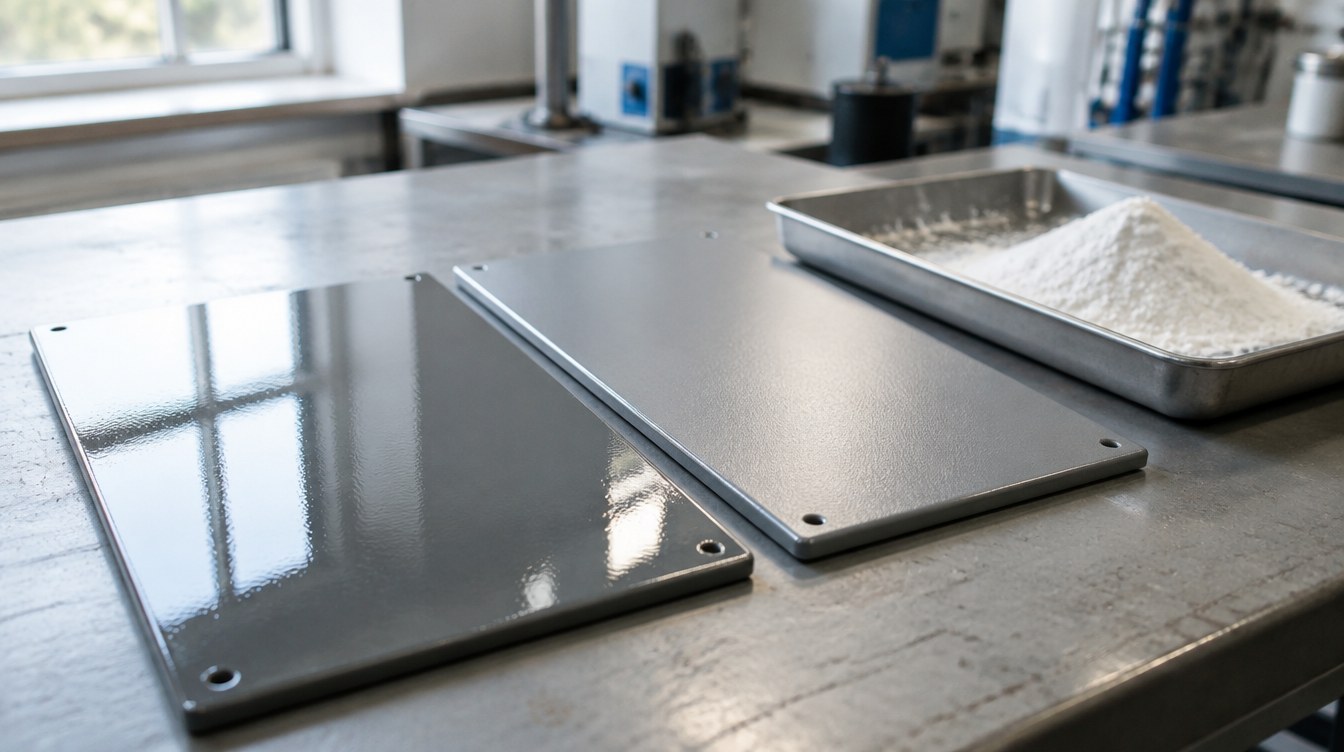
Your exterior clearcoat has passed accelerated weathering with both candidate hardeners, and the formulator still needs a decision: an HDI isocyanurate, an IPDI trimer, or a blend. The yellowing question was settled the day your specification said aliphatic. What is left is a trade between hardness and flexibility, between early physical dry and full chemical cure, and between high solids and the solvent an IPDI share brings with it.
Pick wrong and the topcoat chips on a panel that flexes, or stays soft long enough to block on the drying rack. Start from a detail most selection charts skip: the two isocyanate groups on isophorone diisocyanate do not react alike, and that fact explains more about where IPDI gets bought than its hardness does.
Why the yellowing argument is already settled
Yellowing is a question of where the isocyanate group sits. In toluene diisocyanate (TDI) and diphenylmethane diisocyanate (MDI), the NCO group is bonded straight to a benzene ring. Under sunlight and oxygen the aromatic urethane oxidizes toward quinone-imide structures, conjugated chromophores that absorb blue light and read as amber. The same aromatic backbone that makes TDI and MDI cheap and fast is the part that fails outdoors.
HDI and IPDI carry their NCO groups on saturated carbon. Hexamethylene diisocyanate is a straight chain of six methylene groups with an NCO at each end; isophorone diisocyanate is cycloaliphatic, built on a saturated six-membered ring. Neither has an aromatic system to oxidize into a chromophore, so both hold color and gloss through long UV exposure. Comparing them on yellowing is comparing two passes.
Aromatics still earn their place. Aliphatics cost more and generally react slower than aromatics, so an interior primer or a hidden adhesive is usually better served by an aromatic system. Spend the aliphatic budget on the layer the sun reaches.
What does the isophorone ring change?
PubChem gives isophorone diisocyanate (CAS 4098-71-9) the formula C12H18N2O2 and a molecular weight of 222.28 g/mol. Its IUPAC name, 5-isocyanato-1-(isocyanatomethyl)-1,3,3-trimethylcyclohexane, tells the rest of the story. One NCO group hangs directly off the ring as a secondary isocyanate. The other sits on a methylene arm attached to a fully substituted ring carbon, a crowded position next to a methyl group.
The ring is what you pay for in hardness. Built into a urethane network, the rigid cycloaliphatic unit raises the film’s glass transition, so IPDI-based coatings develop hardness sooner and finish harder than HDI-based ones. The six-carbon HDI chain bends, and the film returns that as flexibility and impact resistance. Neither is better in the abstract: ask whether your film is likelier to fail soft, marking and blocking, or hard, cracking when the substrate moves.
For the mix calculation, two NCO groups per 222.28 g/mol molecule means the monomer’s equivalent weight is half its molecular weight. Do not formulate from that theoretical figure. Trimers, prepolymers and adducts each carry their own NCO content, and the number that sets your mix ratio is the measured value on each lot’s Certificate of Analysis (CoA).
Two isocyanate groups that do not react alike
In hexamethylene diisocyanate the two NCO groups are identical, because a symmetric chain gives each end the same chance to react. In isophorone diisocyanate the ring-bound secondary group and the crowded primary group react at different rates. With the tin catalysts common in polyurethane coatings, the secondary group on the ring reacts first, while the primary group, shielded by its fully substituted neighbor, lags.
Selectivity is not fixed. It moves with catalyst, temperature and the alcohol being reacted, and some tertiary-amine catalysts shrink the preference or reverse it. It is the claim in this article most worth checking against your own kinetics, because the commercial pattern below hangs on it.
The consequence is a cleaner prepolymer. React isophorone diisocyanate with a polyol at two NCO groups per hydroxyl, and the faster secondary groups cap the chain ends while the slower primary groups survive as the free NCO. Chain extension stays lower than with a symmetric diisocyanate, so the prepolymer comes out thinner and with less free monomer before any stripping step. That is why IPDI turns up in moisture-curing one-pack systems, waterborne polyurethane dispersions and elastomer prepolymers.
HDI takes the other route: its equivalent NCO groups are built into oligomers and the leftover monomer is stripped, so HDI reaches most formulators as a finished polyisocyanate hardener. The biuret keeps N-H groups and gives a tougher, more flexible film. The isocyanurate, or trimer, closes into a ring and gives the harder, more chemical-resistant film that automotive refinish clearcoats standardize on. Low-viscosity trimers and allophanates give up some hardness for higher solids.
Where IPDI leads and where it follows
| Application | Lead isocyanate | Where IPDI fits | Why |
|---|---|---|---|
| Liquid two-component exterior topcoat or clearcoat | HDI isocyanurate | Minority co-hardener for early hardness and block resistance | Best balance of weathering and flexibility |
| Flexible or impact-prone substrates | HDI biuret or allophanate | A small share at most | Ring stiffness cracks when the part flexes |
| High-solids liquid coatings | Low-viscosity HDI trimer or allophanate | Limited | IPDI trimer is a solid and has to be cut in solvent |
| Polyurethane powder coatings | IPDI blocked adducts and uretdiones | Lead | Solid adducts keep the powder free-flowing in storage |
| Moisture-cure one-pack, dispersions, prepolymers | IPDI | Lead | Unequal NCO reactivity gives thinner, lower-monomer prepolymers |
| Light-stable elastomers | Dicyclohexylmethane diisocyanate or HDI | Shared | Hardness without aromatic yellowing |
The powder row is where the solid trimer flips from drawback to asset. A powder hardener has to stay a free-flowing solid through warm storage, then melt, flow and crosslink in the oven. IPDI adducts, blocked or internally blocked as uretdiones, are solids at room temperature, while HDI polyisocyanates are liquids that would turn a powder into a sticky cake. The product record for isophorone diisocyanate lists electrostatic powder coatings among its main uses, next to non-yellowing paints and varnishes, one-pack enamels and polyurethane elastomers.
In a liquid clearcoat the same solid adduct costs you. IPDI trimer arrives dissolved in solvent, so every increase in IPDI share adds solvent to a formula you may be holding at high solids. That is why IPDI earns its price in liquid work as a blend partner beside an HDI isocyanurate, not as a straight swap.
What the PubChem record tells a buyer about the monomer
Physical data below come from PubChem CID 169132, in the units PubChem reports.
| Property | PubChem value | What it means for your purchase |
|---|---|---|
| Molecular weight | 222.28 g/mol | Two NCO groups per molecule; mix ratios still come from the CoA |
| Melting point | Approximately -60 °C | Stays liquid in winter transit; the real cold risk is condensation in a chilled drum opened warm |
| Boiling point | 316 °F at 10 mmHg | Quoted under vacuum; see vapor pressure below |
| Vapor pressure | 0.0003 mmHg at 68 °F; 0.0007 mmHg at 122 °F | Rises with temperature, so treat any heated step as its own exposure case |
| Flash point | Greater than 200 °F | Take the storage figure from the SDS |
| Autoignition temperature | 430 °C | Relevant to heated tanks, lines and ovens |
| Density | 1.056 to 1.062 at 68 °F | Slightly denser than water; convert drum volume with the lot figure |
| logP | 4.75 (calculated) | Insoluble in water, yet water still reacts with it |
| Solubility | Miscible with esters, ketones, ethers and hydrocarbons | Use dry, alcohol-free urethane-grade solvents |
The water rows mislead people. Water does not dissolve isophorone diisocyanate, but it reacts with any NCO group it touches, forming an amine that goes on to make urea and releasing carbon dioxide. The lot loses NCO content, gains viscosity and can throw urea solids. Keep drums sealed under dry nitrogen between draws, let cold drums reach room temperature before opening, and reject any lot whose CoA shows NCO content outside your specification.
Low vapor pressure is not a clearance. The hazard statements in the current Safety Data Sheet (SDS) and the product page safety section set handling and exposure controls for every grade, monomer or adduct; read both before sampling.
What should go in the RFQ?
Specify the decision, not just the chemical name. Ask for:
-
Measured NCO content on every lot’s CoA, with the test method named.
-
Free monomer content on the CoA for any trimer, adduct or prepolymer.
-
For IPDI trimer in solution, the solvent and solids content, to check against your solvent budget.
-
For IPDI prepolymers, the catalyst family used, because selectivity, residual monomer and viscosity all move with it.
-
Packaging under dry nitrogen, with a reseal plan for part-used drums.
-
The current SDS before the first sample ships.
A practical starting point for a liquid exterior clearcoat: run the HDI isocyanurate alone, then step in IPDI trimer as a minority share until early hardness meets your line’s handling time, and stop when flexibility or solids slip. For powder, prepolymer and one-pack work, start from isophorone diisocyanate chemistry and make any move away from it justify itself on the panel.
Methodology: physical properties are quoted from PubChem (CID 169132) in the units PubChem reports, and application roles come from the isophorone diisocyanate product record on this site. Reactivity comments are standard polyurethane chemistry without figures; validate catalyst-dependent behavior on your own system.
Frequently asked questions
Is IPDI harder than HDI?
Can I swap an HDI trimer for an IPDI trimer one for one?
Why is IPDI preferred for prepolymers and polyurethane dispersions?
Does isophorone diisocyanate freeze in winter shipping?
Sources & methodology
Figures are RawSource sourcing data unless attributed to a named source. Regulatory citations are current as of publication. Chemical identities verified by CAS number against the RawSource catalog.
Search 1,300+ industrial chemicals by name or CAS, or send us your spec — we quote by the drum, tote, or container.
Browse the Chemical Index → Request a Quote