
By RawSource Sourcing Desk, Commercial & Sourcing Desk · About RawSource
A municipal plant takes in a tote of bleach and parks it on the same bunded pad as the drummed acid feed, because both are “cleaning chemicals” on the receiving sheet. A week later a small leak puts the two puddles together, the pad fills with chlorine gas, and the shift evacuates. Nothing on the purchase order was wrong. The chemistry was filed under the wrong assumption, and the segregation rule that would have caught it lived in two documents nobody read at the dock.
That is the shape of most chemical-safety failures in procurement. They are rarely exotic. They come from a lot accepted without its hazard data verified, two incompatible drums stored together, or a concentration nobody confirmed. This guide reads industrial chemical safety the way a sourcing team has to: what the GHS label and the Safety Data Sheet (SDS) promise, which chemicals you keep apart, and what you demand from a supplier before a container moves.
What GHS and OSHA HazCom require
Industrial chemical safety in the United States runs on one framework: the Globally Harmonized System (GHS), adopted into OSHA’s Hazard Communication Standard at 29 CFR 1910.1200. The standard sets two deliverables a supplier owes you for every hazardous chemical: a compliant label and a 16-section SDS.
The label carries a signal word, the relevant pictograms, and the hazard (H) and precautionary (P) statements. Danger means a more severe hazard category; Warning means a lesser one. The SDS expands that into a fixed 16-section format, harmonized so Section 2 always holds the hazard identification, Section 8 always covers exposure controls and personal protective equipment (PPE), and Section 14 always carries transport data including the UN number.
For a buyer, the value is comparability. Because the format is fixed, you can line up two suppliers’ Section 2 entries for the same chemical and see immediately whether they classify the lot the same way. A mismatch there is a signal, not a formatting quirk. It means one supplier is reading the hazard, or the concentration, differently from the other.
Who is affected, by vertical
Every vertical that takes in bulk chemicals carries this exposure, but the dominant hazard shifts by sector.
In water treatment, the daily risk is oxidizer-and-acid handling. Sodium hypochlorite for disinfection and acids for pH control move through the same plant, and the bleach-and-acid chlorine reaction is the classic incident. Segregated day tanks and clear placarding are the controls that matter.
In home and industrial cleaning, the formulation bench mixes acids and bases with hypochlorite and surfactants, so the incompatibility map is dense. A blender who treats two corrosives as interchangeable because both say “corrosive” can still generate a toxic gas.
In industrial manufacturing, the spread runs from flammable solvents to strong mineral acids to fluoride etchants. The same site might hold d-limonene as a degreaser and ammonium bifluoride for metal finishing, two chemicals with completely different storage rules. The common failure is a single storeroom organized by alphabet instead of by hazard class.
Oil and gas adds a transport and pressure dimension on top of the chemistry. Field sites take in mineral acids for well treatment and oxidizers for water management, often at remote locations where the emergency response window is longer than at a plant.
Here the UN number and packing group on Section 14 of the SDS carry extra weight, because a placarding error can strand a load at a terminal far from the wellhead. The same verification discipline applies regardless of vertical: confirm the hazard data before the lot is on a truck.
How do you read an SDS before the lot ships?
Read the SDS at the quote stage, not when the truck arrives. Five sections do most of the work for a sourcing decision.
Section 2 gives the GHS classification and pictograms, plus the H-codes. This is where you confirm the hazard you are buying. Section 8 lists the occupational exposure limits and the required PPE, which tells you what your receiving staff need before the lot lands.
Section 9 reports the physical properties, including flash point, pH, and density, the numbers that drive storage and spill response. Section 10 covers stability and reactivity, naming the incompatible materials you must store the chemical away from. Section 14 carries the UN number and packing group, which must match the carrier’s placard and your dock paperwork.
If any of these is blank, vague, or copied from a different concentration than the one you ordered, treat it as a defect in the shipment, the same way you would treat an off-spec assay. A current revision date matters too. An SDS more than a few years old may predate a reclassification.
Storage incompatibilities you cannot store side by side
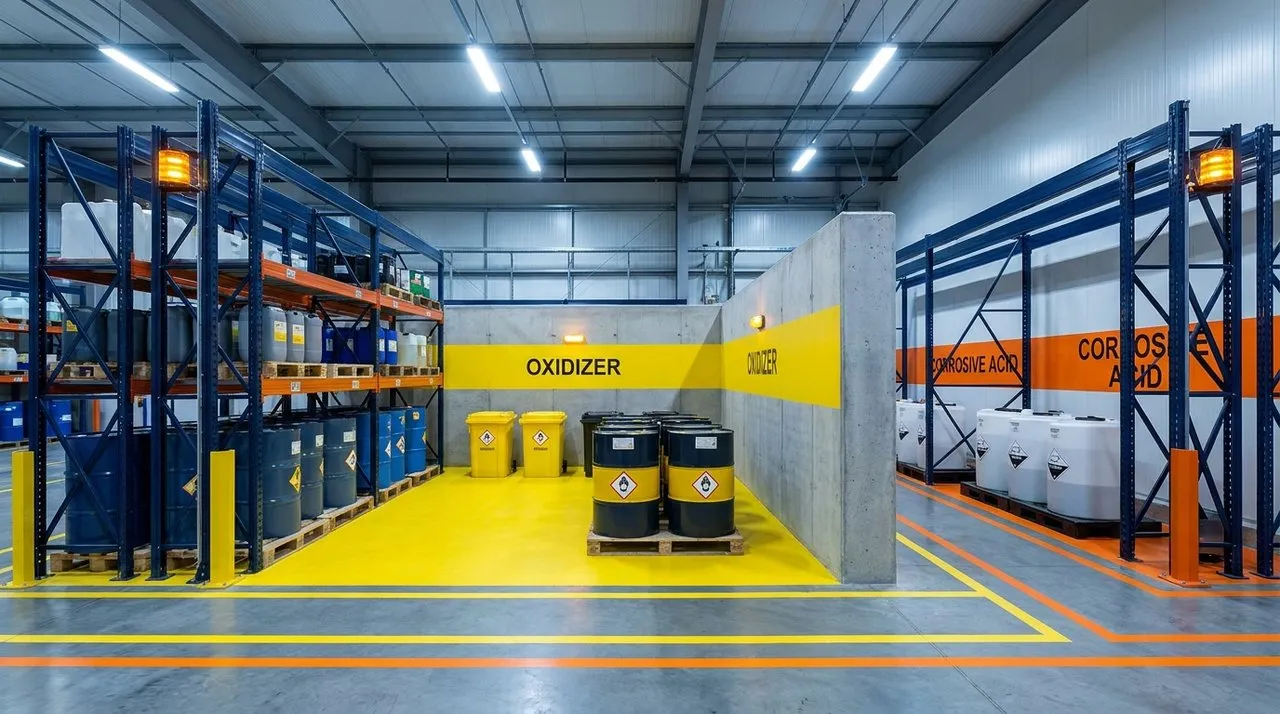
Segregation is organized by hazard class. The table below pairs chemicals RawSource commonly supplies with the catalog and PubChem hazard data, and the single most important material to keep them away from. Physical constants are drawn from PubChem and EPA records.
| Chemical (CAS) | UN no. | GHS class / signal | Key incompatibility |
|---|---|---|---|
| Sodium hypochlorite (7681-52-9) | UN 1791 | Corrosive oxidizer, Danger (H314) | Acids: releases chlorine gas |
| Hydrochloric acid (7647-01-0) | UN 1789 | Corrosive / Acute Tox, Danger | Hypochlorite, bases, active metals |
| Sulfuric acid 93% (7664-93-9) | UN 1830 | Corrosive / Acute Tox, Danger (H314/H330) | Water (violent), bases, organics |
| Hydrogen peroxide (7722-84-1) | UN 2015 | Oxidizer, Danger (H351/H314) | Flammables, organics, reducers |
| D-limonene (5989-27-5) | UN 2319 | Flammable liquid, Danger (H226) | Oxidizers, ignition sources |
| Ammonium bifluoride (1341-49-7) | UN 1727 | Corrosive / Acute Tox, Danger (H314) | Acids and glass: liberates HF |
Three rules cover most of the table. Keep acids and bases apart from each other and from hypochlorite. Keep oxidizers away from anything that burns. Keep fluoride salts away from acids and glass.
Sulfuric acid adds its own caution. At 93% and a density of 1.841 g/cm3 it is heavier than water and reacts violently when water is added to acid, so dilution always means acid into water, never the reverse. The full reactivity profile for sodium hypochlorite and for hydrochloric acid sits in Section 10 of each SDS, and the chlorine-gas pairing is why those two never share a bund.
The hidden case: when concentration is the hazard
A chemical name is not a hazard class. Sulfuric acid shows this plainly: the 93% grade carries H314 (severe burns) and H330 (fatal if inhaled) per its PubChem record, while a dilute battery-acid solution is far less aggressive. Same molecule, different label, different PPE. If your CoA says only “sulfuric acid” without the assay, you cannot complete the safety review.
Fluoride chemistry is the sharper example. Ammonium bifluoride looks like a mild solid, with a pH near 3.5 in a 5% solution, yet it decomposes near 230 C (446 F) and generates hydrofluoric acid on contact with acids, moisture, or heat. HF (CAS 7664-39-3) is a weak acid by titration but a systemic poison by exposure. It penetrates skin and binds calcium, so the SDS for any bifluoride salt specifies calcium gluconate as the standard first-aid measure and bans glass containers.
A buyer who files ammonium bifluoride next to the shop acids has built the exact condition that releases HF. The deeper handling profile is covered in the companion guides on ammonium bifluoride properties and safety and on d-limonene safety and handling.
What to demand from a supplier, with deadlines
Documentation gaps are cheap to close at the quote stage and expensive at the dock. Build these into the RFQ.
Current SDS, before you commit. Require the 16-section GHS SDS for the exact grade quoted, with a revision date inside the last three years. No SDS, no order.
Label proof and UN number, before the lot ships. Confirm the GHS label artwork and the UN number plus packing group, so the placard the carrier applies matches your dock paperwork.
CoA with assay, with each lot. The certificate must state the tested concentration, not only the chemical name, because the assay drives the hazard class.
H-code reconciliation, at receiving. Match Section 2 of the SDS to the drum label before signing. A mismatch is a hold condition.
Segregation plan, before first receipt. Map the chemical to a hazard-class zone in your store, away from its named incompatibilities, before the first delivery arrives.
Typical documentation gaps buyers miss
The recurring gaps are predictable. An SDS supplied for a different concentration than the one ordered, so Section 2 understates the hazard. A missing or stale revision date that predates a GHS reclassification. A UN number on the SDS that does not match the carrier’s placard, which can hold a shipment at a terminal.
Two more show up often. A CoA that reports purity for a quality review but omits the data point a safety review needs. And the quiet one: a chemical received and stored without anyone checking Section 10, so an incompatibility surfaces only when two materials meet.
A concrete example shows how small the gap can be. A buyer orders 35% hydrochloric acid but receives an SDS written for the 10% grade. Both documents say “hydrochloric acid,” both look complete, and the receiving clerk files it.
The Section 2 hazard codes, the PPE in Section 8, and the exposure controls all reflect the weaker solution, so the handling plan is built one tier too low for the lot that arrived. The defect stays invisible until a spill or an exposure forces someone to reread the sheet. Catching it requires one habit: comparing the assay on the CoA against the concentration the SDS was written for, every time.
Cost and timeline of getting this wrong
The economics favor verification. Closing a documentation gap at the quote stage costs an email and a day. Discovering it at the dock can hold a container, trigger a demurrage charge, and idle a line. An incident, a chlorine release or an HF exposure, escalates to evacuation, medical response, and a regulatory investigation.
OSHA’s penalty schedule for Hazard Communication violations runs into five figures per serious violation and six figures for willful or repeat violations, adjusted annually for inflation. Those figures sit on top of the production loss, which is usually the larger number.
The methodology here is simple and auditable: every CAS, UN number, and hazard statement in this guide is drawn from the RawSource catalog and cross-checked against PubChem and EPA records, including sodium hypochlorite and sulfuric acid.
How RawSource helps
That is the specific answer to the question this guide raises: how to verify a chemical’s hazard before a container ever moves.
Frequently asked questions
What does a GHS classification tell a chemical buyer?
Which industrial chemicals must never be stored together?
What is the difference between a CoA and an SDS, and why do you need both?
How do you verify a supplier’s safety documentation before a shipment ships?
Why does dilution or concentration change a chemical’s hazard label?
Sources & methodology
Regulatory citations are current as of publication. Chemical identities verified by CAS number against the RawSource catalog.
Search 1,300+ industrial chemicals by name or CAS, or send us your spec — we quote by the drum, tote, or container.
Browse the Chemical Index → Request a Quote