
Your food safety auditor stops at the tote feeding the evaporator and asks two questions: which regulation lets that defoamer into the food, and what paper shows that this lot meets it? If your purchase order reads “silicone antifoam, 20% active” and the supplier’s listing says Technical Grade, you can answer neither. Foam control is bought on knockdown and price, then audited on documents, and a price-led order is where the documents get left out.
Plants say antifoam or defoamer for the same drum; the difference between antifoam and defoamer lies in when you dose. The heading a buyer needs is “Defoaming agents,” quoted below from the eCFR text of 21 CFR 173.340, up to date as of September 30, 2026. Other listings and other markets’ rules sit outside that section; if a supplier relies on one of them, ask for that citation and its date in writing.
What does the FDA allow for foam control in food processing?
Under 21 CFR 173.340 (Defoaming agents), the dimethylpolysiloxane in a defoamer is limited to 10 parts per million in food (in a concentrated food, 10 parts per million once prepared as directed on the label) and to zero in milk.
The section opens by saying defoaming agents “may be safely used in processing foods, in accordance with the following conditions” (21 CFR 173.340). Read plainly, the conditions are the permission: a use outside them gets nothing from this section. The table below quotes only the entries a silicone defoamer buyer meets, and those entries are not the whole of the conditions. Paragraph (a)(1) also admits “Substances generally recognized by qualified experts as safe in food or covered by prior sanctions for the use prescribed by this section.”
Paragraph (b) sets a condition on the amount added: “They are added in an amount not in excess of that reasonably required to inhibit foaming” (21 CFR 173.340(b)).
The numeric limit, by contrast, is written on the food, not on the dose rate, and the exceptions keep that logic. Each higher figure comes with a lower one for the food as eaten, and both exceptions hang on labeling: the dry gelatin dessert mix is labeled for use so that the ready-to-serve dessert meets the lower figure, and the salt is labeled for cooking purposes.
A reading, not a ruling: the dimethylpolysiloxane entry states its limits in the food and sets no figure for the process stream, and paragraph (b) states its condition as an amount “reasonably required to inhibit foaming,” not as a number. The text does not say how much of a given dose stays in the product.
What the section says, entry by entry
The table quotes the entries of 21 CFR 173.340 that a buyer of a silicone defoamer meets, as the eCFR showed them up to date as of September 30, 2026. Wording in quotation marks is the regulation’s own.
| Substance | Limit or specification | Condition |
|---|---|---|
| Dimethylpolysiloxane | “substantially free from hydrolyzable chloride and alkoxy groups” | Specification of the silicone |
| Dimethylpolysiloxane | “no more than 18 percent loss in weight after heating 4 hours at 200 °C” | Specification of the silicone |
| Dimethylpolysiloxane | “viscosity 300 to 1,050 centistokes at 25 °C” | Specification of the silicone |
| Dimethylpolysiloxane | “refractive index 1.400-1.404 at 25 °C” | Specification of the silicone |
| Dimethylpolysiloxane | 10 parts per million | In food, or in a concentrated food prepared as directed on the label |
| Dimethylpolysiloxane | Zero | In milk |
| Dimethylpolysiloxane | 110 parts per million | In dry gelatin dessert mixes labeled for use so that no more than 16 parts per million is present in the ready-to-serve dessert |
| Dimethylpolysiloxane | 250 parts per million | In salt labeled for cooking purposes, with no more than 10 parts per million in the cooked food |
| Formaldehyde | “not exceeding 1.0 percent of the dimethylpolysiloxane content” | As a preservative in defoaming agents containing dimethylpolysiloxane |
| Polyacrylic acid, sodium salt | “in an amount reasonably required” | As a stabilizer and thickener in defoaming agents containing dimethylpolysiloxane |
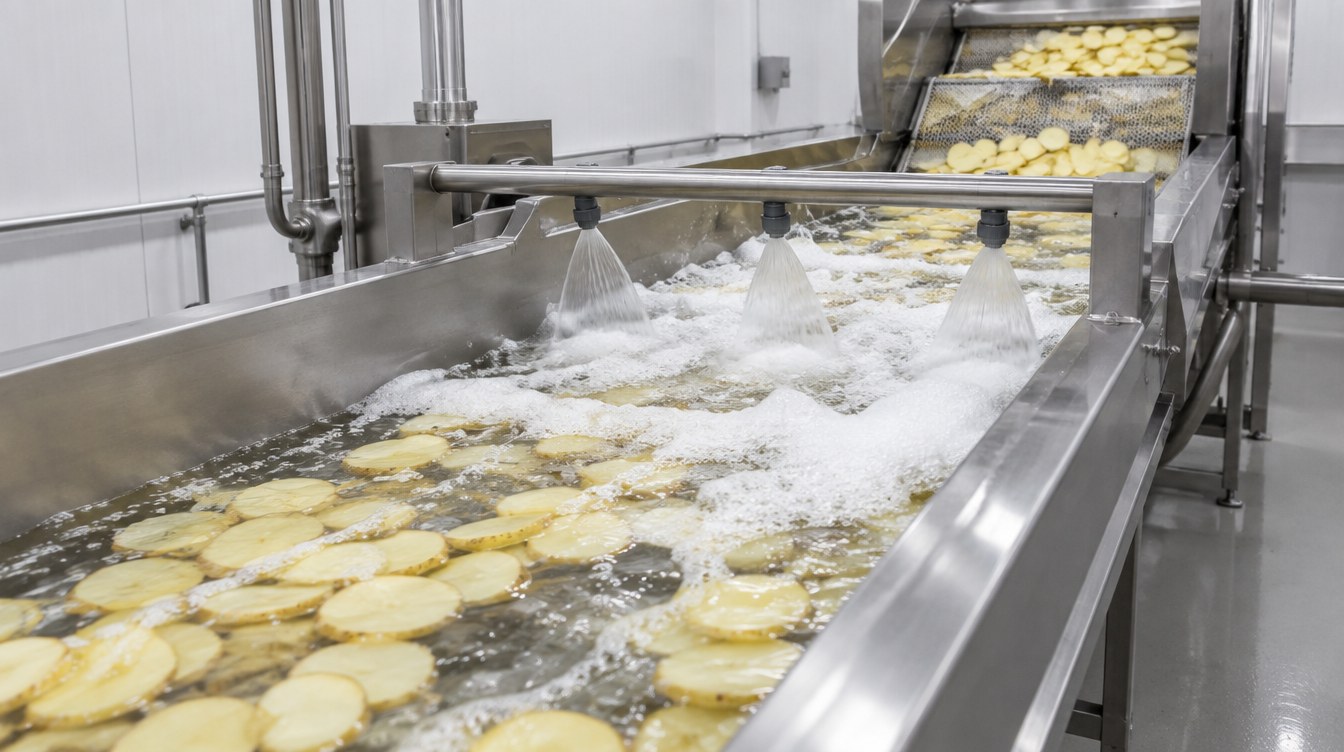
| White mineral oil, conforming with § 172.878 | “not to exceed 0.008 percent of the wash water” | As a component of defoaming agents for use in wash water for sliced potatoes |
The same section, at 21 CFR 173.340(a)(2), lists further components of defoaming agents, each with its own stated limitation. They include polyethylene glycol (§ 172.820), polyoxyethylene 40 monostearate (U.S.P. XVI), polysorbate 60 (§ 172.836), polysorbate 65 (§ 172.838), propylene glycol alginate (§ 172.858), silicon dioxide (§ 172.480) and sorbitan monostearate (§ 172.842).
In formulation terms the polysorbates and sorbitan monostearate are emulsifiers, and silicon dioxide is the silica that makes a silicone compound break foam fast. Check each limitation against the supplier’s full formula.
Does the 200 °C test mean the defoamer survives a high-temperature process?
No. The heat-loss line is a property of the silicone itself: after 4 hours at 200 °C, it may lose no more than 18 percent of its weight (21 CFR 173.340). Read as chemistry, that caps the volatile fraction, the short chains and small rings that evaporate on heating. With the viscosity window, it describes a fluid of moderate chain length and limited volatile content.
The test does not describe the emulsion in your drum. The silicon-oxygen backbone tolerates heat better than the fatty and vegetable-oil actives of organic defoamers, so heat is a reason to choose dimethylpolysiloxane for evaporators, blanchers and cook kettles. On those lines the weak point is the emulsifier package that holds the silicone droplets in water.
Ethoxylated emulsifiers, the polysorbates among them, become less water-soluble as temperature rises. An emulsion that disperses well at room temperature can split in a hot stream into silicone drops that coat steel and float as a skin, and the dose climbs while knockdown falls.
Ask the supplier for the temperature range the emulsion is formulated for, then trial it at the line’s own temperature and dose point, not on the bench. Foam in hot frying oil is a separate problem: silicone antifoam emulsion (10-50% active), listed in the catalog as Technical Grade, is described there for aqueous foam control, and oil-phase foam calls for a different product form with its own documentation. How a defoamer family is matched to a process in the first place is covered in the guide to defoamers.
What must the purchase order say for a food-processing silicone defoamer?
Write the order so that each line has to be answered by a document. A drum that knocks foam down in a jar test answers none of them.
-
The grade and its basis. Specify a grade documented for food use against 21 CFR 173.340, named exactly as it appears on the supplier’s written statement, with the date of the regulatory text that statement relies on. The catalog lists silicone antifoam emulsion (10-50% active) as Technical Grade, and a Technical Grade listing is not food documentation, whatever industries a product description names.
-
The silicone specification. Ask for the four specification points in the table, reported for the silicone used in your lot. Viscosity and refractive index are both results on the silicone: in a water-based emulsion, a viscosity or a refractive index taken on the finished product describes the emulsion, not the silicone, so ask which material each result comes from.
-
The active content and its basis. State percent active silicone with its basis and test method. The active content is what turns a silicone limit in the food into a product dose, and two suppliers can state it on different bases.
-
The emulsifier, carrier and preservative system. Have every component named, so your quality team can check each one against the components the section lists and the limitation stated for each. If the preservative is formaldehyde, ask for its level as a percent of the dimethylpolysiloxane content, the basis 21 CFR 173.340 uses for its 1.0 percent cap.
-
The documents for every lot. Require the written statement for the grade, a certificate of analysis (CoA) for each lot that reports the agreed specification points, and written notice before any change to the formula. The statement and the CoA document what you bought; the drum label does not.
The CAS number belongs on the order too, but only as identity. CAS 63148-62-9, the catalog’s CAS number for this silicone, covers dimethyl silicone polymers across a wide spread of chain lengths, so the specification points, not the number, tie a lot to the regulation.
Is a defoamer in vegetable wash water held to the same limit?
One entry puts the limit on the water: under 21 CFR 173.340, white mineral oil in defoaming agents for wash water for sliced potatoes may be used “at a level not to exceed 0.008 percent of the wash water.”
That entry names sliced potatoes and white mineral oil. For other produce, or a silicone defoamer in a flume, ask the supplier which entry their written statement relies on. Wash water touches the food, so document its defoamer the way you document one dosed into the product.
Methodology: regulatory text is quoted from 21 CFR 173.340 (Defoaming agents) in the eCFR, up to date as of September 30, 2026. Identity and grade come from the catalog record for CAS 63148-62-9; the heat and emulsion statements are general chemistry, given without figures. This is general information about the text of the regulation, not regulatory advice.
Frequently asked questions
Do food grade defoamers need more than the words “food grade” on a data sheet?
Can a silicone defoamer be used in milk?
Why does a defoamer specification include a refractive index?
How do I turn a silicone limit in the food into a dose of emulsion?
Sources & methodology
Figures are RawSource sourcing data unless attributed to a named source. Regulatory citations are current as of publication. Chemical identities verified by CAS number against the RawSource catalog.
Search 1,300+ industrial chemicals by name or CAS, or send us your spec — we quote by the drum, tote, or container.
Browse the Chemical Index → Request a Quote