
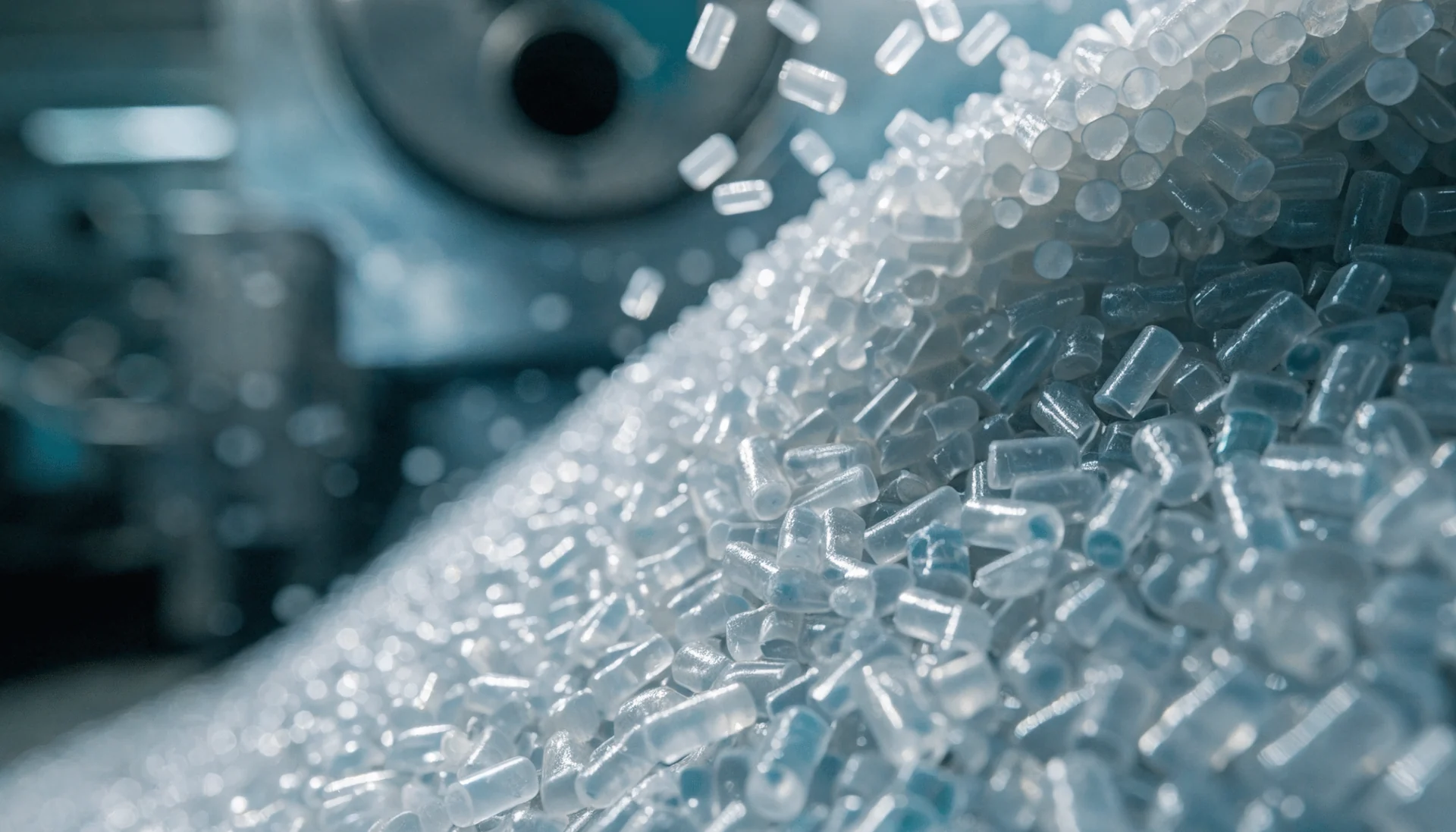
Solution Approach
RawSource supplies the base chemicals that go into these programs. We can help with product selection, grade matching, and sourcing from multiple origins for supply security.
Typical Formulation Workflow
1
Polymer & Process Definition
Identify the resin and process (extrusion, molding, film) and the targets — thermal stability, clarity, flame retardance, slip, or color.
2
Additive Selection
Match stabilizers, antioxidants, plasticizers, lubricants, flame retardants, or masterbatch carriers to the polymer and processing temperatures.
3
Compounding Trial
Confirm loading and dispersion on a compounding or molding trial, checking processability, mechanicals, and aesthetics against the control.
4
Validation & Scale-Up
Verify long-term performance (heat aging, migration, weathering) and lock the formulation, packaging, and lot specs for production.
Recommended Chemistries (6)
Titanium Dioxide
CAS 13463-67-7
Mineral Fillers & Pigments
UV blocker and white pigment
Primary white pigment/opacifier; high refractive index scatters light for hiding power and tint base
Melting Point: 1860 °C (decomposes) Boiling Point: 2500–3000 °C at 760 mmHg Density: 3.9 to 4.2
Quick view
Full Details
Calcium Stearate
CAS 1592-23-0
Esters
Surfactancy
Metal-soap dispersion/processing aid: coats pigment and filler particles to reduce agglomeration and lubricate flow during compounding
Physical Description: Pellets or crystals, liquid, solid, dry powder,… Appearance: FINE, WHITE TO YELLOWISH WHITE, BULKY POWDER Melting Point: Melting point equals 217 ° F
Quick view
Full Details
Zinc Stearate
CAS 557-05-1
Acids & Salts
Lubrication
Lubricant/dispersant metal soap that wets pigment surfaces and improves release, aiding even color development
Physical Description: Zinc stearate is a white, hydrophobic powder wi… Appearance: White powder free from gritiness Odor: Slight, characteristic odor
Quick view
Full Details
Polyether-Modified Trisiloxane (Silicone Surfactant)
CAS 27306-78-1
Silicone Fluids & Oils
Conditioning
Lowers surface tension to wet pigment surfaces, helping break agglomerates in liquid/aqueous color systems
Quick view
Full Details
Carbon black
CAS 1333-86-4
Mineral Fillers & Pigments
Color / Pigmentation
1362 (CARBON, ACTIVATED) · Class Primary black pigment and UV/conductive additive for masterbatch tinting
Physical Description: Pellets or crystals, solid, dry powder, liquid,… Appearance: Steel gray to black greasy feeling solid Odor: Odorless
Quick view
Full Details
Iron Oxide Synthetic Black
CAS 12227-89-3
Mineral Fillers & Pigments
Color / Pigmentation
Inorganic colorant for masterbatch/compound; heat- and light-stable pigment that disperses cleanly for consistent tone (Synthetic Yellow 51274-00-1 and Red 1309-37-1 also stocked for the colorant range)
Quick view
Full Details
Related Product Families
● Sourcing-only
UV Stabilizers & HALS
UV absorbers and hindered amine light stabilizers for outdoor weathering resistance
UV ProtectionStabilization
2 chemistries
View family
● Available
Mineral Fillers & Extenders
Calcium carbonate, fumed silica, TiO2, and specialty minerals for reinforcement, cost reduction, and property modification
FillingReinforcementOpacity
10 chemistries
View family