
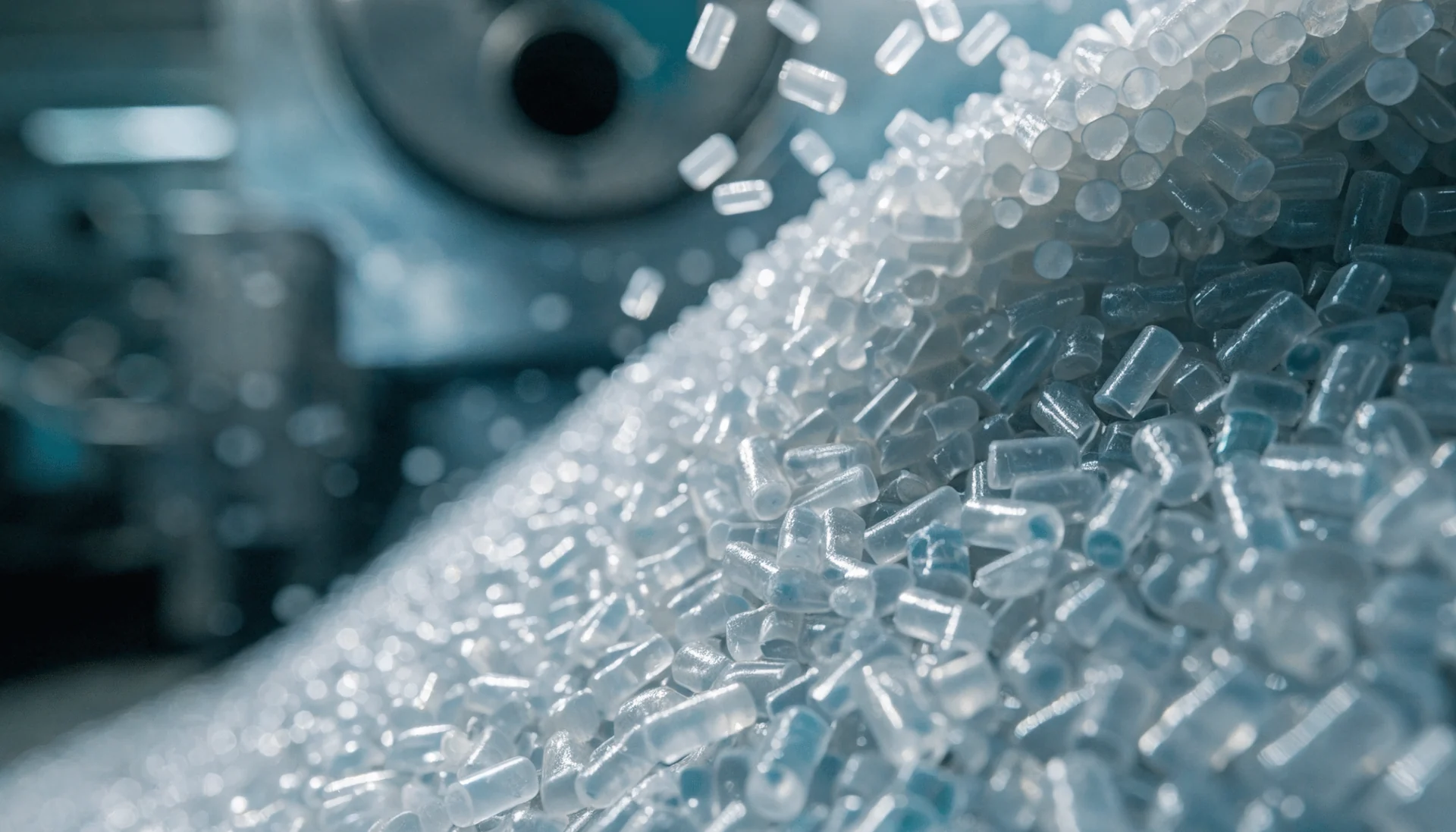
Solution Approach
RawSource supplies the base chemicals that go into these programs. We can help with product selection, grade matching, and sourcing from multiple origins for supply security.
Typical Formulation Workflow
1
Polymer & Process Definition
Identify the resin and process (extrusion, molding, film) and the targets — thermal stability, clarity, flame retardance, slip, or color.
2
Additive Selection
Match stabilizers, antioxidants, plasticizers, lubricants, flame retardants, or masterbatch carriers to the polymer and processing temperatures.
3
Compounding Trial
Confirm loading and dispersion on a compounding or molding trial, checking processability, mechanicals, and aesthetics against the control.
4
Validation & Scale-Up
Verify long-term performance (heat aging, migration, weathering) and lock the formulation, packaging, and lot specs for production.
Recommended Chemistries (4)
Aluminum Hydroxide (ATH)
CAS 21645-51-2
Specialty Additives
Mineral FR filler
Decomposes endothermically near 200C, releasing water vapor that cools the substrate and dilutes combustible gases; the residual alumina forms a protective char layer
Physical Description: White solid in various forms; White odorless gr… Appearance: Usually obtained in white, bulky, amorphous powder Melting Point: 300 °C
Quick view
Full Details
Antimony Trioxide
CAS 1309-64-4
Specialty Additives
Halogen FR synergist
1549 (ANTIMONY TRIOXIDE) · Class Halogen synergist: forms volatile antimony halides in the flame that scavenge H- and OH- radicals, multiplying the effectiveness of halogenated FRs
Melting Point: 655 °C Boiling Point: 1550 °C at 760 mmHg (sublimes); 870 °C at 210 mmHg Density: 5.2 at 25 °C
Quick view
Full Details
Ammonium Polyphosphate (APP)
CAS 68333-79-9
Acids & Salts
Intumescent FR
Intumescent acid source: releases polyphosphoric acid on heating that dehydrates the polymer to a swelling carbon char, insulating the underlying material
Quick view
Full Details
Magnesium Hydroxide
CAS 1309-42-8
Specialty Additives
pH Adjustment
Higher-temperature endothermic water-releasing mineral hydroxide (decomposes ~330C), suited to engineering polymers processed above ATH's onset
Physical Description: White odorless solid; Colorless or white solid;… Appearance: White, hexagonal crystals Odor: Odorless
Quick view
Full Details