
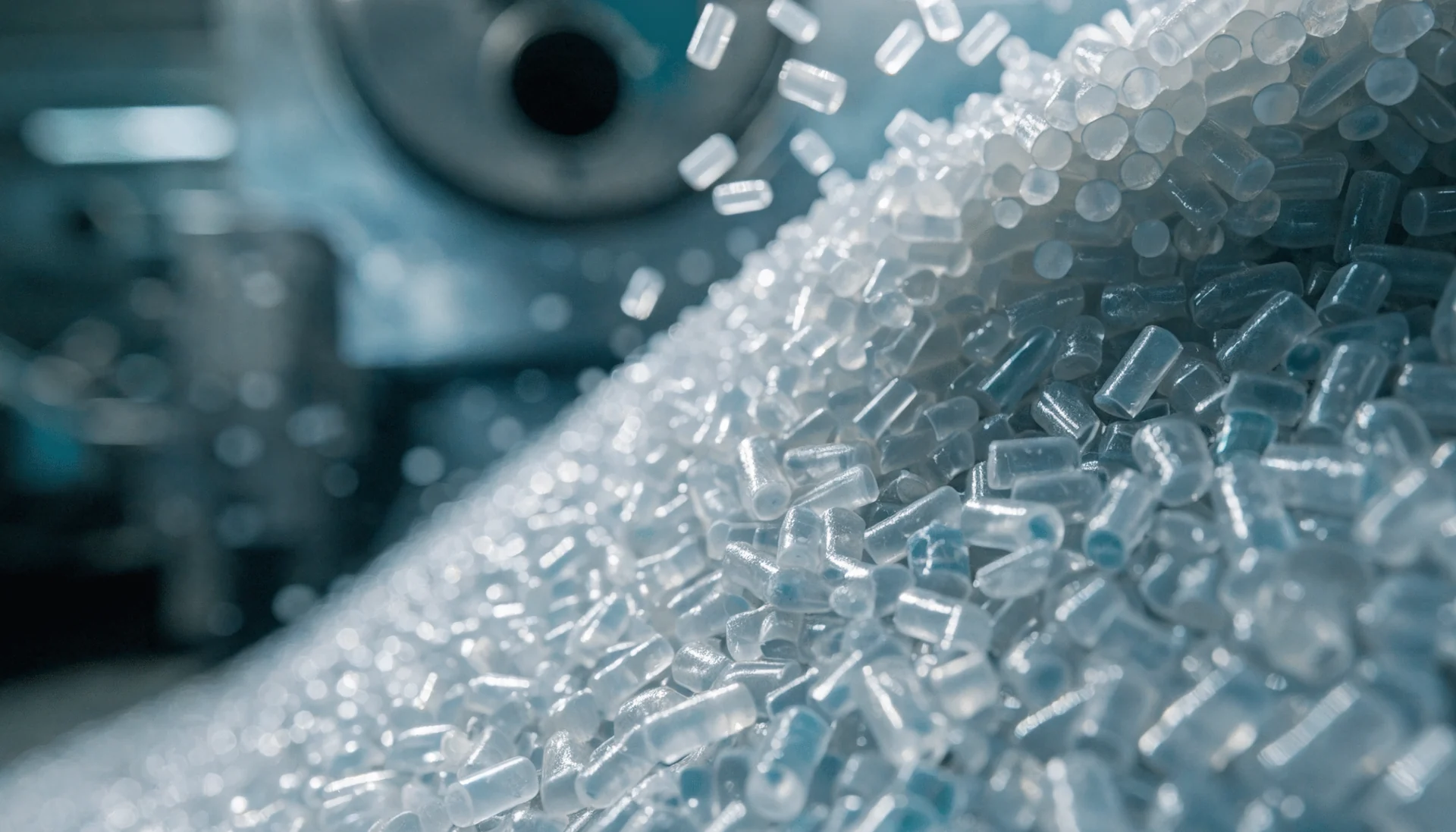
Solution Approach
RawSource supplies the base chemicals that go into these programs. We can help with product selection, grade matching, and sourcing from multiple origins for supply security.
Typical Formulation Workflow
1
Polymer & Process Definition
Identify the resin and process (extrusion, molding, film) and the targets — thermal stability, clarity, flame retardance, slip, or color.
2
Additive Selection
Match stabilizers, antioxidants, plasticizers, lubricants, flame retardants, or masterbatch carriers to the polymer and processing temperatures.
3
Compounding Trial
Confirm loading and dispersion on a compounding or molding trial, checking processability, mechanicals, and aesthetics against the control.
4
Validation & Scale-Up
Verify long-term performance (heat aging, migration, weathering) and lock the formulation, packaging, and lot specs for production.
Recommended Chemistries (4)
Decamethyltetrasiloxane (MD2M)
CAS 141-62-8
Silicone Fluids & Oils
Conditioning
Low-surface-energy linear siloxane migrates to the tool interface to form a non-stick, low-friction film for clean part release (a low-MW volatile siloxane, not a high-MW PDMS)
Vapor Pressure: 0.37
Quick view
Full Details
Carnauba Wax
CAS 8015-86-9
Specialty Additives
Film Formation
Non-silicone hard wax that blooms to the surface, providing slip and an anti-stick barrier without silicone transfer (paintable parts)
Quick view
Full Details
Zinc Stearate
CAS 557-05-1
Acids & Salts
Lubrication
Internal/external metal-soap lubricant that reduces friction at the polymer-mold interface and aids ejection
Physical Description: Zinc stearate is a white, hydrophobic powder wi… Appearance: White powder free from gritiness Odor: Slight, characteristic odor
Quick view
Full Details
Octyltriethoxysilane
CAS 2943-75-1
Silanes & Organosilanes
Film Formation
Ester lubricant providing slip/release as a non-silicone alternative
Quick view
Full Details
Related Product Families
● Available
Amino Silane Coupling Agents
Aminopropyl silanes for adhesion promotion between polymers and mineral fillers, glass fiber, and metal surfaces
Adhesion PromotionCoupling
5 chemistries
View family
● Available
Vinyl & Methacrylate Silanes
Reactive silanes for PE crosslinking, polyester composites, and acrylic systems
CrosslinkingCoupling
5 chemistries
View family
● Available
Sulfide & Mercapto Silanes
Sulfur-functional silanes for silica-rubber coupling in tire and rubber compounds
CouplingVulcanization
3 chemistries
View family
● Available
Epoxy Silane Coupling Agents
Glycidoxypropyl silanes for epoxy composites and filled thermoset systems
Adhesion PromotionCrosslinking
3 chemistries
View family
● Available
Silicone Processing Aids
PDMS fluids, silicone rubber, and specialty silicones for mold release, defoaming, and lubrication in polymer processing
ReleaseDefoamingLubrication
4 chemistries
View family
● Available
Antioxidants
BHT, phenolic antioxidants, and phosphite stabilizers for thermal and oxidative stability during processing and service life
PreservationStabilization
3 chemistries
View family
● Sourcing-only
UV Stabilizers & HALS
UV absorbers and hindered amine light stabilizers for outdoor weathering resistance
UV ProtectionStabilization
2 chemistries
View family
● Available
Flame Retardant Systems
ATH, antimony trioxide, ammonium polyphosphate, and borate FR raw materials for polymer flame retardancy
Flame Retardancy
8 chemistries
View family