
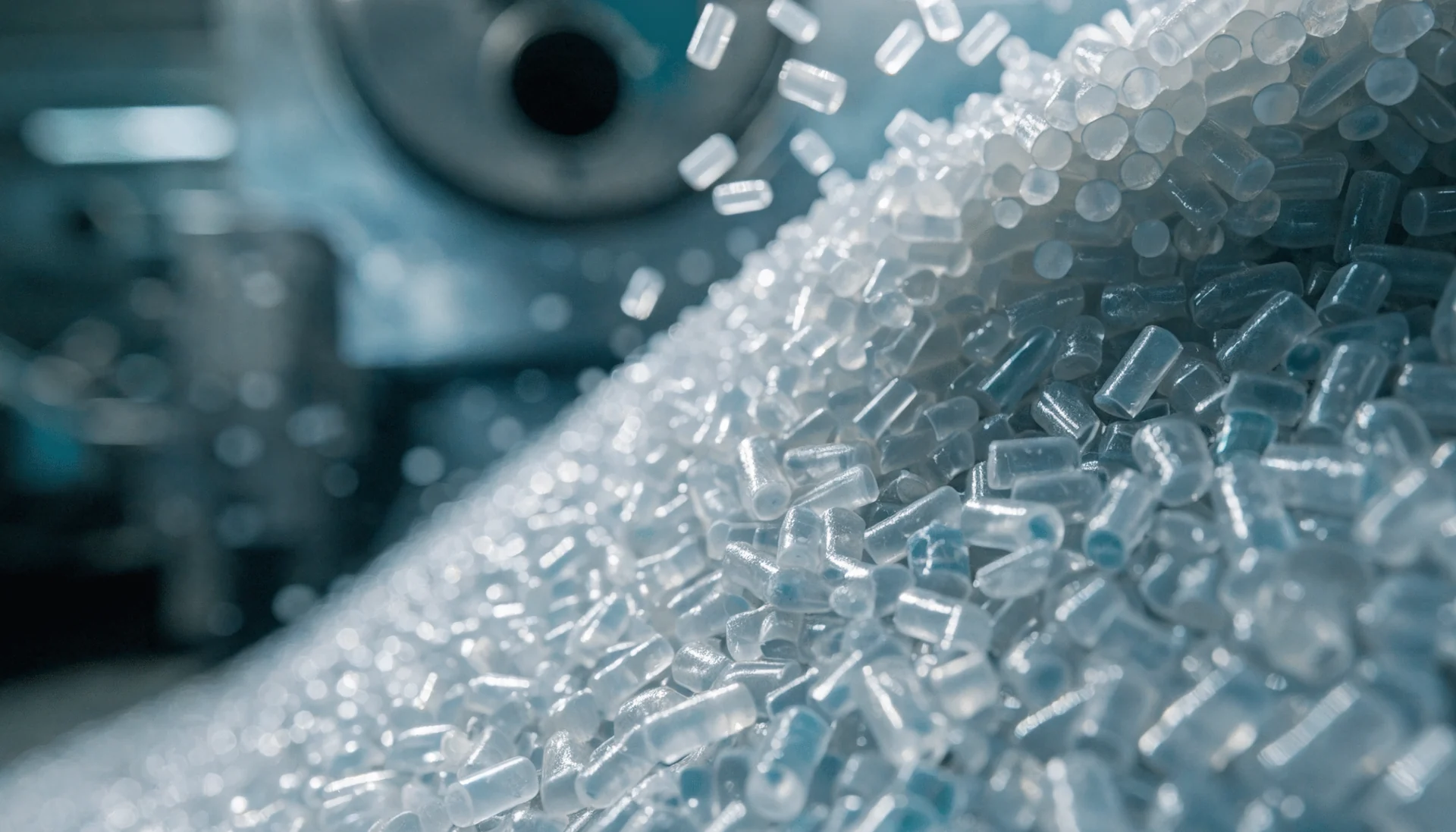
Solution Approach
RawSource supplies the base chemicals that go into these programs. We can help with product selection, grade matching, and sourcing from multiple origins for supply security.
Typical Formulation Workflow
1
Polymer & Process Definition
Identify the resin and process (extrusion, molding, film) and the targets — thermal stability, clarity, flame retardance, slip, or color.
2
Additive Selection
Match stabilizers, antioxidants, plasticizers, lubricants, flame retardants, or masterbatch carriers to the polymer and processing temperatures.
3
Compounding Trial
Confirm loading and dispersion on a compounding or molding trial, checking processability, mechanicals, and aesthetics against the control.
4
Validation & Scale-Up
Verify long-term performance (heat aging, migration, weathering) and lock the formulation, packaging, and lot specs for production.
Recommended Chemistries (6)
Dioctyl Terephthalate (DOTP)
CAS 6422-86-2
Specialty Additives
Plasticizing
Non-ortho-phthalate terephthalate diester; solvates PVC chains to lower Tg and durometer and serves as the leading regulatory-safe drop-in replacement for DEHP
Physical Description: Pellets or crystals or liquid Boiling Point: 383 °C Melting Point: -48 °C
Quick view
Full Details
Diisononyl Phthalate (DINP)
CAS 28553-12-0
Specialty Additives
Lubrication
High-molecular-weight branched-C9 ortho-phthalate; low volatility gives good permanence at the high loadings used for soft flexible PVC
Physical Description: Di-isononyl phthalate is an oily colorless liqu… Appearance: Colorless liquid Boiling Point: 78 °C at 760 mmHg
Quick view
Full Details
Epoxidized Soybean (ESBO)
CAS 8013-07-8
Specialty Additives
Emolliency
Bio-based secondary plasticizer and co-stabilizer; the epoxide rings scavenge HCl liberated during PVC processing while adding flexibility
Quick view
Full Details
Triethyl Citrate
CAS 77-93-0
Specialty Additives
Plasticizing
Citrate-ester non-phthalate plasticizer used where regulatory-sensitive, food-contact-grade flexibility is required
Physical Description: practically colourless, oily liquid; bitter tas… Appearance: Colorless, mobile liquid Odor: Fruity odor
Quick view
Full Details
Acetyl Tributyl Citrate (ATBC)
CAS 77-90-7
Non-phthalate citrate ester with higher permanence than triethyl citrate; the standard choice for toy and food-contact flexible PVC (source on demand)
Quick view
Full Details
Dioctyl Adipate (DOA)
CAS 103-23-1
Adipate ester with a low glass-transition contribution, delivering cold-flex low-temperature flexibility for films and tubing (source on demand)
Quick view
Full Details
Related Product Families
● Available
Amino Silane Coupling Agents
Aminopropyl silanes for adhesion promotion between polymers and mineral fillers, glass fiber, and metal surfaces
Adhesion PromotionCoupling
5 chemistries
View family
● Available
Vinyl & Methacrylate Silanes
Reactive silanes for PE crosslinking, polyester composites, and acrylic systems
CrosslinkingCoupling
5 chemistries
View family
● Available
Sulfide & Mercapto Silanes
Sulfur-functional silanes for silica-rubber coupling in tire and rubber compounds
CouplingVulcanization
3 chemistries
View family
● Available
Epoxy Silane Coupling Agents
Glycidoxypropyl silanes for epoxy composites and filled thermoset systems
Adhesion PromotionCrosslinking
3 chemistries
View family
● Available
Silicone Processing Aids
PDMS fluids, silicone rubber, and specialty silicones for mold release, defoaming, and lubrication in polymer processing
ReleaseDefoamingLubrication
4 chemistries
View family
● Available
Antioxidants
BHT, phenolic antioxidants, and phosphite stabilizers for thermal and oxidative stability during processing and service life
PreservationStabilization
3 chemistries
View family
● Sourcing-only
UV Stabilizers & HALS
UV absorbers and hindered amine light stabilizers for outdoor weathering resistance
UV ProtectionStabilization
2 chemistries
View family
● Available
Flame Retardant Systems
ATH, antimony trioxide, ammonium polyphosphate, and borate FR raw materials for polymer flame retardancy
Flame Retardancy
8 chemistries
View family