
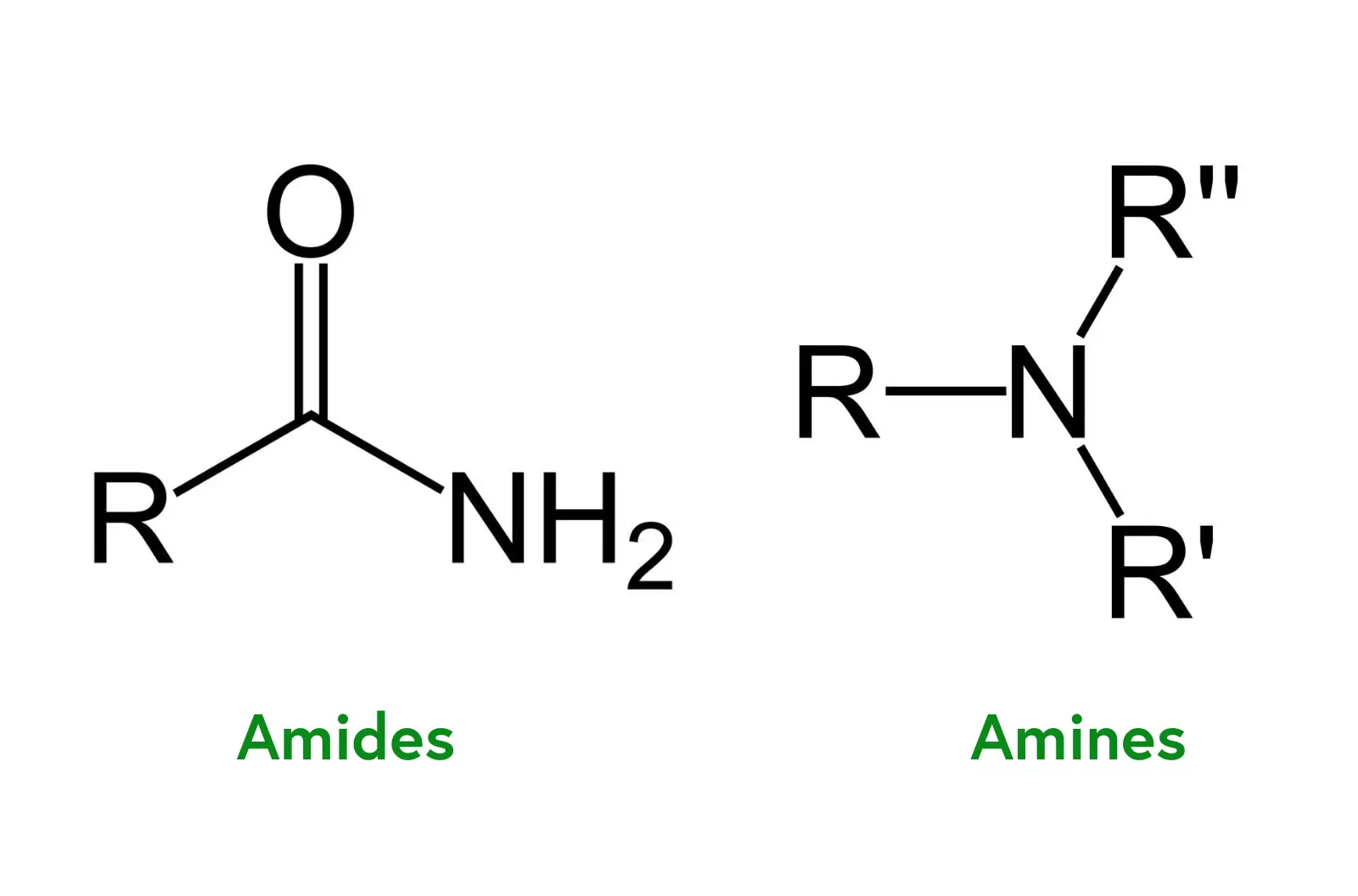
The One Structural Difference That Drives Everything
An amine is ammonia (NH₃) with one or more hydrogens swapped for organic groups: primary (R-NH₂), secondary (R₂NH), tertiary (R₃N). The nitrogen keeps a free lone pair, so amines are basic and nucleophilic. An amide places a carbonyl (C=O) directly on that nitrogen (R-CO-NR₂). The lone pair delocalizes into the carbonyl by resonance, which flattens the structure and strips the nitrogen of its basicity. That resonance is the whole story. It makes amides stable and weakly reactive, and amines reactive and basic.Basicity: A Ten-Order-of-Magnitude Gap
Basicity is measured by the pKaH of the conjugate acid. Simple alkylamine conjugate acids sit at pKaH roughly 10 to 11, so they readily grab a proton and form salts. Aromatic amines are far weaker; aniline (CAS 62-53-3) has a pKaH near 4.6 because the lone pair delocalizes into the ring. Amides are effectively non-basic, with a protonated-form pKaH near 0, because protonating the nitrogen destroys the resonance stabilization.| Class | Example | pKaH (conj. acid) | Behavior |
|---|---|---|---|
| Alkyl amine | Monoethanolamine | ~9.5 | Basic, forms salts, scrubs acid gas |
| Alkyl amine (typical) | Triethylamine | ~10.7 | Strong organic base / catalyst |
| Aryl amine | Aniline | ~4.6 | Weakly basic (ring delocalization) |
| Amide | Acetamide | ~0 (protonated) | Non-basic, resonance-stabilized |
Physical Properties and Reactivity
Amides hold the higher melting and boiling points for a given molecular weight because of strong N-H hydrogen bonding plus the polar carbonyl. They resist hydrolysis; cleaving an amide to its acid and amine needs acid or base plus heat and time. Amines boil lower, are stronger hydrogen-bond donors when primary or secondary, and react fast: nucleophilic substitution with alkyl halides, protonation to ammonium salts, and condensation to imines and enamines. The trade-off is reactivity versus durability. Amine reactivity is what makes it useful as a building block, and also what makes it more corrosive and irritating to handle.Industrial Amides You Actually Buy
The amides that move in volume are not lab curiosities. Fatty primary amides are the dominant slip and antiblock additives for polyolefin film: oleamide (CAS 301-02-0) and erucamide (CAS 112-84-5). Dosed at roughly 0.05% to 0.3% in LDPE/LLDPE, they bloom to the surface and cut the coefficient of friction sharply, in some cable compounds from about 0.70 down to near 0.16. The choice between them is a real engineering trade-off. Oleamide migrates fast and acts quickly but has a lower melting point and less thermal stability. Erucamide melts and stays stable to higher temperatures (around 270°C), migrates more slowly, and gives a more durable, consistent slip layer for higher-temperature processing.| Amide slip agent | CAS | Migration | Thermal stability | Best for |
|---|---|---|---|---|
| Oleamide | 301-02-0 | Fast | Lower | Quick slip, lower-temp PE film |
| Erucamide | 112-84-5 | Slower, controlled | Higher (~270°C) | Durable slip, BOPP/higher-temp lines |
Industrial Amines You Actually Buy
The ethanolamines are the volume amines: monoethanolamine (MEA, CAS 141-43-5), diethanolamine (DEA, CAS 111-42-2), and triethanolamine (TEA, CAS 102-71-6), all made by reacting ethylene oxide with ammonia. MEA is the strongest base of the three and the standard for CO₂ and H₂S removal in gas treating, typically run as a 15% to 30% aqueous solution. TEA is widely used as a pH adjuster and corrosion inhibitor. Ethanolamines also build surfactants, while ethylenediamine feeds epoxy and polyurethane chemistry. The handling trade-off is sharp: MEA is corrosive and can cause chemical burns, so concentrated amine streams demand proper PPE, materials of construction, and ventilation.Choosing Between Them: A Buyer’s Checklist
Start from the function. Need to neutralize, scrub acid gas, adjust pH, or build a polymer or surfactant? That is amine territory; spec the specific ethanolamine or alkyl amine and its concentration. Need a stable additive, a slip agent for film, or an aprotic process solvent? That is amide territory; for slip, choose oleamide for speed or erucamide for durability and heat. Do not assume one substitutes for the other. They share a nitrogen and almost nothing else functionally.Sourcing and RFQ Guidance
On an RFQ, name the exact molecule and CAS, never just “an amine” or “an amide.” For ethanolamines, state MEA/DEA/TEA, purity, and whether you need a low-color or low-DEA grade. For slip amides, state oleamide or erucamide, the target dose, your processing temperature, and any food-contact requirement, since migration and FDA food-contact status both matter for packaging film. Request the CoA, SDS, and current regulatory status, and confirm packaging (bags, drums, IBC, or bulk). If you buy bulk ethanolamines, fatty-amide slip agents, or specialty amines and amides and want material matched to your application and volume, send the CAS, grade, and target dose and we will source against your spec.FAQs
What are the main structural differences between amides and amines?
Amides have a carbonyl group (C=O) bonded directly to nitrogen, which delocalizes the nitrogen lone pair by resonance and makes them non-basic and stable. Amines have no carbonyl; the nitrogen keeps a free lone pair, so they are basic and reactive, with conjugate-acid pKaH values around 10 to 11 for simple alkyl amines.
Which amides are used as slip agents in plastic film?
Oleamide (CAS 301-02-0) and erucamide (CAS 112-84-5) are the primary fatty-amide slip agents for polyolefin film. Dosed around 0.05% to 0.3%, they bloom to the surface and lower the coefficient of friction. Oleamide migrates faster; erucamide is more thermally stable (to roughly 270°C) and gives a more durable slip layer.
Which amines are most common in industry?
The ethanolamines lead by volume: monoethanolamine (CAS 141-43-5), diethanolamine (CAS 111-42-2), and triethanolamine (CAS 102-71-6). MEA is the strongest base and is widely used for acid-gas (CO₂/H₂S) scrubbing as a 15% to 30% aqueous solution; TEA is common as a pH adjuster and corrosion inhibitor.
Why are amides used in nylon and para-aramid fibers?
The amide bond is strong and resists hydrolysis, and the N-H to C=O hydrogen bonding between chains adds rigidity and tensile strength. That bonding is what gives polyamides like nylon and para-aramid their durability.
How do I specify amides or amines on an RFQ?
Name the exact compound and CAS. For ethanolamines, state MEA/DEA/TEA, purity, and grade. For slip amides, state oleamide or erucamide, target dose, processing temperature, and any food-contact requirement. Always request the CoA, SDS, current regulatory status, and packaging format.
Search 1,300+ industrial chemicals by name or CAS, or send us your spec — we quote by the drum, tote, or container.
Browse the Chemical Index → Request a Quote