
Two polyoxypropylene diamine sheets sit side by side. One prints the amine value as 454 to 488 mg KOH/g, the other as 4.0 to 4.6 meq/g. A buyer comparing the bare numbers has already gone wrong: the scales differ by a factor of 56.1, the molecular weight of potassium hydroxide. Neither line sets the dose. The amine hydrogen equivalent weight does, and it is the first figure to find on any polyetheramine sheet.
Polyetheramine grades and data sheets
Quote by RS code. Grades share a generic name, and four of the diamines share CAS 9046-10-0, so the RS code and the grade designation (polyetheramine D-230, polyetheramine T-403 and so on) are what identify the material on a purchase order. Every value below stays in its producer’s own unit, unconverted.
| RS code | Chemistry | CAS | Nominal MW | Amine type | Amine value | Form | Packaging |
|---|---|---|---|---|---|---|---|
RS-D400TDS · Request quote |
Polyoxypropylene |
9046-10-0 |
430 | Diamine (primary) | 4.0–4.6 meq/g | Liquid | 200 kg drums |
RS-D2000TDS · Request quote |
Polyoxypropylene |
9046-10-0 |
2000 | Diamine (primary) | 0.98–1.10 meq/g | Liquid | 200 kg drums, 1,000 kg IBC |
RS-D4000TDS · Request quote |
Polyoxypropylene |
9046-10-0 |
4000 | Diamine (primary) | 0.44–0.52 mmol/g | Liquid | 200 kg drums, 1,000 kg IBC, ISO tank |
RS-D230TDS · Request quote |
Polyoxypropylene |
9046-10-0 |
On request | Diamine (primary) | 454–488 mg KOH/g | Liquid | 195 kg drums, 950 kg or 942 kg IBC, ISO tank |
RS-T403TDS · Request quote |
Polyoxypropylene |
39423-51-3 |
440 | Triamine (primary) | 6.1–6.8 meq/g | Liquid | 200 kg drums |
RS-T5000TDS · Request quote |
Polyoxypropylene |
64852-22-8 |
5000 | Triamine (primary) | 0.50–0.57 meq/g | Liquid | 200 kg drums, 1,000 kg IBC |
RS-SD2001†TDS · Request quote |
N,N’-Diisopropyl polyoxypropylene |
81455-53-0 |
2000 | Diamine (secondary) | 0.875–1.03 mmol/g | Liquid | 200 kg net drums |
RS-ED600TDS · Request quote |
Propylene oxide-capped polyethylene glycol diamine, Mn ≈ 600polyetheramine ED-600 | 65605-36-9 |
600 | Diamine (primary) | 3.0–3.43 mmol/g‡ | Liquid | 200 kg drums, 1,000 kg IBC, ISO tank |
RS-ED900TDS · Request quote |
Propylene oxide-capped polyethylene glycol diamine, Mn ≈ 900polyetheramine ED-900 | 65605-36-9 |
900 | Diamine (primary) | 1.8–2.25 mmol/g | Liquid | 200 kg drums, 1,000 kg IBC, ISO tank |
RS-M600TDS · Request quote |
Methoxy PEG/ |
83713-01-3 |
600 | Monoamine (primary) | 1.55–1.75 mmol/g | Liquid | 200 kg drums, 1,000 kg IBC, ISO tank |
RS-M1000TDS · Request quote |
Methoxy PEG/ |
83713-01-3 |
1000 | Monoamine (primary) | On request | Waxy solid | 200 kg drums, 1,000 kg IBC, ISO tank |
RS-M2005TDS · Request quote |
Polypropylene glycol monoamine, PO/ |
83713-01-3 |
2000 | Monoamine (primary) | 0.44–0.52 mmol/g | Liquid | 200 kg drums, 1,000 kg IBC, ISO tank |
RS-M2070TDS · Request quote |
Methoxy PEG/ |
83713-01-3 |
2000 | Monoamine (primary) | 0.45–0.51 mmol/g | Liquid | 200 kg drums, 1,000 kg IBC, ISO tank |
RS-M3085TDS · Request quote |
Methoxy PEG/ |
83713-01-3 |
3000 | Monoamine (primary) | 0.30–0.38 mmol/g | Waxy solid | 200 kg drums, 1,000 kg IBC, ISO tank |
RS-B100TDS · Request quote |
Nonylphenoxy polyoxypropylene monoamine, Mn ≈ 1000polyetheramine B-100 | 144736-30-1 |
1000 | Monoamine (primary) | 0.95–1.08 mmol/g | Liquid | 200 kg drums, 1,000 kg IBC, ISO tank |
RS-B200TDS · Request quote |
Nonylphenoxy polyoxypropylene monoamine, Mn ≈ 2000polyetheramine B-200 | 144736-30-1 |
2000 | Monoamine (primary) | 0.44–0.52 mmol/g | Liquid | 200 kg drums, 1,000 kg IBC, ISO tank |
Which polyoxypropylene diamines and triamines fit an epoxy cure?
Two equivalent weights fix the dose: parts per hundred resin equal AHEW × 100 ÷ the resin’s epoxy equivalent weight. Against the same resin, RS-D4000 (1000 g/eq) goes in at about 16.7 times the weight of RS-D230 (60 g/eq), 1000 ÷ 60. Each amine hydrogen drags far more polyether chain with it.
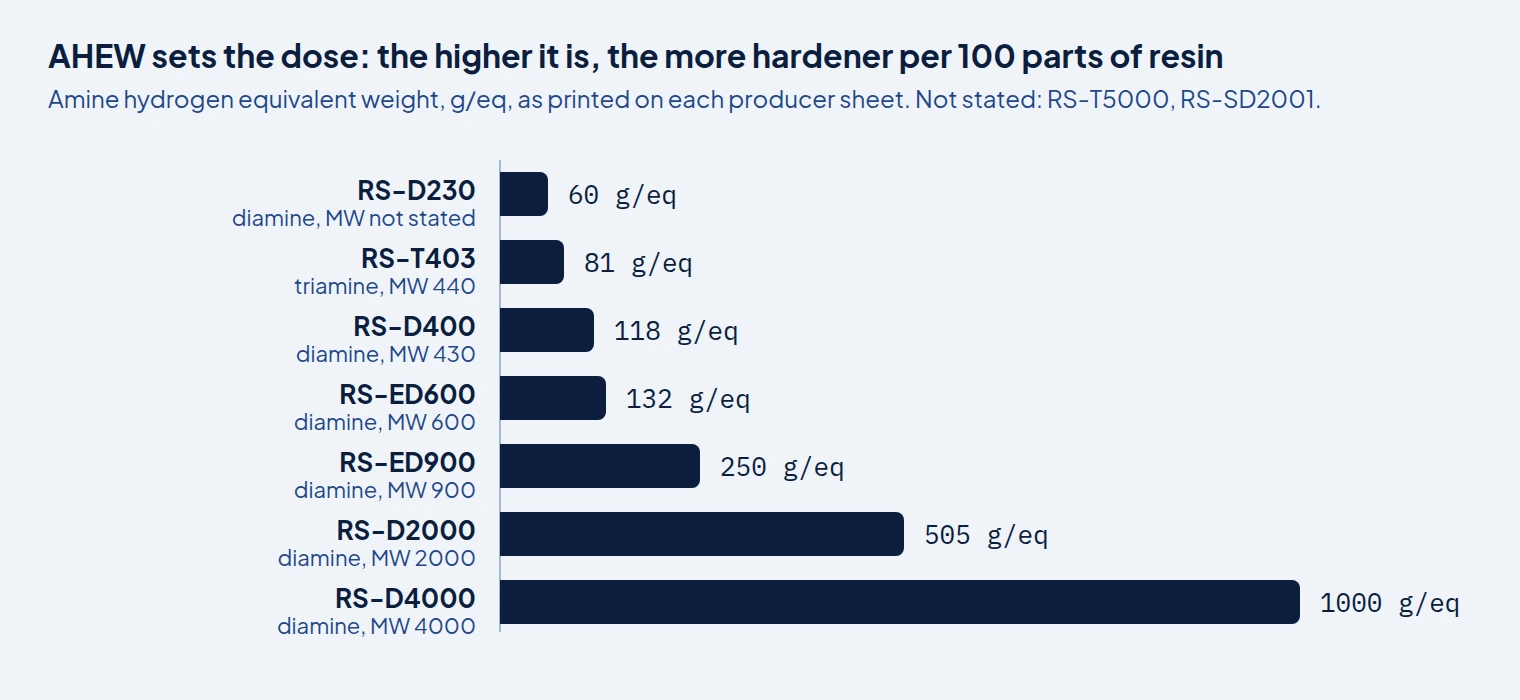
The low-molecular-weight grades are the hardeners. The producer of RS-D230, polyetheramine D-230, credits the cured resin with relatively high elongation and good thermal-shock resistance, and caps viscosity at 15 mPa·s at 25 °C. RS-D400, polyetheramine D-400, goes where the epoxy needs more flexibility, and into polyurethanes and thermoplastic polyamide adhesives.
RS-T403, polyetheramine T-403, is the trifunctional option at a stated 81 g/eq, miscible with a range of solvents, water included. The third amine group buys crosslink density, and its producer also credits RS-T403 with improved flexibility and strength. Its primary amine floor is lower, 90.0 wt% against 95.0 wt% on RS-D230 and RS-D400, a line worth holding to on every lot.
| RS code | Nominal MW, g/mol | AHEW, g/eq | Amine value | Viscosity | Primary amine | Form |
|---|---|---|---|---|---|---|
RS-D400 |
430 | 118 | 4.0–4.6 meq/g | On request | 95.0 min wt% | Colorless to light yellow liquid |
RS-D2000 |
2000 | 505 | 0.98–1.10 meq/g | On request | 97 min wt% | Colorless to light yellow liquid |
RS-D4000 |
4000 | 1000 | 0.44–0.52 mmol/g | On request | 95.0 min % | Colorless to yellowish transparent liquid |
RS-D230 |
On request | 60 | 454–488 mg KOH/g | 15 max mPa·s at 25 °C | 95.0 min wt% | Colorless to light yellow liquid |
| RS code | Nominal MW, g/mol | AHEW, g/eq | Amine value | Viscosity | Primary amine | Form |
|---|---|---|---|---|---|---|
RS-T403 |
440 | 81 | 6.1–6.8 meq/g | On request | 90.0 min wt% | Colorless to light yellow liquid |
RS-T5000 |
5000 | On request | 0.50–0.57 meq/g | On request | 97.0 min wt% | Colorless to light yellow liquid |
Further up the molecular-weight scale, the same backbone turns from hardener to flexibilizer. RS-D2000, polyetheramine D-2000, at a stated AHEW of 505 g/eq, is a co-reactant for epoxies that need more flexibility and toughness.
Polyoxypropylene diamines and triamines for polyurea and RIM
Against an isocyanate the arithmetic changes. A primary amine group consumes one isocyanate group, though its two hydrogens can each open an epoxide. RS-D4000, polyetheramine D-4000, states both figures: 1000 g/eq as AHEW, 2000 g/eq with isocyanates. Run a polyurea index on the epoxy figure and you have half the amine you think.
Its producer calls RS-D2000 a key ingredient in polyurea and reaction injection molding (RIM), and RS-D4000 fast-reacting with isocyanates. RS-T5000, polyetheramine T-5000, a triamine of about 5000 molecular weight, goes into spray polyurea elastomers. It carries acetylatables of 0.58 to 0.63 meq/g against an amine value of 0.50 to 0.57 meq/g. The gap is hydroxyl ends left unconverted by amination, and they react with isocyanate far more slowly than amine does. Specify both lines; if the gap widens from lot to lot, your effective index moves with it.
Where the shot gels too fast, RS-SD2001, polyetheramine SD-2001, is the secondary diamine derived from the 2000 molecular weight polyoxypropylene diamine, built for a slower cure and a lower exotherm. Its specification is provisional, so qualify it on lot COAs.
| RS code | Nominal MW, g/mol | AHEW, g/eq | Amine value | Viscosity | Primary amine | Form |
|---|---|---|---|---|---|---|
RS-SD2001† |
2000 | On request | 0.875–1.03 mmol/g | On request | 5 max % | Colorless to pale-yellow transparent liquid |
For the hydroxyl side of a polyurethane or hybrid polyurea system, see the polyurethane polyols page.
Polyethylene-glycol-core diamines
RS-ED600 and RS-ED900, polyetheramine ED-600 and polyetheramine ED-900, are diamines on a propylene-oxide-capped polyethylene glycol core. The core makes them hydrophilic as well as flexible, and their producer lists both for polyamides modified for hydrophilicity.
Choose between them on equivalent weight: RS-ED600 states 132 g/eq, RS-ED900 250 g/eq. RS-ED600 pairs that 132 with an amine value of 3.0 to 3.43 mmol/g, and for a primary diamine the two do not agree. Confirm the dose basis on the first lot COA before trials. Both allow 0.35 max % water, looser than the 0.25 max wt% on most polyoxypropylene grades, so set your own limit if moisture matters downstream.
| RS code | Nominal MW, g/mol | AHEW, g/eq | Amine value | Viscosity | Primary amine | Form |
|---|---|---|---|---|---|---|
RS-ED600 |
600 | 132‡ | 3.0–3.43 mmol/g | On request | On request | Colorless to pale yellow transparent liquid |
RS-ED900 |
900 | 250 | 1.8–2.25 mmol/g | On request | On request | Colorless to pale yellow transparent liquid |
Polyether monoamines
A monoamine has one reactive end, so it caps or grafts rather than extending a chain. RS-M2005, polyetheramine M-2005, controls molecular weight in polyamides and builds comb polymers on poly(acrylic acid). RS-M2070, polyetheramine M-2070, emulsifies water-based epoxy and serves in pressure-sensitive adhesives; RS-M1000, polyetheramine M-1000, goes into ore flotation and agricultural emulsifiers.
The propylene oxide to ethylene oxide ratio decides how hydrophilic each one is: about 3/19 for RS-M1000, a white waxy solid at room temperature, and about 29/6 for RS-M2005. Plan for melting before you meter the waxy grade. The RS-M1000 release specification is on request.
| RS code | Nominal MW, g/mol | AHEW, g/eq | Amine value | Viscosity | Primary amine | Form |
|---|---|---|---|---|---|---|
RS-M600 |
600 | 291 | 1.55–1.75 mmol/g | On request | On request | Colorless to pale yellow transparent liquid |
RS-M1000 |
1000 | 489 | On request | On request | On request | White waxy solid at room temperature |
RS-M2005 |
2000 | 1045 | 0.44–0.52 mmol/g | On request | On request | Colorless to pale yellow transparent liquid |
RS-M2070 |
2000 | 1040 | 0.45–0.51 mmol/g | On request | On request | Colorless to light yellow liquid |
RS-M3085 |
3000 | On request | 0.30–0.38 mmol/g | On request | On request | White waxy solid |
What to put on the purchase order
Write these lines into the purchase order:
- The RS code and the grade designation.
- The equivalent weight you designed to, against epoxy or isocyanate.
- The amine value with its unit and test method.
- The color limit with its scale, APHA or Pt-Co as the producer uses it.
- The maximum water or moisture; limits run from 0.10 max % on RS-B100 to 0.35 max % on RS-ED600, RS-ED900 and RS-M600.
- The minimum primary amine, where the sheet gives one.
- The pack, its net weight and the delivery point.
Before a new grade replaces one already in your formula, agree the equivalent-weight and amine-value ranges in writing and run one side-by-side cure.
Packs on the producer sheets: 200 kg drums; 200 kg drums (nitrogen blanketed); 1,000 kg IBC totes; ISO tank; 195 kg drums; 950 kg or 942 kg IBC totes; 200 kg net drums (nitrogen blanketed); bulk ISO tank. Name the pack and the net weight on the purchase order; drum and IBC net weights differ between sheets.
A request for quotation gets the fastest answer when it carries: RS code; quantity and annual volume; pack (drum / IBC / ISO tank); delivery point; application (epoxy cure, polyurea, dispersant, other); specification sheet or target values.
What the certificate of analysis shows
A COA reports the lot against the sales specification: appearance, color, amine value, water or moisture, and primary amine where the grade has one. Specific gravity, refractive index and AHEW are typical values that a lot is not released against.
If your dose depends on AHEW, check it against each lot’s amine value. For a grade whose amine groups are all primary, AHEW in g/eq is 1,000 divided by twice the amine value in meq/g; for an all-secondary diamine it is 1,000 divided by the amine value, close enough for RS-SD2001 with its primary amine capped at 5 max %.
The same arithmetic estimates an AHEW for RS-T5000 and RS-SD2001, whose producers state none. Where a COA and a sheet differ, the COA for the lot governs.
Regulatory status by grade
Take inventory status from each supplier SDS, then confirm US status before a first import against the EPA TSCA Inventory, the list EPA keeps under TSCA section 8(b), 15 U.S.C. 2607(b).
| RS code | On TSCA | On DSL | On NDSL | On AICS | On IECSC |
|---|---|---|---|---|---|
RS-D2000 |
Yes | Yes | No | Yes | Yes |
RS-D230 |
Yes | Yes | No | Yes | Yes |
RS-T5000 |
Yes | No | Yes | No | Yes |
Industries served
| Industry | Producer-listed grades |
|---|---|
| Coatings & Construction | RS-D400 RS-D2000 RS-D4000 RS-D230 RS-T403 RS-T5000 RS-SD2001 RS-ED600 RS-ED900 RS-M600 RS-M1000 RS-M2005 RS-M2070 RS-M3085 RS-B100 RS-B200 |
| Industrial Manufacturing | RS-D400 RS-D2000 RS-D4000 RS-D230 RS-T403 RS-T5000 RS-SD2001 RS-ED600 RS-ED900 RS-M2070 RS-M3085 |
| Plastics & Polymers | RS-ED600 RS-ED900 RS-M600 RS-M2005 RS-M3085 |
| Agriculture | RS-M1000 RS-M2070 |
| Mining | RS-M1000 RS-M2070 |
Packaging, documents and quotes
Each product page carries the grade’s specification and its quote form; “Request quote” in the grade table opens that form directly.
Other polyetheramine product pages
These polyetheramines are in the catalog without a published specification on this page yet; request a quote from each product page.
Other polyetheramine product pages (14)
Related polyetheramine pages
| Page | What it covers |
|---|---|
| Polyurethane polyols (polyether and polyester) | The hydroxyl-terminated side of polyurethane and hybrid polyurea systems |
| Epoxy curing agent selection guide | Choosing a hardener by amine chemistry, then by AHEW |
| Epoxy curing agents (hardeners): types | Amine, anhydride and other hardener classes side by side |
| Epoxy hardeners and pot-life control | Cure speed and pot life in coatings and construction epoxies |
| Polyurea vs polyaspartic vs polyurethane raw materials | Which raw materials each elastomer chemistry needs |
| Amines and amides catalog | Every amine and amide product in the catalog |
Sources & methodology
Grade values are from the producer technical data sheets and safety data sheets received in October 2026, as printed: nothing is converted between units or calculated from molecular weight, and a value missing from the producer’s sheet reads “On request”. The dose ratios above are AHEW × 100 ÷ EEW, with the arithmetic shown; the unit factor 56.1 is the molecular weight of potassium hydroxide (PubChem). Inventory status is as each supplier safety data sheet prints it.
Frequently asked questions
How do I calculate how much polyetheramine hardener to add to an epoxy resin?
Divide the hardener’s amine hydrogen equivalent weight (AHEW) by the resin’s epoxy equivalent weight (EEW) and multiply by 100. The result is parts of hardener per 100 parts of resin at one amine hydrogen per epoxide group.
For RS-D230, at a stated 60 g/eq, the dose is 6,000 (60 × 100) divided by your resin’s EEW; for RS-T403, at 81 g/eq, it is 8,100 (81 × 100) divided by the EEW. Take the EEW from the resin lot’s own certificate of analysis (COA). Stoichiometry is where trials start, so run a small cure at that point before you scale.
What is the difference between a polyetheramine diamine and a triamine?
A polyoxypropylene diamine carries two primary amine groups per molecule and a triamine three. Cured at stoichiometry, the triamine builds the denser network.
Molecular weight will not tell them apart. RS-T403 states about 440 and RS-D400 about 430, yet RS-T403 states an AHEW of 81 g/eq against 118 for RS-D400. Swap one for the other at the same parts per hundred and the mix lands well off stoichiometry, so recalculate the dose before any substitution trial.
Why do the amine values on these data sheets use different units?
Producers report amine value in their own unit, and the grades here use three. For an amine, meq/g and mmol/g are the same number, and mg KOH/g is 56.1 times it, from the molecular weight of potassium hydroxide (PubChem CID 14797).
RS-D230 reports mg KOH/g; RS-D400, RS-D2000, RS-T403 and RS-T5000 report meq/g; RS-D4000, RS-ED600, RS-ED900, RS-M2005, RS-M2070 and RS-SD2001 report mmol/g. Converting is the easy part. Ask whether the titration counts total amine or primary amine, and by which method, and write both into your specification.
Which polyetheramine gives the longest working time?
RS-SD2001, the secondary diamine, is the grade built for extended working time. Its values are provisional, so confirm them on the lot COA.
The provisional specification caps primary amine at 5 max % and moisture at 0.20 max %. Watch the primary amine line closely. Residual primary amine reacts faster than the secondary amine around it and pulls gel time in, so a lot near the cap can shorten the working time you qualified on. Require the figure on the COA for every lot.
How do I turn a meter-mix machine’s volume ratio into a weight ratio?
Multiply each side’s volume by its density at the same temperature, then compare the two masses. Stoichiometry is a weight ratio, so convert the machine setting before the first shot.
At 25 °C, RS-D230 has a specific gravity of 0.95 g/cm³, RS-D400 0.97, RS-T403 0.98 and RS-D2000 0.99. Take the resin’s density from its own data sheet at the same temperature, because both values shift as the materials warm.
Sources & methodology
Figures are RawSource sourcing data unless attributed to a named source. Regulatory citations are current as of publication. Chemical identities verified by CAS number against the RawSource catalog.
Search 1,300+ industrial chemicals by name or CAS, or send us your spec — we quote by the drum, tote, or container.
Browse the Chemical Index → Request a Quote