
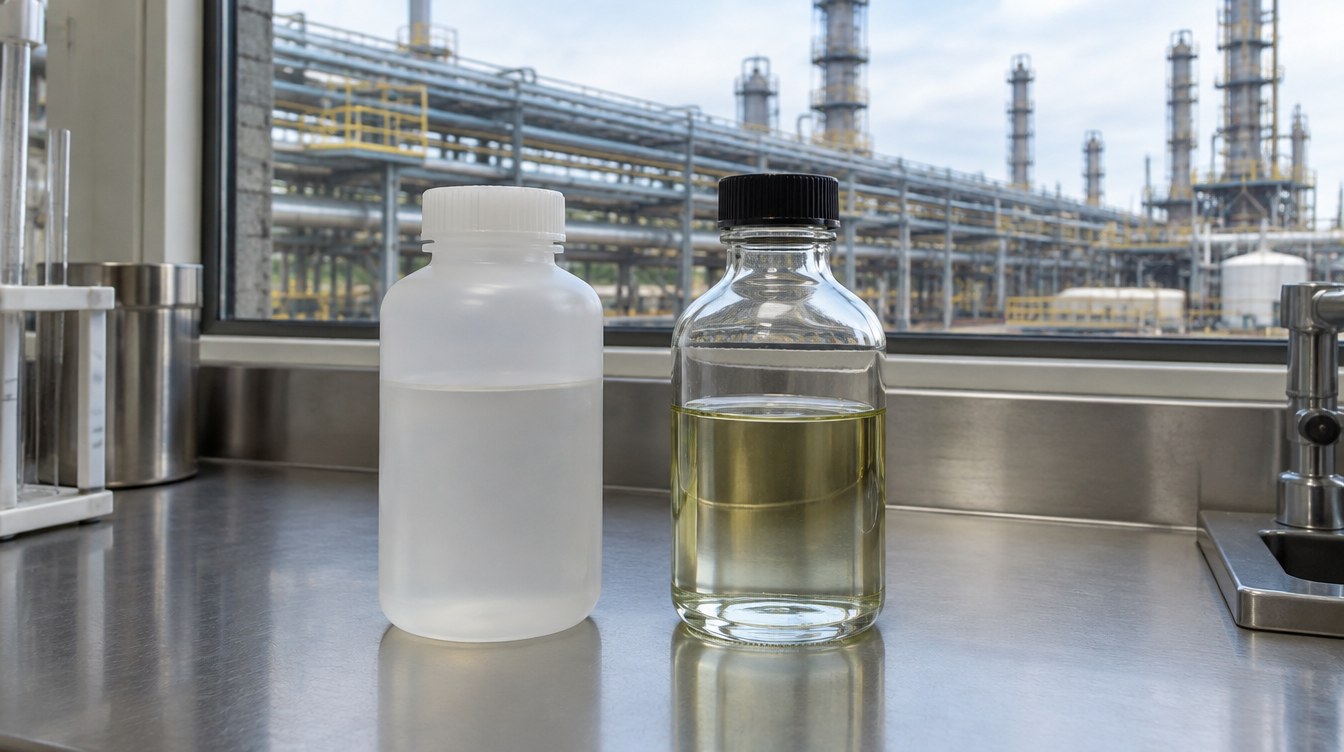
Two quotes land on your desk for the same glass-finishing line, one for hydrofluoric acid and one for sulfuric acid. Rank them by acid strength and sulfuric acid gets the heavier tank, the stricter procedure and the bigger worry. That ranking points the wrong way. The weaker acid of the pair is the one that dissolves the glass sight gauge, the glass-lined nozzle and the silica-filled gasket that sulfuric acid service runs on for years.
Hydrofluoric acid vs sulfuric acid: which is the stronger acid?
Sulfuric acid is the stronger acid in water. Hydrofluoric acid is a weak acid there, with a pKa of 3.19 in the Hazardous Substances Data Bank (HSDB), while sulfuric acid gives up its first proton completely. Hydrofluoric acid is the harder one to contain because fluoride attacks glass and silica, which sulfuric acid leaves intact.
PubChem gives sulfuric acid a pH of 0.3 at 1 N, 1.2 at 0.1 N and 2.1 at 0.01 N: close to one unit per tenfold dilution, the behavior of a fully dissociated acid. NIOSH files hydrofluoric acid as a weak acid; in water, most of it stays as HF molecules.
Anhydrous hydrogen fluoride changes the picture. HSDB calls it one of the most acidic substances known, with a Hammett acidity function of -10.98. Measured values for anhydrous HF move with trace water, so the figure is a guide, not a ranking; the 93% sulfuric acid grade, which carries water, is weaker than the pure acid. In either form, strength does not predict how hard the acid is to hold; the post on hydrofluoric acid properties, formula and density has its full profile.
Strength does not predict the hazard to people either. Hydrofluoric acid’s hazard differs in kind from sulfuric acid’s, so the hazard statements and first-aid section of its current Safety Data Sheet (SDS) set the handling controls, not a sulfuric acid procedure.
What does each acid dissolve?
Fluoride is the difference. HSDB says hydrofluoric acid dissolves silica, silicic acid and glass. Fluoride breaks the silicon-oxygen bond and takes silicon into solution, mostly as fluorosilicic acid in ordinary aqueous HF. The SiF4 gas in quartz sand patent CN110182814B comes from a high-temperature, high-pressure step. Sulfuric acid carries no fluoride to break that bond, which is why it is bottled in glass and run through glass-lined steel.
The documented uses of aqueous hydrofluoric acid are silicate and oxide jobs: etching and polishing glass, cleaning brick, stone and metal castings, quartz purification, rust removal, and stainless steel pickling in nitric-hydrofluoric baths. The International Chemical Safety Cards (ICSC) add that it also attacks some forms of plastic, rubber and coatings.
Sulfuric acid (sulphuric acid in British spelling) works on a different list. It dissolves many metals and their oxides, which makes it a standard pickling acid for carbon steel and a leaching acid for metal ores. In concentrated form it pulls water out of organic matter and chars sugars, wood and paper. It leaves glass, quartz and silica alone.
A mixed bath of the two, as in crystal glass polishing and some etch baths, inherits the fluoride problem in full. However small the HF fraction, specify the bath’s materials as if it held dilute hydrofluoric acid: no glass, no glass-lined steel, no silica-filled gaskets and no carbon steel, which dilute solutions of both acids attack.
HF vs H2SO4 at a glance
The figures come from the PubChem record for hydrofluoric acid and the PubChem record for sulfuric acid, in their source units. The sulfuric acid column describes the compound; take freezing and boiling points for a 93% grade from your supplier’s technical data sheet (TDS), because they differ.
| Property | Hydrofluoric acid | Sulfuric acid (PubChem record) |
|---|---|---|
| Formula, molecular weight | HF, 20.0064 g/mol | H2SO4, 98.08 g/mol |
| Strength in water | Weak acid, pKa 3.19 | Strong acid, pH 0.3 at 1 N |
| Water-free acidity | Anhydrous HF: Hammett H0 -10.98 (HSDB); “one of the most acidic substances known” | The 93% grade carries water and is weaker than the pure acid |
| Boiling point | 19.51 °C (anhydrous); 152 °F (70% solution) | 554 °F at 760 mmHg |
| Melting point | -92.2 °F (70% solution) | 50.65 °F |
| Density (water = 1 unless stated) | 1.23 (70% solution); 0.958 g/mL at 25 °C (anhydrous) | 1.841 |
| Vapor pressure | 917 mmHg at 25 °C (anhydrous); 150 mmHg at 77 °F (70% solution, partial pressure) | 1 mmHg at 294.8 °F |
| Glass and silica | Dissolved | Not attacked |
The vapor pressure row matters most for storage. Anhydrous HF sits above the 760 mmHg of the atmosphere at room temperature, a liquefied gas that HSDB says belongs in steel cylinders. ICSC puts the vapor of the 70% grade at 1.86 times the density of air, so it collects low. Sulfuric acid barely evaporates; its tanks need protection from moisture coming in, not vapor going out.
Why does water content decide the steel question for both acids?
Both acids are carbon steel acids only while they stay concentrated; water is what turns each one against the steel. For hydrofluoric acid the line is documented. OSHA’s Technical Manual says HF alkylation units should hold in-process acid above 65% with moisture below 4% to prevent corrosion. NOAA’s CAMEO Chemicals profile puts the same 65% figure on a second problem: diluted with water below that strength, HF can react with iron and steel and release hydrogen gas.
Below that line, wet hydrofluoric acid needs materials chosen for fluoride service. Fluoropolymers, polyethylene and nickel-copper alloys are the usual candidates; glass and silicate-bearing materials are out, and the gasket filler matters as much as the polymer. The guide to hydrofluoric acid storage and materials of construction covers the selection.
Sulfuric acid follows the same pattern. Concentrated acid is routinely held in carbon steel because a sulfate film forms on the metal and slows further attack; dilute the acid and the film goes, and the same steel corrodes quickly. Dilution also releases a large amount of heat, so acid goes into water, never the reverse.
Get the minimum strength for carbon steel service from your corrosion engineer, write it into the specification, and check vents and sample points for moisture ingress. The sulfuric acid buying guide covers its grades and specifications.
Which hydrofluoric acid concentration is on your order?
One CAS number, 7664-39-3, covers anhydrous hydrogen fluoride and every aqueous grade; ICSC needs two cards for it, ICSC 0283 for the anhydrous liquid and ICSC 1777 for the 70% solution. Sulfuric acid’s 7664-93-9 is just as broad. The CAS on a purchase order tells you little; the form and the concentration tell you what will arrive.
PubChem’s use records give 49% as the standard concentration for semiconductor wet etching, and buffered oxide etch patent CN119685022A specifies electronic-grade feed at 48-50% by mass. Anhydrous HF is the form EPA names as the alkylation catalyst. The 49% vs 70% hydrofluoric acid grades post compares the two aqueous strengths.
One property limits what you can do with spent acid. HSDB lists a 38.2% w/w mixture of HF and water as a constant-boiling azeotrope at 112.2 °C. Boil a weaker solution and it concentrates toward that composition and stops there, so evaporation alone will not bring spent etch acid back up to 49%.
Concentration also moves the paperwork. EPA’s Risk Management Program list (40 CFR 68.130, as published on eCFR in 2026) sets a 1,000 lb threshold quantity for hydrogen fluoride or hydrofluoric acid at 50% or greater. A 49% grade sits below that line only when its certificate of analysis (CoA) assays below 50%, which matters when electronic-grade feed runs 48-50%; the 70% and anhydrous forms sit above it.
Below the line is not outside the paperwork. The CERCLA reportable quantity for a hydrofluoric acid release, 100 lb (45.4 kg) under 40 CFR 302.4 (HSDB via PubChem, 2026), applies at any strength. Confirm the effect of a grade change with your environmental, health and safety team.
Where are hydrofluoric acid and sulfuric acid used together?
Most commercial hydrofluoric acid starts with sulfuric acid. HF is made by reacting fluorspar (calcium fluoride) with sulfuric acid, which releases hydrogen fluoride gas and leaves calcium sulfate behind, so sulfuric acid is one of the raw materials behind an HF quote, alongside fluorspar.
The two also share process steps. Crystal glass polishing runs them in one bath. Quartz sand patent CN110182814B describes a step in which fluoride frees metal impurities from the quartz lattice and they leave as fluoride and sulfate salts. In wafer fabrication they run in sequence: sulfuric acid-based cleans strip organic residue, and dilute HF strips oxide.
HF alkylation or sulfuric acid alkylation: what decides it?
Refinery alkylation is the one large market where the two acids compete for the same job. OSHA’s Technical Manual describes it as combining light olefins, mainly propylene and butylene, with isobutane over a sulfuric acid or hydrofluoric acid catalyst. The product, alkylate, is a clean-burning gasoline blending stock with exceptional antiknock properties. EPA names anhydrous HF as the form used.
The advantages of HF alkylation over sulfuric acid come from standard refinery chemistry. An HF unit regenerates its acid inside the unit, so fresh acid make-up stays small. A sulfuric acid unit consumes acid at a much higher rate, and its spent acid has to go to a separate regeneration plant. HF reacts at temperatures cooling water can hold, while sulfuric acid alkylation needs refrigeration.
Against that, OSHA’s account of the HF unit shows what the route demands:
- In-process acid above 65% and moisture below 4%, to control corrosion.
- A thorough dry-out after any shutdown that used water, before HF goes back in.
- Continuous cooling water, which holds process temperature; OSHA notes that losing it could cause a process upset.
- An HF stripper for the propane, which carries trace HF and is catalytically defluorinated before storage.
So the trade is acid logistics and refrigeration on the sulfuric acid side against moisture discipline on the HF side, where anhydrous HF also adds a toxic-substance listing above the 50% Risk Management Program line (40 CFR 68.130, eCFR 2026). OSHA attributes alkylate octane mainly to the olefins used and the operating conditions. Its manual gives no acid consumption or cooling duty figures for either route; ask the process licensor for both on the same feed.
What to write on the order
- Form and concentration (anhydrous, 70% or 49% HF; 93% sulfuric acid), not only the CAS number.
- Acid assay and water content on every CoA.
- A materials audit of glass and silica-filled parts before a line moves from sulfuric acid to HF.
- A check of the CoA assay of stored HF against the 50% Risk Management Program line before a grade change.
- Each acid’s current SDS; never reuse a sulfuric acid procedure for HF.
Methodology: figures come from the PubChem records for hydrofluoric acid (CID 14917) and sulfuric acid (CID 1118) and the sources they aggregate (HSDB, ICSC, NIOSH, NOAA CAMEO Chemicals), EPA’s health effects notebook for hydrogen fluoride, OSHA’s Technical Manual, eCFR and patents CN110182814B and CN119685022A. Statements without a figure are standard chemistry. This is not engineering advice: site materials and procedures need review by your process-safety or corrosion engineer.
Frequently asked questions
Why is hydrofluoric acid called a weak acid if it dissolves glass?
Can a tank or line move from sulfuric acid service to hydrofluoric acid service?
What are the advantages of HF alkylation over sulfuric acid alkylation?
Which is denser, hydrofluoric acid or sulfuric acid?
Sources & methodology
Figures are RawSource sourcing data unless attributed to a named source. Regulatory citations are current as of publication. Chemical identities verified by CAS number against the RawSource catalog.
Search 1,300+ industrial chemicals by name or CAS, or send us your spec — we quote by the drum, tote, or container.
Browse the Chemical Index → Request a Quote