
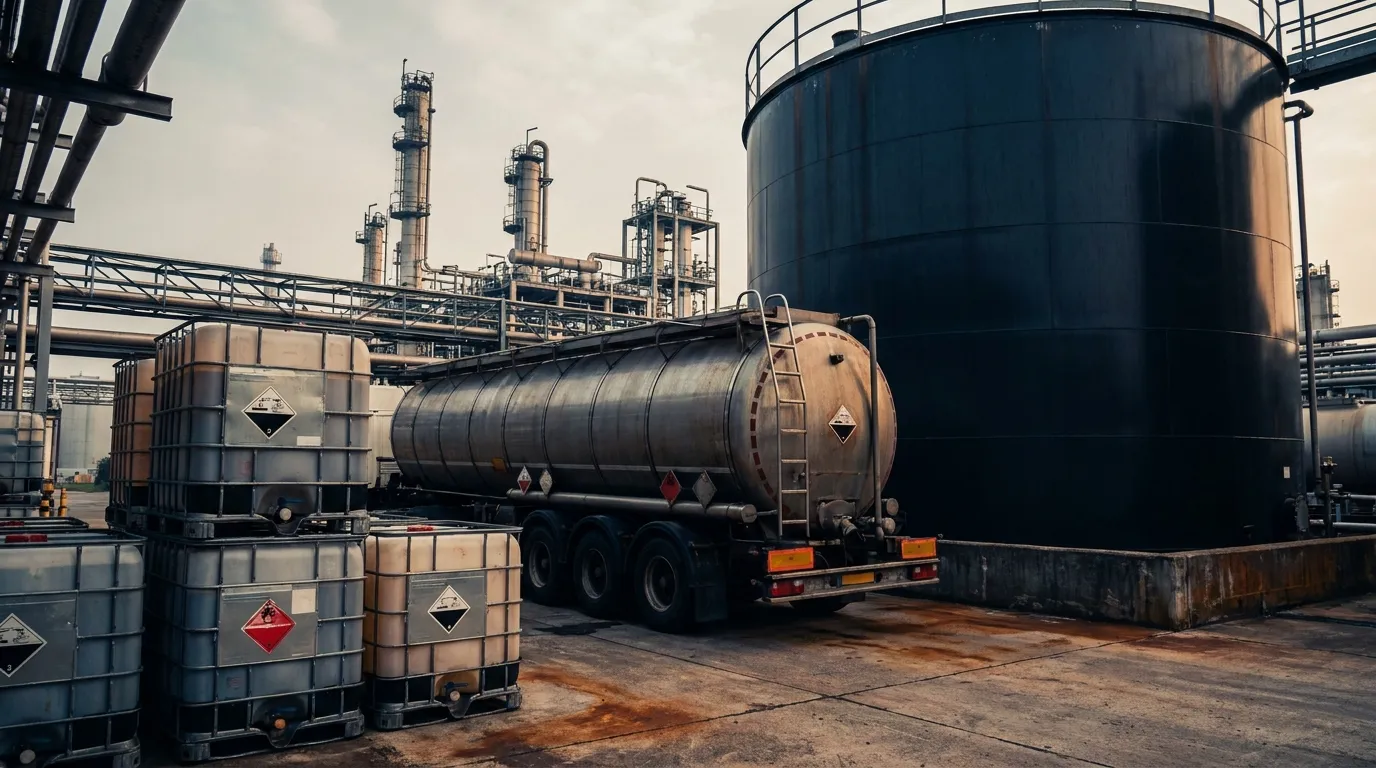
A 24-MT ISO tank of “98% sulfuric acid” lands at your dock, and your incoming-QC pulls a chloride reading of 35 ppm against a spec ceiling of 5 ppm. The acid is technically 98% H2SO4, the CoA the supplier issued looks clean, and you cannot use it on your 316L stainless circuit without pitting the welds within a shift. The problem was never the assay. It was everything your RFQ did not pin down: chloride, iron, color, and which UN number actually rode on the manifest.
Sulfuric acid (CAS 7664-93-9) is the highest-tonnage industrial chemical on earth, and that scale fools buyers into treating it as a commodity you can buy on price and percent. You can’t. Between battery grade, technical grade, and oleum sit three different transport classifications, two different materials-of-construction regimes, and a price that swings with copper smelter rates and sulfur, none of which appear on a one-line PO. This guide is how you write a spec and an RFQ that lands the right acid the first time.
Which grade of sulfuric acid do you actually need?
Grade names are shorthand for an assay range and an impurity profile, and the shorthand is inconsistent between suppliers, so you specify the underlying numbers. The three families you buy are dilute battery/electronic grades (~30–40%), concentrated technical/commercial grades (93–98%), and oleum (fuming acid carrying free SO3).
Battery and electronic grades run low concentration but tight on metals: a lead-acid battery electrolyte or a semiconductor etch cannot tolerate the iron and chloride that a fertilizer-grade acid carries. Technical and commercial grades at 93–98% cover the bulk of metal pickling, alkylation, water treatment, and chemical synthesis. Oleum (typically quoted as 20–65% free SO3) is what you buy when a sulfonation or nitration reaction needs the SO3, and it demands pressure-rated equipment and stricter transport handling than standard concentrated acid.
| Grade / concentration | Typical H2SO4 assay | Primary uses | UN number | Container / MOC |
|---|---|---|---|---|
| Battery / electrolyte | ~33–37% | Lead-acid batteries | UN 2796 (≤51%) | HDPE drums, lined IBC; 316L for handling |
| Electronic / high-purity | ~30–98% (low metals) | Semiconductor etch, plating | 1830 or 2796 by conc. | PFA-lined / high-purity 316L |
| Technical / commercial | 93–98% | Pickling, alkylation, water treatment, synthesis | UN 1830 (>51%) | Carbon-steel ISO tank (passivated); 316L for dilute service |
| Oleum (fuming) | 100%+ as free SO3 20–65% | Sulfonation, nitration, dyes/detergents | UN 1831 | Pressure-rated dedicated tank, heated lines |
Note the trade-off most price sheets bury: a “98%” technical acid and a “98%” electronic acid can differ 3–10x in price entirely on metals and chloride control. If your process tolerates fertilizer-grade impurity loads, do not pay for electronic purity. If it doesn’t, no commercial-grade discount is worth the off-spec batch.
How does concentration drive transport classification and paperwork?
The single hinge that buyers miss: concentration sets the UN number. Sulfuric acid above 51% H2SO4 ships as UN 1830; acid at or below 51% (battery acid) ships as UN 2796; oleum ships as UN 1831. All are IMDG and DOT 49 CFR Class 8 (corrosive) dangerous goods, packing group II, but the UN number on the dangerous-goods declaration and the tank placard must match the actual concentration you bought.
Get this wrong and the consequences are immediate: a battery-acid tank placarded UN 1830, or a 98% tank declared as 2796, fails the port hazmat check, sits at the berth, and accrues demurrage and detention while you re-paper it. For sea freight you need the IMDG multimodal dangerous-goods declaration, vessel pre-notification, and a hazmat berth slot. Verify the ISO tank’s suitability certificate and last-cargo record before you accept the booking; a tank previously in chloride service can contaminate a low-chloride load.
Drum, IBC, ISO tank, or rail: how should you take delivery?
Packaging is a freight-and-handling decision, not just a volume one. The economic crossover is real: below roughly 1 MT, drums or IBCs win on flexibility; from a few MT to ~24 MT per shipment, the ISO tank is almost always the lowest landed cost; above that, dedicated rail or marine bulk dominates for steady high-volume offtake.
| Mode | Typical quantity | Best for | Watch-outs |
|---|---|---|---|
| HDPE / poly drums | 25–250 kg | Lab, small batch, dilute grades | Highest $/MT; venting on concentrated acid |
| IBC (lined) | ~1 MT | Intermittent mid-volume use | Material compatibility; not for hot oleum |
| ISO tank container | ~20–24 MT | Recurring container-load demand | Tank suitability cert; last-cargo / passivation |
| Rail tank car / marine bulk | 60–90+ MT | Continuous high-volume offtake | On-site unloading, storage MOC, dedicated logistics |
The ISO tank is where most container-load procurement lives, and it carries an honest downside: you are renting a hazmat-rated asset, demurrage on it runs while it waits at your gate, and you need on-site capability to unload corrosive Class 8 material safely. If your draw is steady enough to justify storage and a dedicated unloading station, bulk rail or marine beats ISO tanks on $/MT, but only once your throughput supports the fixed cost.
What materials of construction will actually survive your acid?
The counterintuitive rule that catches new buyers: concentrated sulfuric acid is handled in carbon steel, while dilute acid destroys it. At 93–98%, sulfuric acid passivates carbon steel by forming a protective iron-sulfate film, which is why concentrated-acid ISO tanks and storage are commonly plain carbon steel. Dilute the same acid below roughly 70–80% and that film fails — corrosion rates climb sharply, and you need 316L stainless, alloy, or lined vessels.
Two caveats determine whether your circuit lasts. First, velocity: even in concentrated service, flow above a few feet per second strips the passivation film and gouges carbon steel, so pumps and elbows often need upgraded metallurgy regardless of concentration. Second, chloride: 316L tolerates clean dilute sulfuric, but chloride contamination triggers pitting and stress-corrosion cracking in stainless — which is exactly why a chloride ceiling belongs in your spec, not just in your CoA review. For high-chloride or high-temperature duty, higher alloys (Alloy 20, nickel-molybdenum alloys) or PTFE/PFA linings are the defensible call.
Which CoA parameters do you put in writing?
A Certificate of Analysis that only states “98% H2SO4” tells you almost nothing about fitness for use. The four parameters that decide whether the acid runs on your process are assay, iron, chloride, and color — and each needs a number and a method in the spec, not a grade name.
- Assay (% H2SO4): specify a range, e.g. 96.0–98.0%, not a single number. Concentrated acid is hygroscopic and drifts; a hard “98.0% minimum” invites borderline rejections on a product that is otherwise fine.
- Iron (Fe), ppm: the impurity that colors the acid and matters for catalysts, plating, and battery service. Commercial acid may run tens to low-hundreds of ppm; electronic grades demand single-digit or sub-ppm.
- Chloride (Cl), ppm: the corrosion driver. A few ppm protects your 316L; tens of ppm pits it. This is the parameter that most often arrives uncontrolled because the seller “met assay.”
- Color (APHA / turbidity): a fast proxy for organic and iron contamination, especially in regenerated or byproduct acid.
Add the rights, not just the limits: define the CoA threshold that triggers automatic rejection, your right to third-party testing at the supplier’s cost when CoA and your incoming-QC disagree, and a rejection notification window (typically 48–72 hours of arrival). Without those, an off-spec tank becomes a negotiation instead of a return. Our chloride-dispute example at the top resolves itself when the contract says 5 ppm is the rejection line and the supplier pays the lab.
What actually drives the price you’ll pay?
Sulfuric acid pricing is not one market — it is the residual of two upstream economics. Roughly a quarter of global supply is involuntary byproduct from copper, zinc, and nickel smelting, produced regardless of acid demand; the rest is “burner” acid made deliberately from elemental sulfur. So your price tracks copper-smelter utilization and sulfur far more than any “acid demand” headline.
On the demand side, phosphate fertilizer and phosphoric-acid production consume the majority of world output, which makes acid pricing seasonal and regionally lumpy — a fertilizer-season pull in one basin can tighten merchant acid hundreds of kilometers away. The third lever is freight: because acid is dense, low-value-per-ton, and hazmat, ISO-tank and bulk freight is a large fraction of landed CFR cost, and a freight spike can swing your delivered price more than the acid itself. When you compare regional sources, the India vs China sourcing trade-offs show up here as freight-plus-leadtime, not just ex-works price. The defensible procurement posture is an index-linked annual contract on your base volume with spot for the swing — full spot exposes you to fertilizer-season spikes; 100% fixed strips your leverage when smelter acid floods the merchant market.
How do you write the RFQ so the right acid shows up?
The RFQ is where you spend your leverage. Send a number-request before you’ve pinned the spec and every quote comes back on different assumptions, impossible to compare. Pin these, in writing, before you ask for price:
- Concentration range and assay floor (e.g. 93–98%, ≥96.0% on receipt), not “concentrated.”
- Impurity ceilings: chloride ppm, iron ppm, color/APHA, plus any process-specific metals. This is the line item that separates real quotes from guesses.
- Grade and intended use so the supplier flags a mismatch (don’t quote me electronic grade for pickling).
- Packaging and UN number: ISO tank vs IBC vs drum, and UN 1830 / 2796 / 1831 matched to concentration.
- Incoterm (CFR/CIF/DAP/FCA per 2020 rules) so freight and DG handling responsibility is unambiguous.
- Documentation set: CoA with the four parameters above, SDS in destination format, TDS, Certificate of Origin, IMDG declaration; and for EU import, the REACH registration number.
- Origin lock and CoA/rejection rights: name the producing facility, require notice before origin substitution, and state the rejection threshold and third-party-test clause.
For the full procurement workflow around any bulk chemical, see our guide to sourcing bulk chemicals, and vet new acid suppliers against the chemical supplier audit checklist before you place container-load volume. A tight spec costs an hour to write and saves the off-spec tank, the demurrage, and the dispute.
Where RawSource fits
The honest framing: our value is in matching your written spec (the chloride ceiling, the origin lock, the UN-number-correct booking, the complete documentation set) to producers who can hit it, and in keeping you from paying electronic-grade price for fertilizer-grade duty. If your annual draw justifies bulk rail or marine over ISO tanks, we’ll tell you — that’s a freight math we don’t always win. Request a bulk quote with your concentration range, impurity ceilings, packaging, and Incoterm, and you’ll get a comparable number instead of a grade name.
Methodology and sources
Identity and property context for Sulfuric Acid (Sulphuric Acid) (CAS 7664-93-9) in this guide is anchored to the compound's PubChem record. Hazard-communication framing follows OSHA's Hazard Communication Standard, 29 CFR 1910.1200. Always defer to the supplier's current SDS and CoA for the specific grade and lot you handle.
Frequently Asked Questions
What is the difference between technical grade and industrial grade sulfuric acid?
Technical grade sulfuric acid typically refers to 93–98% H2SO4 (CAS 7664-93-9) with controlled impurity levels suitable for most industrial processes including metal pickling, chemical synthesis, alkylation, and water treatment. “Industrial grade” is often used interchangeably but may tolerate higher impurity thresholds in applications such as fertilizer production where iron and chloride sensitivity is lower. Because the names are not standardized between suppliers, always specify your assay range, chloride and iron ceilings (in ppm), and color limit in the RFQ rather than relying on the grade name alone.
What is oleum and when is it used in industrial processes?
Oleum, or fuming sulfuric acid, is concentrated H2SO4 containing dissolved sulfur trioxide (SO3), expressed as a percentage of free SO3 (e.g. 20% oleum = 80% H2SO4 plus 20% free SO3). It is used in sulfonation reactions for detergents, dyes, and surfactants, and in nitration processes. Oleum ships as UN 1831 (distinct from UN 1830 for concentrated acid), requires pressure-rated dedicated tank containers and often heated lines, and is subject to additional transport handling beyond standard Class 8 corrosive classification. Specify free-SO3 percentage and confirm tank suitability before booking.
How is sulfuric acid transported in bulk shipments?
Concentrated sulfuric acid above 51% (UN 1830) is transported in dedicated ISO tanks, typically passivated carbon steel for concentrated service or acid-resistant lined steel; dilute service moves to 316L or lined vessels. Battery acid at or below 51% (UN 2796) carries different container and documentation requirements, and oleum (UN 1831) needs pressure-rated tanks. All are IMDG/DOT Class 8 dangerous goods (packing group II) and require a multimodal dangerous-goods declaration, vessel pre-notification, and a hazmat berth slot. Verify the ISO tank suitability certificate and last-cargo record before accepting any booking.
What documentation is required to import sulfuric acid?
Standard import documentation includes the Safety Data Sheet (SDS, in destination-market format), Certificate of Analysis (CoA), Technical Data Sheet (TDS), commercial invoice, packing list, bill of lading, and the IMDG multimodal dangerous-goods declaration with the correct UN number (1830, 2796, or 1831). EU imports additionally require confirmation of the REACH registration number, and some jurisdictions require a controlled-substance import permit for concentrated H2SO4. Any missing document creates a customs hold that generates immediate demurrage, so confirm in the RFQ which documents the supplier provides and which you source.
What drives sulfuric acid price fluctuations?
Three factors dominate H2SO4 price movement. First, byproduct availability from copper, zinc, and nickel smelting, which supplies roughly a quarter of the global market and is produced regardless of acid demand, so prices track smelter utilization and sulfur cost. Second, fertilizer-sector seasonality, since phosphate and phosphoric-acid production consume the majority of world output and tighten merchant acid regionally. Third, ISO-tank and bulk freight rates, which are a large share of landed CFR cost because acid is dense, low value per ton, and hazmat. Buyers with predictable annual volumes reduce exposure through index-linked annual contracts with a spot allowance for swing volume rather than full spot purchasing.
Search 1,300+ industrial chemicals by name or CAS, or send us your spec — we quote by the drum, tote, or container.
Browse the Chemical Index → Request a Quote