
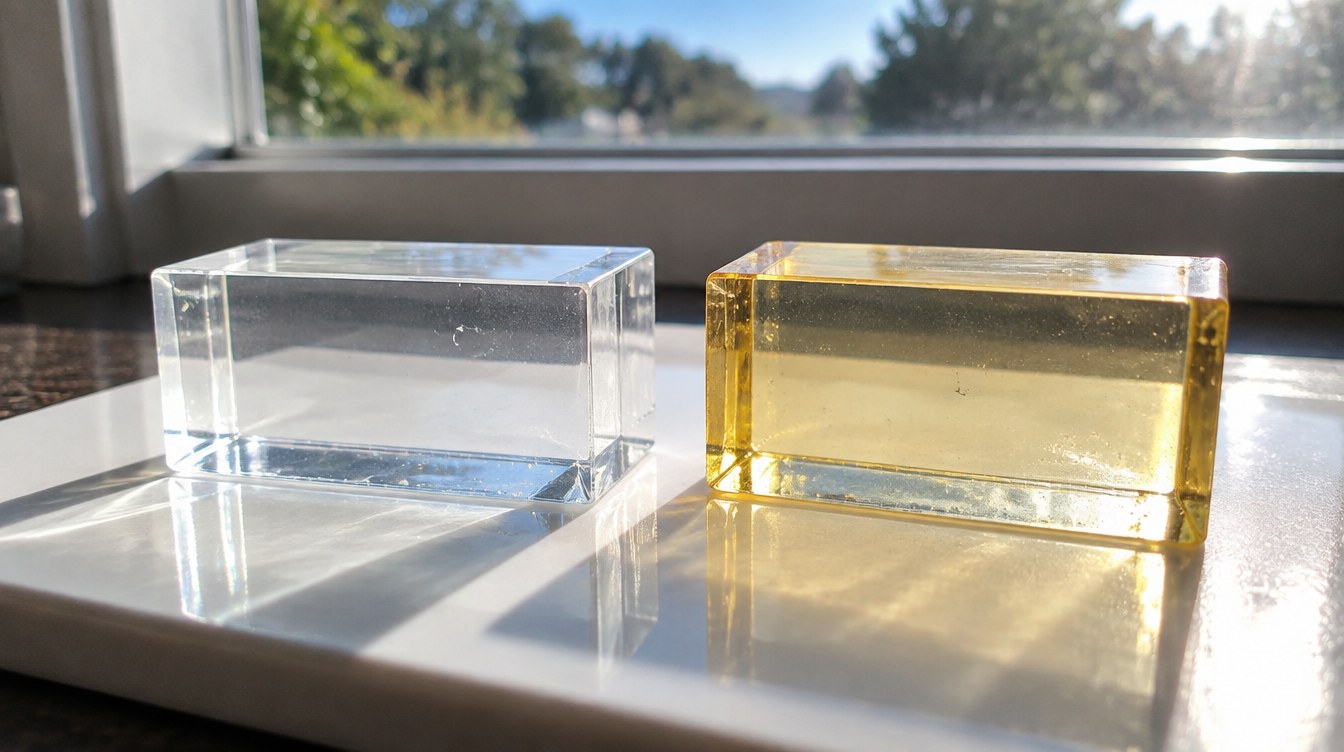
Last spring you moved a clear casting line off a fast araliphatic amine hardener and onto a cycloaliphatic one sold as non-yellowing. This autumn’s field returns are amber anyway: darkest through thick sections, yellow where the sun reached the part, while a retained piece in a dark drawer has barely moved. Same resin lot, same tooling. The hardener swap was right but incomplete, because the resin backbone is aromatic and, on the outdoor parts, nothing stopped the ultraviolet light before it reached the epoxy.
Below are the two routes to color, the hardener classes that hold color, and what stabilizers can and cannot do. The central claim is one you can test on your own panels: a lightfast clear topcoat shields the epoxy underneath only if the topcoat itself absorbs UV.
Two routes to yellow: heat in the dark, ultraviolet in the sun
The first route is thermal oxidation. Oxygen attacks the cured network, and heat and humidity speed the reaction. The products are carbonyl groups and conjugated structures along the polymer chains, and these chromophores absorb blue and violet light, so the part looks yellow and then amber. This is the slow ambering of an indoor bar top or of potted electronics that run warm. It needs no light, and thick sections show it first because a deep pour cannot shed the heat of its own cure.
The second route is photo-oxidation. Ultraviolet light is absorbed by the aromatic rings of the bisphenol A units in the resin and in any aromatic hardener, and the excited groups start a radical chain that builds the same chromophores far faster than heat alone. Photo-oxidation starts at the surface, where the light and the oxygen are, and works inward.
Before you blame a lot, ask where the part spent its life. A casting that ambered in a dark cabinet points to heat and oxidation. A panel that yellowed on a south-facing wall points to UV.
What the resin record tells you, and what it does not
The resin in question is bisphenol A diglycidyl ether (DGEBA) epoxy resin, catalogued under CAS 25068-38-6. Its registry name, 2-(chloromethyl)oxirane;4-[2-(4-hydroxyphenyl)propan-2-yl]phenol, does not name one molecule. It names the two starting materials, epichlorohydrin and bisphenol A, separated by a semicolon.
The listed formula, C18H21ClO3, and molecular weight, 320.8 g/mol, are those two molecules added together, one of each. They identify the resin family. They do not describe the drum you receive, and they say nothing about color. The same CAS number also covers the higher-molecular-weight solid resins made from the same pair, so the registry entry cannot tell you whether the lot is a liquid casting resin or a solid one.
For a clear part, the certificate of analysis (CoA) matters more than the registry. Ask for the resin’s color and its epoxide equivalent weight, which places the lot between liquid and solid, and for the hardener’s color. A clear system starts its service life at the color of its two components, so set a color limit on both.
One fact no hardener can change: bisphenol A carries two aromatic rings, so every molecule of bisphenol A diglycidyl ether (DGEBA) epoxy resin carries at least two. A cycloaliphatic hardener cuts the hardener’s share of the chromophore budget. The resin’s share stays. Bisphenol F epoxy, a lower-viscosity option, is aromatic as well.
Which hardeners hold color, and why does the nitrogen’s neighbor decide it?
The dividing line is what the amine nitrogen is bonded to. In an aromatic amine, the nitrogen sits directly on a benzene ring, and that arrangement oxidizes readily to colored, quinone-like structures under heat or light. In an aliphatic or cycloaliphatic amine there is no aromatic ring at the nitrogen, so there is less to oxidize into a chromophore and the cured film holds its color better.
| Hardener class (generic) | Nitrogen bonded to | Color in a clear | What it costs you |
|---|---|---|---|
| Aromatic amines | A benzene ring | Darkens quickly under heat or UV; keep out of clears | Not worth the color penalty in clear work |
| Cycloaliphatic amines, such as isophorone diamine (IPDA) | Saturated carbons: one amine on the ring, one on a CH2 beside it | Low starting color, good hold | Slower ambient cure; can blush in cold, damp conditions |
| Polyoxypropylene diamines (polyetheramines) | A polyether chain carbon | Water-clear; used in deep-pour clear castings | Lower glass transition temperature (Tg); slow at ambient |
| Araliphatic amines, such as m-xylylenediamine (MXDA) | A CH2 group on a benzene ring | Better than aromatic, not the cleanest for color-critical clears | Fast cure, strong chemical resistance |
| Phenalkamines and Mannich bases | A CH2 group on a phenolic ring | Start dark, from the phenolic raw material | Built for fast, cold cure, not clarity |
| Polyamides and amidoamines | Aliphatic carbons in the polyamine segments | Start amber | Flexibility and wetting, not clarity |
Starting color also comes from the rest of the molecule: a phenalkamine is dark because of its phenolic backbone, whatever its nitrogen is bonded to.
For clear work that sees UV, the rule follows: no aromatic amine. Choose between a cycloaliphatic amine and a low-molecular-weight polyoxypropylene diamine on cure speed and Tg, since both start low in color; a blend of the two is a workable middle. Judge a formulated hardener by its CoA color, because accelerators and diluents ride along with the amine.
Stabilizers slow yellowing; they do not stop it
Two additive classes work by different routes, and a clear in sunlight needs both. A UV absorber, such as a hydroxyphenyl benzotriazole or a hydroxyphenyl triazine, takes up ultraviolet light and releases it as heat before the light can excite the resin. Its protection depends on path length: it shields the depth of a thick film or casting well and the top surface least, which is where photo-oxidation begins.
The absorber is photostable, but it is lost slowly over service life through gradual photodegradation and migration out of the film, so its protection fades.
A hindered amine light stabilizer (HALS) absorbs no ultraviolet. It traps the radicals that photo-oxidation creates and is regenerated in the cycle, so a small loading keeps working at the surface, where the absorber is weakest. Forms you will meet include bis(2,2,6,6-tetramethyl-4-piperidyl) sebacate, a low-molecular-weight N-H HALS, and bis(1,2,2,6,6-pentamethyl-4-piperidyl) sebacate, a liquid N-methyl HALS. Both stay basic. Where an acid catalyst or a cationic cure is involved, the low-basicity choice is an N-alkoxy (NOR) HALS.
The pair slows yellowing and gloss loss. It does not stop them. A well-stabilized clear aromatic epoxy in full sun still yellows; it yellows later.
Heat needs its own lever. For parts that run warm or sit in the dark, add an antioxidant package: a hindered phenol that traps the radicals heat creates, often paired with a phosphite that breaks down hydroperoxides before they split into new radicals. It slows thermal ambering; like the light stabilizers, it does not stop it.
The topcoat protects the epoxy only if it absorbs UV
For clear outdoor service, the deciding layer is a weatherable clear topcoat: an aliphatic polyurethane built on hexamethylene diisocyanate (HDI) isocyanurate or biuret, or on isophorone diisocyanate (IPDI), or a polyaspartic ester system cured with an aliphatic polyisocyanate. These stay lightfast because their isocyanate groups sit on aliphatic or cycloaliphatic carbon, with no aromatic ring to photo-oxidize.
Lightfast describes the topcoat. It says the clear will not yellow itself; it says nothing about how much ultraviolet light passes through it to the epoxy below. A clear topcoat with no UV absorber transmits much of the UV that reaches it, so the epoxy underneath photo-oxidizes at the interface. The part yellows under a finish that still looks perfect, and the oxidized epoxy surface can lose its grip on the coat above.
Write the topcoat requirement as two lines, not one: an aliphatic, lightfast clear, and a UV absorber plus HALS in that clear, qualified at your film build. Then ask for weathering data on the full stack, epoxy plus topcoat, not on the topcoat alone.
The topcoat also adds a coat, its labor and a recoat window. A cycloaliphatic amine-cured epoxy can blush in cold, damp conditions, leaving an amine carbamate film on the surface that weakens intercoat adhesion. Wash it off before you topcoat.
When no topcoat is allowed, change the resin
Some parts cannot take a topcoat, such as a cast clear with tight dimensions or an encapsulant. If such a part must stay clear in sunlight, the aromatic ring has to leave the resin.
Hydrogenated bisphenol A diglycidyl ether keeps the glycidyl ether chemistry, with the rings saturated, and still cures with amines. Expect a higher price, and requalify cure speed and hardness against your current system. Cycloaliphatic epoxy resins, with the epoxide on a cyclohexane ring, react sluggishly with amines and are cured with anhydrides or cationic catalysts. That is a process change, not a resin swap, and a basic HALS can inhibit a cationic cure, so confirm stabilizer compatibility before the first trial.
The decision, by exposure
-
Indoor clear, away from windows: a cycloaliphatic amine or polyoxypropylene diamine hardener, an antioxidant package (hindered phenol plus phosphite) with a HALS, a color limit on both CoAs and controlled exotherm in thick pours. Expect slow ambering, not none.
-
Indoor near windows or under skylights: add a UV absorber to the HALS, because window glass passes part of the ultraviolet range.
-
Clear outdoors: an epoxy build coat under an aliphatic polyurethane or polyaspartic clear that carries its own UV absorber and HALS.
-
Clear outdoors with no topcoat permitted: a non-aromatic resin, requalified from the start.
-
Pigmented outdoors: a pigment such as titanium dioxide hides the color shift, but an aromatic epoxy surface still chalks, so topcoat to hold gloss.
Treat this list as general guidance, not a specification: qualify the full system on your own parts, and ask for weathering data on it. A “non-yellowing” label on a hardener is a statement about the hardener.
Methodology: the molecular formula, molecular weight and IUPAC name come from the product catalog record for CAS 25068-38-6. Mechanisms and hardener behavior are standard coatings chemistry, stated without figures where no primary source was in hand; handling information is left to the current safety data sheet (SDS).
Frequently asked questions
Does “non-yellowing” on an epoxy data sheet mean the part will stay clear outdoors?
Can I add more UV absorber to the epoxy instead of applying a topcoat?
Why did the thick section of a casting turn amber before the thin edges?
What should a certificate of analysis show for a clear-grade epoxy resin and its hardener?
Sources & methodology
Figures are RawSource sourcing data unless attributed to a named source. Regulatory citations are current as of publication. Chemical identities verified by CAS number against the RawSource catalog.
Search 1,300+ industrial chemicals by name or CAS, or send us your spec — we quote by the drum, tote, or container.
Browse the Chemical Index → Request a Quote