
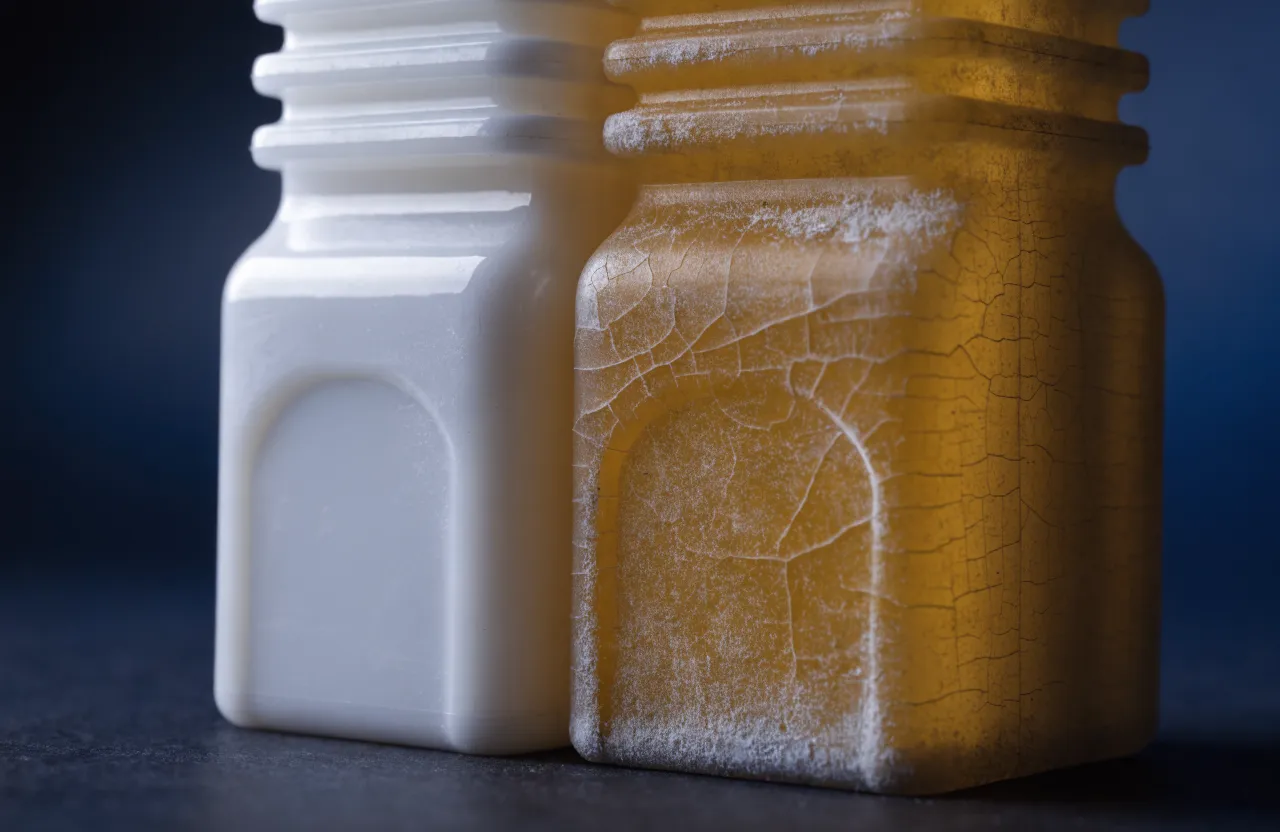
The housings shipped bright white. Eighteen months on a rooftop and the field returns come back yellow at the corners, dull where a gloved thumb wipes a faint powder off the surface, and split along the molded-in rib lines. The resin grade never changed and the tool never changed. What changed is that the part spent a year and a half in sunlight, and the polymer is doing exactly what an unstabilized polymer does outdoors: it is photo-oxidizing. The good news for a compounder is that yellowing, chalking, and cracking are the same failure wearing three faces, the mechanism is well understood, and the additive chemistry that slows it down is selectable by polymer, section thickness, and cure system.
The short version: Sunlight’s UV drives photo-oxidation. UV photons generate free radicals in the polymer, those radicals react with atmospheric oxygen to form hydroperoxides, and the hydroperoxides break back down into more radicals in a self-feeding (autocatalytic) loop. That chemistry surfaces three ways: conjugated double bonds that absorb visible light (yellowing), surface binder eroded away to leave loose pigment (chalking), and chain scission that drops molecular weight until the part embrittles and cracks. Two additive classes fight it by different routes. UV absorbers soak up UV and release it as heat; they are consumed over time and need film depth to work. Hindered amine light stabilizers (HALS) do not absorb UV at all — they scavenge the radicals and regenerate themselves through the Denisov cycle, so a low loading keeps working for years. Pick a HALS by molecular weight and nitrogen type: low-MW monomeric grades are cheap and mobile but volatile; high-MW polymeric grades resist migration and extraction; NOR (N-alkoxy) grades survive the acidic coatings and agrochemical environments that poison conventional HALS.
Why sunlight degrades plastics: the photo-oxidation mechanism
Terrestrial sunlight reaching the ground carries UV in roughly the 295–400 nm band, and those photons hold enough energy to excite or break chemical bonds. A perfectly pure polyolefin should not absorb much above 290 nm, but real production polymer is never pure. It carries chromophores that do absorb: residual catalyst, carbonyl groups created during melt processing, trace hydroperoxides, certain pigments, and additives. Those light-absorbing sites are where degradation starts.
Once a chromophore absorbs a photon, the sequence is a textbook radical chain. Initiation produces a carbon radical, either by direct C–H cleavage or, in carbonyl-containing polymer, by Norrish Type I and Type II reactions at the ketone. That carbon radical reacts almost instantly with atmospheric oxygen to form a peroxyl radical. The peroxyl radical abstracts a hydrogen from a neighboring chain, which gives a hydroperoxide and a fresh carbon radical, so the chain propagates. The damaging step is what the hydroperoxide does next: under continued UV it photolyzes into an alkoxyl radical and a hydroxyl radical, both of which abstract more hydrogen and start more chains. One absorption event becomes many, which is why photo-oxidation is described as autocatalytic and why an unprotected part can look fine for a season and then fail quickly.
The alkoxyl radical is also where the mechanical damage comes from. It can undergo beta-scission, cutting the polymer backbone; in polypropylene this is the dominant route to chain breaking. Action item for a compounder: stabilize at the formulation stage rather than diagnosing in the field, and qualify candidate packages with accelerated weathering (xenon-arc or fluorescent UV) backed by real outdoor exposure before you commit a grade.
Three failures, one root cause
Yellowing, chalking, and cracking look like separate problems on a returns report. They are the same oxidation chemistry expressed in different properties of the part.
| Symptom | What the part shows | Underlying chemistry |
|---|---|---|
| Yellowing | Amber or yellow cast, rising delta-E | Oxidation builds conjugated double-bond and carbonyl chromophores; once a polyene sequence reaches roughly eight conjugated double bonds it absorbs visible light and reads as color |
| Chalking | Dull, faded surface; a loose powder rubs off | The surface binder is photo-eroded away, leaving unbound pigment and filler as a chalk layer; TiO2 pigment can photocatalytically accelerate this at the surface |
| Embrittlement and cracking | Lost impact and elongation, crazing, fine surface cracks | Chain scission lowers molecular weight while some systems also crosslink; the oxidized surface layer goes brittle and cracks under service stress |
The practical takeaway is to measure the right things. Visual grading misses early failure, so track gloss retention, color shift (delta-E), and retained tensile elongation against exposure time. Those numbers tell you whether a stabilizer package is holding long before a part visibly chalks or cracks.
UV absorbers and HALS are not the same additive
These two classes get lumped together as “UV stabilizers,” but they intervene at different points in the mechanism, and confusing them leads to underperforming formulations.
A UV absorber (UVA), built on benzotriazole, benzophenone, or hydroxyphenyl-triazine chemistry, works like a sunscreen. It preferentially absorbs UV and dissipates that energy as low-grade heat before the photon can excite the polymer. Two honest limits follow from that. A UVA is consumed as it works, so its protection declines over service life, and it needs path length (film or wall thickness) to absorb a meaningful fraction of the light, which makes it weak at the very surface and in thin sections such as fibers and films.
A HALS does not absorb UV. It lets the light through and instead intercepts the radicals that the light creates, shutting down the propagation chain after initiation. Because of how it regenerates (next section), a HALS is roughly two to four times more efficient per unit than a UVA in many polyolefin systems and keeps working far longer. The honest counterpoint: a HALS cannot shield a UV-sensitive substrate or colorant sitting underneath a coating the way a UVA screen can, so a clearcoat over wood or a sensitive pigment usually wants both. In melt-processed polymer, HALS are also normally paired with a phenolic antioxidant or phosphite to handle thermal oxidation during compounding and molding. One real tension to design around: phenolic antioxidants are mildly acidic and can antagonize basic HALS (and contribute to gas-fade discoloration), so the antioxidant and light-stabilizer choices are not independent.
How HALS actually work: the Denisov cycle
It is worth being precise here, because the regeneration is the whole reason HALS earn their cost. The functional core is a 2,2,6,6-tetramethylpiperidine ring. The bulky methyl groups around the nitrogen are what let the molecule form a stable nitroxyl radical instead of being destroyed.
In service, the parent amine is oxidized by peroxyl species and hydroperoxides to a nitroxyl radical (>N–O•). That nitroxyl radical traps a carbon radical from the degrading polymer to give an alkoxyamine (>N–O–R). The alkoxyamine then reacts with a peroxyl radical, which regenerates the nitroxyl radical and releases non-radical products. The nitrogen center cycles between the nitroxide, alkoxyamine, and hydroxylamine forms rather than being used up. That is the Denisov cycle, and it is why one HALS molecule can scavenge many radicals across years of exposure instead of being spent stoichiometrically the way a UVA is.
Two honest caveats keep this from sounding like magic. First, HALS interrupt propagation; they do not stop initiation. The UV still reaches the part, and the additive slows the autoxidation chain rather than preventing the first radical. Second, the cycle only protects where the HALS actually is and stays mobile. If the grade volatilizes during processing, blooms out of a thin part, or gets extracted by water or solvent in service, the protection leaves with it. That is exactly the trade-off the next section turns into a selection rule.
Monomeric, polymeric, or NOR: the real trade-offs
HALS grades differ along two axes that decide where they belong: molecular weight (which sets volatility, migration, and extraction resistance) and the chemistry at the nitrogen (N–H, N–CH3, or N–OR, which sets basicity and acid tolerance). Basicity runs N–H > N–CH3 > N–OR, and the lower the basicity, the better the grade survives acidic environments.
| HALS class | Representative grade | MW and volatility | Strengths | Watch-outs |
|---|---|---|---|---|
| Low-MW monomeric (N–H) | Bis(2,2,6,6-tetramethyl-4-piperidyl) sebacate | Low MW, higher volatility | Fast, mobile, excellent cost-performance, strong in coatings and thin sections | Can volatilize at processing temperatures, can bloom or migrate from thin parts; basic, so acid-antagonized |
| Low-MW liquid (N–CH3) | Bis(1,2,2,6,6-pentamethyl-4-piperidyl) sebacate | Liquid, low MW | Easy to dose, well suited to clearcoats and other liquid coatings | Still moderately basic; volatility limits very thin films |
| Oligomeric / polymeric (N–H) | Oligomeric succinate-piperidine HALS; polymeric triazine HALS | High MW, low volatility and migration | Durable in thick sections and films, extraction-resistant, long service life | Slower to diffuse into place; still basic, so acid-sensitive |
| NOR / N-alkoxy (low basicity) | An N-alkoxy (NOR) HALS | Liquid, low basicity | Tolerates acid-catalyzed coatings and agrochemical, halogenated, and flame-retardant systems | Typically higher cost; different regeneration kinetics than N–H grades |
Read the table as a decision, not a ranking. There is no single best HALS; there is a best HALS for a stated part. A general rule that holds in practice: as section thickness drops toward films and fibers, weight your selection toward higher-MW grades (or blends) so you do not lose the additive to volatilization and migration, and reserve the cheaper low-MW monomerics for thicker parts and coatings where their mobility is an advantage and their volatility is less punishing.
Match the HALS to the polymer and the application
- PP, PE, and TPO molded parts, automotive exterior, thick sections. Lead with a high-MW grade, a polymeric triazine HALS or an oligomeric succinate-piperidine HALS, for migration and extraction resistance over a long service life, often blended with a low-MW grade for early mobility. Background on dosing for these resins is in our guide to a UV stabilizer for polypropylene and polyolefins.
- PP fibers and tapes, raffia, greenhouse and agricultural films. Thin sections lose volatile additive fast, so favor high-MW grades, and move to a NOR grade where sulfur- or halogen-based pesticides and acidic residues are present. Conventional basic HALS are deactivated by those agrochemicals; a low-basicity NOR grade keeps cycling.
- Coatings, clearcoats, and refinish. Pair a liquid HALS such as the pentamethylpiperidyl sebacate with a UV absorber for the screen-plus-scavenger combination. For acid-catalyzed and coil-coating systems, choose an N-alkoxy (NOR) HALS; a strong-acid catalyst will salt out a basic HALS and suppress nitroxide formation, which is the chemistry the NOR grade is built to dodge.
That acid-antagonism point is the single most common reason a HALS underperforms in a system that worked fine elsewhere. Basic HALS form salts with acids: acid cure catalysts, acidic halogenated flame retardants, agrochemical residues, even an acidic phenolic antioxidant. The salt cannot form the protective nitroxyl radical efficiently, so the package looks dead even though it is correctly dosed. NOR (N-alkoxy) chemistry sidesteps it by carrying far lower basicity at the nitrogen. The same “free amine meeting an unforgiving environment” logic shows up elsewhere in formulation work — see how it plays out in a different chemistry in our note on amine blush in epoxy.
Buying light stabilizers
Tell us your polymer, section thickness, processing temperature, target service life, and cure chemistry (especially whether it is acid-catalyzed), plus any agrochemical or flame-retardant exposure, and request a sample to qualify weathering behavior on your own system.
Frequently asked questions
Why does plastic turn yellow in sunlight?
UV light starts photo-oxidation in the polymer: photons create free radicals, those radicals react with oxygen to form hydroperoxides, and as oxidation continues it builds conjugated double-bond and carbonyl chromophores. Once a conjugated sequence is long enough it absorbs visible light, and the part reads as yellow, then amber. The yellowing is a visible symptom of the same chemistry that later embrittles the polymer.
What is the difference between a UV absorber and a HALS?
A UV absorber soaks up UV radiation and releases it as heat, acting like a sunscreen; it is consumed over time and needs film thickness to work. A hindered amine light stabilizer (HALS) does not absorb UV at all — it scavenges the free radicals that UV creates and regenerates itself through the Denisov cycle, so it keeps working at low loading for a long time. Formulators frequently use both together because they protect at different points in the mechanism.
How do hindered amine light stabilizers work?
The 2,2,6,6-tetramethylpiperidine core is oxidized in service to a nitroxyl radical, which traps a carbon radical from the degrading polymer to form an alkoxyamine. That alkoxyamine reacts with a peroxyl radical and regenerates the nitroxyl radical, so the same nitrogen center cycles and scavenges many radicals rather than being used up. HALS interrupt the propagation of the oxidation chain; they do not stop UV from reaching the part.
What causes plastic to become chalky and brittle outdoors?
Chalking is surface erosion: UV photo-oxidation breaks down the binder at the exposed surface and leaves loose pigment and filler as a powder, an effect that titanium dioxide pigment can accelerate. Embrittlement and cracking come from chain scission, where the oxidation chemistry cuts the polymer backbone, lowers molecular weight, and produces a brittle oxidized surface layer that cracks under service stress.
Should I use a monomeric or a polymeric HALS?
It depends on section thickness and service conditions. Low-molecular-weight monomeric grades are mobile and cost-effective and work well in thicker parts and coatings, but they can volatilize during processing and migrate or bloom out of thin parts. High-molecular-weight polymeric grades resist migration and extraction and are the better choice for films, fibers, and long outdoor service, though they diffuse into place more slowly. Blending the two is common.
Why do some HALS fail in acid-catalyzed coatings or agricultural films?
Conventional HALS are basic and form salts with acids, which prevents them from generating the protective nitroxyl radical. Acid cure catalysts, acidic halogenated flame retardants, and sulfur- or halogen-based agrochemical residues all do this, so a correctly dosed basic HALS can look inactive in those systems. NOR (N-alkoxy) grades carry much lower basicity at the nitrogen and keep cycling under those acidic conditions.
Editorial note. This article is general technical guidance for plastics compounders, masterbatch producers, and coatings formulators. Weathering performance depends on your specific polymer, pigment system, additive package, section geometry, processing conditions, and exposure environment, and must be validated with accelerated and outdoor testing on your own system; the Certificate of Analysis governs the grade you buy. Review the current Safety Data Sheet (SDS) and use appropriate PPE before handling. Products are sold for industrial and professional use only. Nothing here is a medical, health, safety, or environmental claim. RawSource makes no warranty, express or implied, and assumes no liability for use of this information.
Search 1,300+ industrial chemicals by name or CAS, or send us your spec — we quote by the drum, tote, or container.
Browse the Chemical Index → Request a Quote