
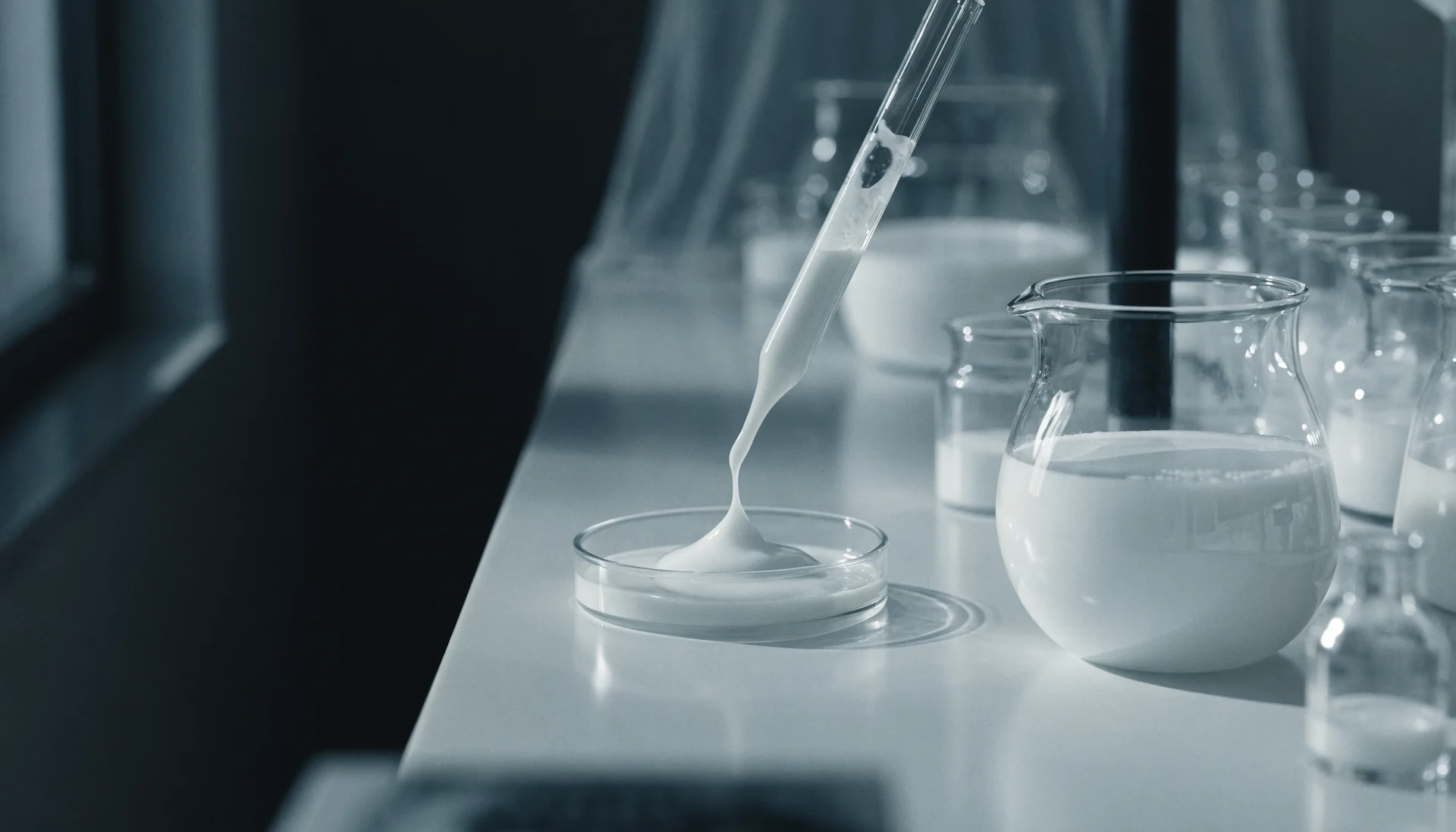
Solution Approach
RawSource supplies the base chemicals that go into these programs. We can help with product selection, grade matching, and sourcing from multiple origins for supply security.
Typical Formulation Workflow
1
Concept & Claim Definition
Define the product type, sensory and claim targets, and the regulatory and label framework (INCI, regional cosmetic regulations, certifications).
2
Ingredient Selection
Match emollients, emulsifiers, surfactants, actives, preservatives, or rheology modifiers to the formula, skin-feel, and compatibility window.
3
Bench Formulation
Build and stabilize the emulsion or system at the bench, checking pH, viscosity, preservative efficacy, and aesthetics.
4
Stability & Compliance Validation
Run stability and compatibility testing, confirm preservative efficacy, and finalize the INCI, CoA, and documentation.
Recommended Chemistries (6)
Propylene Glycol, USP/FCC Food Grade
CAS 57-55-6
Glycols & Polyols
Humectant, solvent, and preservative booster
Polar co-solvent that dissolves water-marginal actives and depresses water activity, aiding delivery and formula robustness
Melting Point: -60 °C Boiling Point: 188 °C at 760 mmHg Density: 1.04 at 20 °C
Quick view
Full Details
Butylene Glycol
CAS 107-88-0
Glycols & Polyols
Humectant and co-solvent for actives
Mild glycol carrier commonly used to disperse botanical extracts and stabilize actives in the water phase
Physical Description: Very hygroscopic liquid; Pure form is colorless Appearance: Pure compound is colorless Odor: Practically odorless
Quick view
Full Details
Polysorbate 80, FCC Food Grade
CAS 9005-65-6
Surfactants
Nonionic emulsifier for oils and lipophilic actives
Nonionic surfactant that micellizes oil-soluble actives (e.g., tocopherol, fragrance) into clear aqueous systems
Quick view
Full Details
D-a Tocopheryl Acetate
CAS 58-95-7
Specialty Additives
Antioxidant vitamin E derivative
The acetate ester caps the phenolic OH, so it is not antioxidant-active in the pack until cleaved by skin esterases; it is a hydrolytically stable vitamin-E carrier — the real in-formula antioxidant/chelant load here is carried by BHT and Disodium EDTA
Melting Point: 28 °C Boiling Point: 184 °C at 0.01 mmHg Density: 0.9507 at 26 °C
Quick view
Full Details
BHT (Butylated Hydroxytoluene), Food Grade
CAS 128-37-0
Specialty Additives
Lipid antioxidant for oil phase protection
Chain-breaking radical scavenger in the oil phase that suppresses peroxidation of retinoids and unsaturated oils, preserving potency
Melting Point: 69–71 °C Boiling Point: 265 °C at 760 mmHg Density: 1.048 at 20 °C
Quick view
Full Details
Disodium EDTA (Food Grade)
CAS 139-33-3
Specialty Additives
Metal chelant for formula stability and preservative efficacy
Removes trace transition metals that catalyze oxidative degradation of vitamins and retinoids over shelf life
Physical Description: White odorless solid; White odorless crystals Appearance: White crystalline powder Melting Point: MP: 242 °C /EDTA disodium dihydrate/
Quick view
Full Details
Related Product Families
● Available
Emulsifiers & Dispersants
Nonionic, anionic, cationic, and amphoteric surfactants for O/W, W/O, and multiple emulsion architectures. Includes pigment dispersants
EmulsificationWettingDetergencyFoam
12 chemistries
View family
● Available
Solvents & Carriers
Cosmetic-grade glycols, esters, and volatile solvents as carriers, solubilizers, and co-solvents for serums, sprays, and anhydrous systems
SolvencyCarrierHumectancy
9 chemistries
View family
● Available
Stabilizers & Processing Aids
Chelators, antioxidants, preservative boosters, pH buffers, and UV filters protecting formulation integrity through processing and shelf life
AntioxidantpH BufferPreservationUV
8 chemistries
View family
● Available
Humectants
Glycerin, glycols, polyols, and natural moisturizing factors that bind water to the skin and hair for lasting hydration and suppleness.
Moisture ControlHydrationConditioning
16 chemistries
View family
● Available
Chelators & pH Adjusters
Metal-ion chelators and pH-adjusting acids, bases, and buffers that prevent rancidity, stabilize color, and hold formulas at their target pH.
ChelationpH AdjustmentSequestration
11 chemistries
View family