
- ▸ Descaling and cleaning: Removes scale and rust in metal and equipment cleaning.
- ▸ Chlorine stabilizer: Stabilizes chlorine in pools, cooling towers, and paper mills.
- ▸ Electroplating: Acid component in plating and metal-finishing baths.
- ▸ Pulp and paper: Bleaching agent in pulp and paper processing.
- ▸ Analytical standard: Primary standard for alkalimetric titration.
A grade-specific Safety Data Sheet (SDS) — with the complete hazard classification, handling precautions, and transport information — is supplied with every shipment and available on request. Confirm all safety and regulatory details against the SDS for your specific grade.
Request SDS →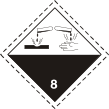
Transport classification per the UN Model Regulations / 49 CFR 172.101 Hazardous Materials Table. Confirm against the grade-specific SDS (Section 14) before shipping.
Sulfamic acid (sulphamic acid, amidosulfonic acid; NH2SO3H, CAS 5329-14-6) is a dry, non-volatile, moderately strong solid acid — a white, odorless crystalline powder that dissolves in water to a strongly acidic solution without the choking fumes of hydrochloric acid. That combination makes it the descaling and cleaning acid of choice for boilers, heat exchangers and cooling systems, and a sulfonating agent and intermediate in chemical synthesis. Identity: PubChem.
What is sulfamic acid?
Sulfamic acid is a solid mineral acid, NH2SO3H. Unlike liquid mineral acids it ships and meters as a stable, non-hygroscopic crystal, yet in solution it is a strong acid comparable to the first proton of sulfuric acid. It is non-volatile and essentially fume-free, descales without etching as aggressively as HCl on many metals, and forms water-soluble salts (sulfamates) with scale-forming metals — the reasons it dominates closed-system descaling.
Applications by sector
Industrial & institutional cleaning. Descaling of boilers, heat exchangers, condensers, cooling towers and CIP circuits; removal of limescale, rust, beerstone, milkstone and cement/grout haze; a common active in acidic cleaners and toilet/hard-surface descalers. Metal finishing. Pickling and surface preparation where a controllable, low-fume acid is preferred. Sulfonation & synthesis. A sulfonating/amidosulfonating reagent and intermediate for sulfamates, dyes, sweeteners (cyclamates) and herbicides (ammonium sulfamate). Pulp, paper & textile. Chlorine/anti-chlor control and bleaching. Water treatment. Chloramine and scale control. Match grade and concentration to the duty.
Forms and grades
Sulfamic acid is supplied as a white crystalline powder or granule, in technical and higher-purity grades. Specify assay, particle size and any purity requirement on the RFQ; the CoA documents the lot.
Handling and documentation
Sulfamic acid is an acidic irritant — harmful to skin and eyes in solution. Do not mix it with chlorine bleach, hypochlorite or nitrites, which can release hazardous gases. Handle per the current Safety Data Sheet (SDS); each lot ships with a Certificate of Analysis (CoA).
Bulk supply and RFQ
RawSource stocks and supplies sulfamic acid in bulk — bags, super sacks and bulk — from domestic US stock to cleaning, water-treatment, metal-finishing and chemical-synthesis buyers, with CoA and SDS per lot. Submit an RFQ with your grade and target quantity for a current quote. Related metal-treatment and descaling chemistries: hydrofluoric acid, ammonium bifluoride, phosphoric acid, oxalic acid, sulfamic acid.
Typical Properties
Typical reference values, not a specification; the Certificate of Analysis (CoA) for the lot governs.
| Property | Typical Value |
|---|---|
| Chemical Name | Sulfamic acid (sulphamic acid, amidosulfonic acid) |
| CAS Number | 5329-14-6 |
| Molecular Formula | NH2SO3H (H3NO3S) |
| Molecular Weight | ~97.1 g/mol |
| Appearance | White, odorless crystalline powder/granule |
| Solubility | Soluble in water (strongly acidic, non-fuming) |
| Character | Dry, non-volatile, moderately strong solid acid |
| Incompatibilities / handling | Do not mix with chlorine/hypochlorite/nitrites; refer to the current SDS |
Regulatory & registration requirements
- TSCA (US):
- REACH (EU):
- EC number: 226-218-8
Source: EPA TSCA Inventory (July 2025 release) · ECHA CHEM — retrieved 2026-07-12
Solutions Using This Product
Process-solution guides on this site that specify this chemistry:
- Acid Descaling & Pickling Chemicals (Industrial Manufacturing)
- Rust & Oxidation Stain Remover (Metal & Concrete) (Home & Industrial Care)
- Acid Descalers for Limescale & Mineral Deposits (Home & Industrial Care)
Frequently Asked Questions
What is sulfamic acid used for?
Sulfamic acid (CAS 5329-14-6) is used as a descaling and cleaning acid for boilers, heat exchangers, cooling towers and CIP systems (limescale, rust, beerstone, cement haze), as a metal-pickling acid, and as a sulfonating agent and intermediate for sulfamates, dyes, sweeteners and herbicides.
Why use sulfamic acid instead of hydrochloric acid for descaling?
Sulfamic acid is a solid, so it ships and meters more conveniently and is essentially fume-free, and it is less aggressive toward many metals than HCl while still dissolving scale effectively. It is the common choice for closed cooling and boiler systems. It is still an acid — handle per the SDS.
Is sulfamic acid safe to handle?
It is an acidic irritant that is harmful to skin and eyes in solution, and it must never be mixed with chlorine bleach, hypochlorite or nitrites (which can release hazardous gases). Handle it with appropriate PPE per the current SDS; “lower-fuming than HCl” does not mean hazard-free.
What is the formula and CAS of sulfamic acid?
Sulfamic acid is NH2SO3H (H3NO3S), CAS 5329-14-6 (PubChem CID 5987), ~97.1 g/mol. The CoA documents assay and grade.
How is bulk sulfamic acid supplied and quoted?
RawSource supplies it as a crystalline powder/granule in bags, super sacks and bulk from domestic US stock, with CoA and SDS per lot. Pricing is quote-based on grade and volume; submit an RFQ with your target quantity and ship-to.
What is the REACH and TSCA regulatory status of Sulfamic Acid (Sulphamic Acid, Amidosulfonic Acid)?
Sulfamic Acid (Sulphamic Acid, Amidosulfonic Acid) (CAS 5329-14-6) is subject to U.S. TSCA Inventory requirements; supplying it into the EU requires valid REACH registration ((EC) No 1907/2006). RawSource cannot verify a third-party supplier's registrations — buyers should require documented TSCA and REACH compliance for their jurisdiction and volume (EC 226-218-8).