
OXALIC ACID- ▸ Metal cleaning: rust, scale and stain removal from metal surfaces
- ▸ Textile processing: stripping, finishing and bleaching of textiles
- ▸ Bleaching: bleaching of leather, straw and wood
- ▸ Chemical manufacture: feedstock for oxalate salts and dyes
- ▸ Rare-earth processing: precipitation and processing reagent in metal refining
A grade-specific Safety Data Sheet (SDS) — with the complete hazard classification, handling precautions, and transport information — is supplied with every shipment and available on request. Confirm all safety and regulatory details against the SDS for your specific grade.
Request SDS →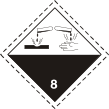
Transport classification per the UN Model Regulations / 49 CFR 172.101 Hazardous Materials Table. Confirm against the grade-specific SDS (Section 14) before shipping.
Oxalic acid (ethanedioic acid; C2H2O4, CAS 144-62-7; usually supplied as the dihydrate, CAS 6153-56-6) is the simplest dicarboxylic acid and one of the strongest organic acids. It is a white crystalline solid that acts as a reducing agent, a metal chelator and a bleaching/cleaning acid. Those properties make it a workhorse for rust and stain removal, wood bleaching, metal finishing and anodizing, and minerals and rare-earth processing. Identity: PubChem.
What is oxalic acid?
Oxalic acid is HOOC–COOH, two carboxyl groups back-to-back. That structure makes it a comparatively strong organic acid, an effective reducing agent, and a chelator that binds iron and calcium — which is why it both dissolves rust/iron stains and precipitates metals. It is normally handled as the crystalline dihydrate; an anhydrous grade is also available. It is a toxic material and is treated accordingly.
Applications by sector
Cleaning & restoration. Rust, iron-stain and tannin removal; wood bleaching and deck brightening; marble, stone and masonry cleaning; radiator and equipment cleaning. Metal finishing. The electrolyte in oxalic-acid anodizing, plus pickling, electropolishing and metal cleaning. Minerals & rare earths. Leaching and the precipitation of rare-earth and other metal oxalates in extraction and refining. Textile & leather. Bleaching and as a mordant/redox agent. Synthesis. A reducing agent and chemical intermediate. Match grade and concentration to the duty.
Forms and grades
Oxalic acid is supplied as the crystalline dihydrate (the common commercial form) and as an anhydrous grade, in technical and higher-purity grades. Specify form, assay and particle size on the RFQ; the CoA documents the lot.
Handling and documentation
Oxalic acid is toxic and corrosive — harmful or fatal if swallowed and an irritant/corrosive to skin and eyes. Handle with appropriate PPE per the current Safety Data Sheet (SDS); each lot ships with a Certificate of Analysis (CoA). Hazard and exposure data come from the SDS.
Bulk supply and RFQ
RawSource stocks and supplies oxalic acid in bulk — bags, super sacks and bulk — from domestic US stock to cleaning/restoration, metal-finishing, minerals and textile buyers, with CoA and SDS per lot. Submit an RFQ with your form (dihydrate/anhydrous), grade and target quantity. Related metal-treatment and descaling chemistries: hydrofluoric acid, ammonium bifluoride, phosphoric acid, oxalic acid, sulfamic acid.
Typical Properties
Typical reference values, not a specification; the Certificate of Analysis (CoA) for the lot governs.
| Property | Typical Value |
|---|---|
| Chemical Name | Oxalic acid (ethanedioic acid) |
| CAS Number | 144-62-7 (anhydrous); 6153-56-6 (dihydrate) |
| Molecular Formula | C2H2O4 (anhydrous) |
| Molecular Weight | ~90.0 g/mol (anhydrous) |
| Appearance | White crystalline solid (commonly the dihydrate) |
| Solubility | Soluble in water |
| Character | Strong dicarboxylic organic acid; reducing agent and metal chelator |
| Hazard / handling | Toxic and corrosive — refer to the current SDS |
Regulatory & registration requirements
- TSCA (US):
- REACH (EU):
- EC number: 205-634-3
Source: EPA TSCA Inventory (July 2025 release) · ECHA CHEM — retrieved 2026-07-12
Frequently Asked Questions
What is oxalic acid used for?
Oxalic acid (CAS 144-62-7) is used for rust and iron-stain removal, wood bleaching and stone/masonry cleaning, as the electrolyte in oxalic-acid anodizing and in metal finishing, and in minerals and rare-earth processing as a leaching and oxalate-precipitation agent.
Is oxalic acid the dihydrate or anhydrous?
Both grades exist; the crystalline dihydrate (CAS 6153-56-6) is the common commercial form, and an anhydrous grade (CAS 144-62-7) is also available. Specify which you need, since the water of crystallization affects dosing.
Is oxalic acid dangerous?
Yes. Oxalic acid is toxic and corrosive — harmful or fatal if swallowed and an irritant/corrosive to skin and eyes. Handle it with appropriate PPE per the current SDS.
What is the formula and CAS of oxalic acid?
Oxalic acid is C2H2O4, CAS 144-62-7 anhydrous (PubChem CID 971) or 6153-56-6 as the dihydrate, ~90.0 g/mol anhydrous. The CoA documents form, assay and grade.
How is bulk oxalic acid supplied and quoted?
RawSource supplies it as dihydrate or anhydrous crystal in bags, super sacks and bulk from domestic US stock, with CoA and SDS per lot. Pricing is quote-based on form, grade and volume; submit an RFQ with your target quantity.
What is the REACH and TSCA regulatory status of Oxalic Acid (Ethanedioic Acid)?
Oxalic Acid (Ethanedioic Acid) (CAS 144-62-7) is subject to U.S. TSCA Inventory requirements; supplying it into the EU requires valid REACH registration ((EC) No 1907/2006). RawSource cannot verify a third-party supplier's registrations — buyers should require documented TSCA and REACH compliance for their jurisdiction and volume (EC 205-634-3).