
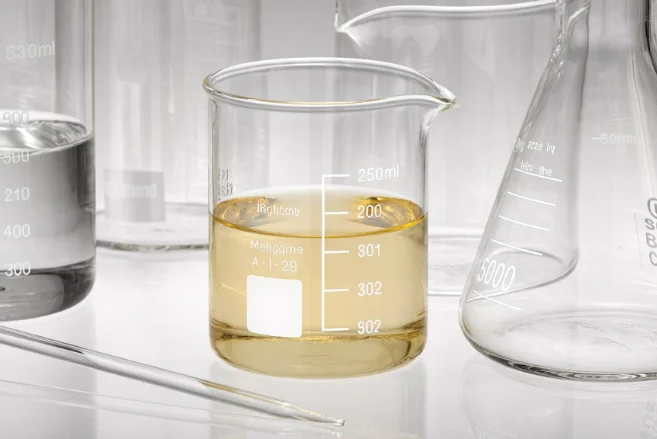
Propylene glycol (PG, CAS 57-55-6) and ethylene glycol (EG, CAS 107-21-1) are both glycols, antifreeze diols that lower the freezing point of water, but they are not interchangeable. The defining difference is toxicity: propylene glycol has markedly lower acute mammalian toxicity, is GRAS-affirmed by the FDA, and is used in food, cosmetics, and pharmaceuticals, while ethylene glycol is toxic if ingested and is used mainly in industrial antifreeze, automotive coolant, and as a feedstock for PET plastic. If a person, animal, or food contact is anywhere near the system, formulators reach for PG; if it is a sealed industrial loop and cost matters, EG usually wins.
Reviewed and updated July 2026 by the RawSource technical team.
The two share a family resemblance and a job description, which is exactly why buyers confuse them on a spec sheet. Both are clear, water-soluble diols sold by the drum, tote, and tanker for heat-transfer and humectant duty. Below is the head-to-head, followed by the chemistry that actually drives the toxicity gap and a buyer’s view of when each one is the right call.
Propylene Glycol vs Ethylene Glycol: Comparison Table
| Property | Propylene Glycol (PG) | Ethylene Glycol (EG) |
|---|---|---|
| Chemical formula | C3H8O2 | C2H6O2 |
| Molar mass | 76.09 g/mol | 62.07 g/mol |
| CAS number | 57-55-6 | 107-21-1 |
| Acute mammalian toxicity | Much lower; oral LD50 (rat) ~20 g/kg | Toxic if ingested; oral LD50 (rat) ~4.7 g/kg, lethal human dose ~1.4 mL/kg |
| Taste | Faintly sweet, slightly bitter | Distinctly sweet (an ingestion hazard for pets and children) |
| Typical uses | Food humectant, pharma/cosmetic solvent, e-liquid, non-toxic-rated antifreeze, deicing fluid, HVAC heat-transfer | Automotive/industrial antifreeze & coolant, PET resin and polyester feedstock, aircraft deicing, industrial heat-transfer |
| Antifreeze use | Yes — preferred where leaks may reach people, food, or animals | Yes — the dominant automotive/industrial antifreeze; better freeze depression per unit cost |
| Food / pharma allowed | Yes — FDA GRAS; permitted in food, drugs, cosmetics | No — not permitted in food, drug, or cosmetic contact |
| Relative cost | Higher, especially USP/food grade | Lower; high-volume industrial commodity |
Why the Toxicity Differs: It Is the Metabolite, Not the Molecule
Both glycols are oxidized in the liver by the same enzyme, alcohol dehydrogenase. The fork in the road is what they become. Ethylene glycol is broken down through glycolaldehyde and glycolic acid into oxalic acid. Oxalate binds calcium and crystallizes as calcium oxalate in the kidneys, which is what makes EG nephrotoxic. This is the documented human path to acute kidney injury after ingestion. The classic antidote, fomepizole, works precisely by blocking that first enzyme so the toxic metabolites never form.
Propylene glycol runs a different route. The extra methyl group on its three-carbon backbone (C3H8O2 versus EG’s C2H6O2) sends it toward lactic acid and pyruvate, ordinary intermediates of human metabolism that the body clears routinely. That is the chemical basis for PG’s GRAS status and its much lower acute toxicity. It is not a license to call PG harmless: large intravenous doses can cause lactic acidosis, and it remains a skin and eye irritant that warrants normal handling. The honest framing is comparative. PG is far less acutely toxic than EG, not “non-toxic” in an absolute sense.
Where Each Glycol Is Used, and Why
Propylene Glycol
PG’s low-toxicity profile is its whole commercial argument. As a humectant it holds moisture in baked goods, pet food, and tobacco; as a solvent it carries flavors, colors, and active pharmaceutical ingredients in syrups and topicals; and it is the standard base for e-liquid. On the industrial side it is the antifreeze and heat-transfer fluid of choice wherever a leak could reach people, food, or animals: breweries, dairies, food-processing chillers, ice rinks, and potable-water-adjacent HVAC loops. The trade-off a buyer accepts: PG depresses the freezing point less efficiently than EG and is more viscous cold, so a PG loop needs a higher glycol percentage and more pumping energy to hit the same protection.
Ethylene Glycol
EG dominates two large arenas. First, antifreeze and coolant: it gives stronger freeze-point depression and better heat transfer per dollar than PG, which is why it fills most automotive radiators and industrial cooling systems running in sealed loops with minimal human contact. Second, and often overlooked, more than half of global EG output never sees a radiator at all. It is a feedstock for polyethylene terephthalate (PET), the polyester in plastic bottles and textile fibers. EG’s lower cost and higher performance are real advantages; the offsetting reality is that its toxicity demands careful handling, clear labeling, and disciplined disposal, since the sweet taste is an active ingestion hazard for pets and children.
Environmental and Handling Differences
One persistent myth is worth retiring: ethylene glycol is not “non-biodegradable.” Both glycols are readily biodegradable under standard test conditions, and both exert an oxygen demand on receiving water as microbes break them down. The real environmental distinction is acute toxicity, not persistence. An EG spill is the bigger hazard to wildlife and pets that may drink it, and to the dissolved oxygen of a small waterway, which is why EG carries stricter spill-response and disposal expectations than PG.
That difference shows up in day-to-day handling. PG’s low-toxicity profile keeps personal-protective and exposure-control requirements modest, which is part of why it is specified for food-plant and occupied-space duty in the first place. EG handling leans harder on closed transfer, secondary containment, spill kits, and disposal through a licensed waste stream rather than a drain. Neither is a substitute for reading the current SDS for the grade you actually receive, since handling, storage, and disposal requirements are set there, not by a comparison article.
How a Buyer Chooses Between PG and EG
The decision usually comes down to a single question: can a leak or residue reach a person, an animal, or food? If yes, propylene glycol is effectively the only defensible choice regardless of the cost premium. Food-and-beverage chillers, ice rinks, RV plumbing, and any potable-system deicing run on PG for exactly this reason. If the answer is no, and it is a sealed automotive or industrial coolant loop where efficiency and price dominate, ethylene glycol is the established workhorse.
Grade matters as much as identity. PG ships as USP/food grade for ingestible and skin-contact use and as industrial grade for heat-transfer duty, and the two carry different price points and documentation. Specify the grade up front. And do not mix the two glycols in one system: differing freeze curves, inhibitor packages, and disposal rules make a blended loop hard to maintain and hard to recycle. Pick one, size the concentration to your lowest expected temperature, and keep the system single-chemistry.
Sourcing Propylene Glycol in Bulk
See the Propylene Glycol product page. If you are spec’ing a low-toxicity antifreeze or heat-transfer fluid and weighing grade, volume, and lead time, our guide to chemical procurement walks through how to compare suppliers and lock down a reliable bulk supply. Send us the grade and volume you need and we will quote it.
Frequently Asked Questions
How to tell if glycol is ethylene or propylene?
Start with the documentation. The certificate of analysis (CoA) and safety data sheet (SDS) name the substance and its CAS number, so a labeled lot is unambiguous: propylene glycol is CAS 57-55-6, ethylene glycol is CAS 107-21-1. For an unlabeled sample, a glycol refractometer with separate ethylene and propylene scales, or a bench density check, narrows it quickly, and gas chromatography confirms identity in a QC lab. Appearance and odor will not: both are clear, near-odorless diols.
Which is better, propylene glycol or ethylene glycol?
Neither is better in the abstract; the application sets the choice. Ethylene glycol gives stronger freeze-point depression and better heat transfer per dollar, so it stays the default in sealed automotive and industrial loops with minimal human contact. Propylene glycol wins wherever a leak could reach people, food, or animals, which is why food-plant chillers, ice rinks, and occupied-space HVAC specify it.
The trade-off is measurable: an inhibited-PG fluid needs about 52 vol% to protect a loop to -30°F (-34°C), which raises both glycol cost and pumping energy. Decide contact risk first, then price the concentration and grade you need.
Is propylene glycol banned in Europe?
No. Propylene glycol is authorised in the European Union as food additive E 1520, and EFSA’s 2018 re-evaluation sustained its acceptable daily intake of 25 mg/kg body weight per day. In the United States it is listed as a direct food substance affirmed as generally recognized as safe under 21 CFR 184.1666.
The “banned in Europe” claim usually confuses propylene glycol with ethylene glycol, or reads a single use-category limit as a blanket ban. For a bulk buyer, PG remains a permitted food, pharmaceutical, and industrial chemical on both sides of the Atlantic; confirm the use category and purity grade against the applicable specification.
Is propylene glycol basically antifreeze?
It is one antifreeze, not the only one. Propylene glycol is a diol that lowers the freezing point of water, so it works as antifreeze and as a heat-transfer fluid, and it is the chemistry specified where low toxicity matters: breweries, dairies, ice rinks, and HVAC loops near people.
That framing understates its range, though. The same low-toxicity profile makes PG a humectant and solvent in food, pharmaceuticals, and cosmetics. Ethylene glycol is the higher-performance antifreeze for sealed automotive and industrial loops. Both perform the antifreeze job; they are matched to different systems by toxicity and cost, not treated as interchangeable.
What is the difference between propylene glycol and ethylene glycol?
Both are glycols (antifreeze diols), but propylene glycol (PG, C3H8O2) has markedly lower acute mammalian toxicity and is FDA GRAS for food, drugs, and cosmetics, while ethylene glycol (EG, C2H6O2) is toxic if ingested and is used mainly in industrial antifreeze, coolant, and PET plastic production. PG is chosen where leaks may reach people or food; EG where a sealed loop and lower cost matter.
Which is safer, propylene glycol or ethylene glycol?
Propylene glycol has much lower acute toxicity and is the safer choice for any application near people, animals, or food, and it is GRAS-affirmed and used in food and pharmaceuticals. Ethylene glycol is toxic if ingested and requires careful handling, labeling, and disposal. PG is not “non-toxic” in an absolute sense (it is a skin and eye irritant), but on acute mammalian toxicity it is far less hazardous than EG.
Can propylene glycol replace ethylene glycol in antifreeze?
Yes, and it routinely does where toxicity is the priority. Food-plant chillers, ice rinks, RV and potable-water systems, and HVAC loops near people use PG-based antifreeze. The trade-off is performance: PG depresses the freezing point less efficiently and is more viscous when cold, so a PG system needs a higher glycol concentration and more pumping energy to reach the same freeze protection as EG.
Are propylene glycol and ethylene glycol interchangeable?
Not freely. They serve the same antifreeze and heat-transfer roles but differ in toxicity, freeze curves, viscosity, and approved uses, so they are not drop-in substitutes for one another. Mixing the two in a single system is not recommended: blended freeze behavior, incompatible inhibitor packages, and combined disposal rules make the loop hard to maintain and recycle. Choose one chemistry per system.
Is propylene glycol the “safe” antifreeze?
PG-based antifreeze is the lower-toxicity option and is the standard where leaks could contact people, animals, or food, which is why it is often called the safer antifreeze. That is a comparative claim, not an absolute one. PG still requires normal industrial handling and should not be treated as harmless. It is much less acutely toxic than ethylene glycol, which is the relevant distinction for most applications.
What are the chemical formulas of propylene glycol and ethylene glycol?
Propylene glycol is C3H8O2 (CAS 57-55-6), with a three-carbon backbone and a molar mass of about 76.09 g/mol. Ethylene glycol is C2H6O2 (CAS 107-21-1), with a two-carbon backbone and a molar mass of about 62.07 g/mol. The extra carbon and methyl group on PG are what route its metabolism toward harmless lactic acid rather than EG’s nephrotoxic oxalic acid.
Which glycol is used in food?
Propylene glycol is the food-permitted glycol. It is FDA GRAS and appears in food as a humectant, an anti-caking and dough-conditioning agent, and a carrier for flavors and colors, and it is also used in pharmaceuticals and cosmetics. Ethylene glycol is not permitted in food, drug, or cosmetic contact because of its toxicity, and should never be substituted into any application involving ingestion.
Search 1,300+ industrial chemicals by name or CAS, or send us your spec — we quote by the drum, tote, or container.
Browse the Chemical Index → Request a Quote