
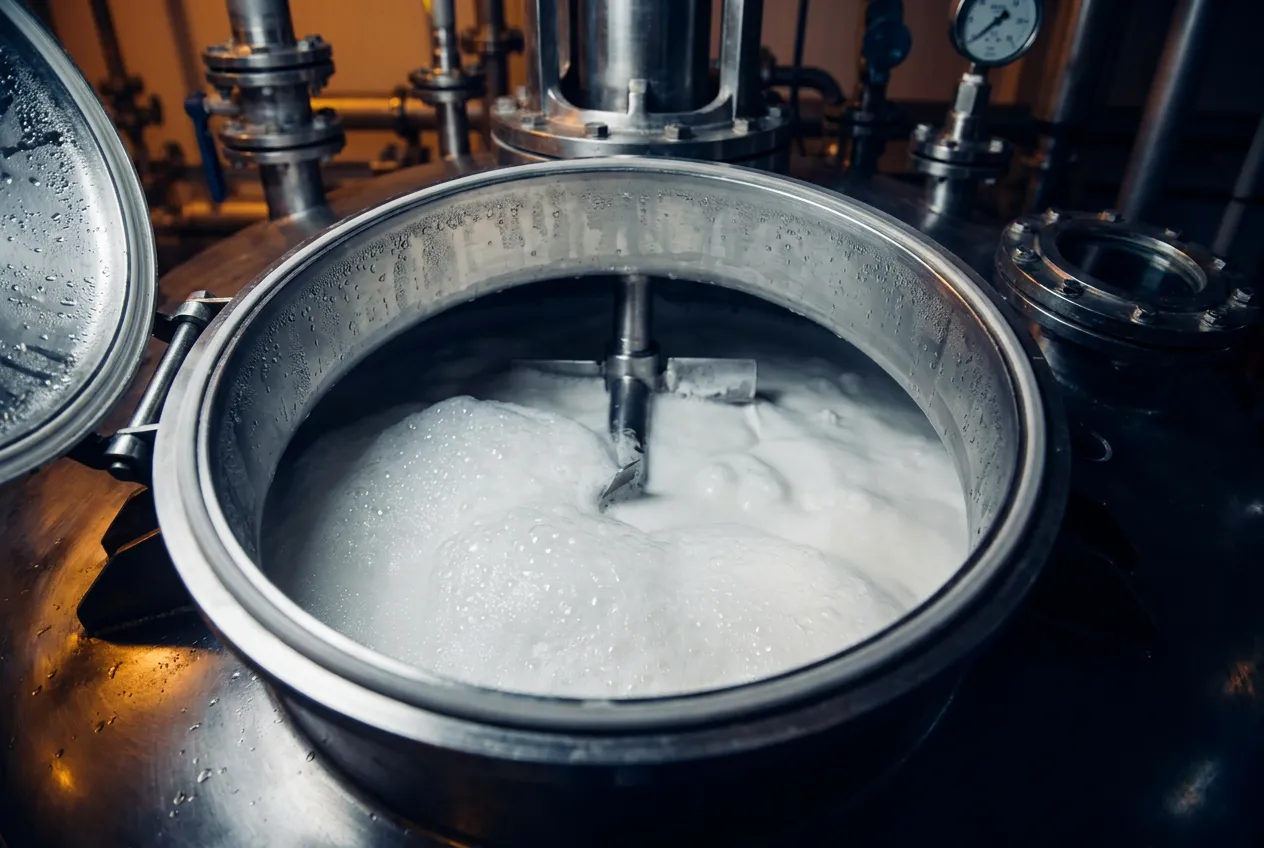
A latex batch hits the exotherm, the agitator and the monomer feed do their work, and the reactor starts climbing with foam. Left alone it steals headspace, threatens carryover into the condenser, and seeds the coagulum and grit that turn a clean batch into a filtration and quality problem. The reactor is built to make a surfactant-stabilized emulsion, so of course it foams.
The short version: emulsion polymerization is surfactant-rich by design, so SBR, VAE, acrylic, and PVA reactors foam readily under agitation, monomer feed, and steam stripping. A defoamer is standard, but it has to control the foam without destabilizing the latex or seeding coagulum. A compatible silicone-polyether is the usual answer: strong knockdown at low dose, and tunable so it breaks foam without shocking the emulsion.
Why emulsion-polymer reactors foam
The recipe itself is the cause. Emulsion polymerization runs on surfactants that stabilize the monomer droplets and the growing latex particles, and those same surfactants stabilize foam. Add the mechanical energy of the agitator, the gas-liquid surface from sparging and steam stripping of residual monomer, and the turbulence of monomer and initiator feeds, and the system foams readily through the batch.
What the foam costs you
| Problem | What it does |
|---|---|
| Lost reactor capacity | foam occupies headspace, so you under-charge to leave room |
| Carryover and fouling | foam carries into the condenser and overhead, fouling surfaces |
| Coagulum and grit | destabilized foam films seed coagulum that shows up as grit and filter load |
| Off-spec product | grit, poor film, and lost solids push the batch out of spec |
Why silicone-polyether is the right control
A bare, strongly incompatible silicone can knock the foam down but risks shocking a surfactant-stabilized latex and seeding coagulum. A weak organic defoamer is gentle on the emulsion but often cannot keep up with a vigorous reactor. A silicone-polyether sits in the right place between them: the PDMS-and-silica backbone delivers strong knockdown at low dose, while the polyether modification tunes the compatibility so it ruptures foam without destabilizing the latex. That balance, sometimes called controlled incompatibility, is why a silicone-polyether is the standard reactor defoamer for emulsion polymers.
Dosing and compatibility
Dose at the low end and work up only until the foam is controlled, and add it where it does the most good, in the initial charge, metered during the monomer feed, or at the strip, depending on where the foam peaks.
The non-negotiable step is a compatibility check in your own recipe: confirm the grade and dose do not raise coagulum or grit, cloud the latex, or leave film defects downstream. A defoamer that controls foam but adds grit is not a win, so qualify it on your formulation before you scale it.
Buying for latex and emulsion-polymer production
Emulsion-polymer producers buy defoamer by the tote and drum and run it on every batch, so the wrong grade multiplies across a lot of product.
The applied-film side, pinholes and fisheyes, is covered in defoamer vs deaerator and paint fisheyes. Qualify a sample in your own recipe before you commit.
Frequently asked questions
Why does emulsion polymerization foam?
The recipe is surfactant-rich by design, and those surfactants stabilize foam as readily as they stabilize the emulsion. Agitation, sparging, steam stripping, and monomer feeds add the gas and turbulence, so the reactor foams through the batch.
Will a defoamer cause coagulum or grit?
It can, if the grade is too incompatible for the latex or over-dosed. That is why a silicone-polyether, tuned for compatibility, is preferred, and why you qualify the grade and dose in your own recipe and check coagulum, grit, and film before scaling.
Silicone or silicone-free for latex reactors?
A silicone-polyether is the common choice because it combines strong knockdown with the tunable compatibility a surfactant-stabilized latex needs. Confirm the specific grade against your recipe and your downstream film requirements.
Where do I add the defoamer?
Where the foam peaks, which varies by process, the initial charge, metered during the monomer feed, or at the steam strip. Many producers split the dose across more than one point.
How much do I use?
Start at the low end of the supplier’s range and work up only until foam is controlled. Over-dosing raises the risk of coagulum and film defects without improving foam control.
See the Silicone Antifoam Emulsion (10-50% active) product page.
Editorial note. This article is general guidance for latex and emulsion-polymer producers, written for industrial and professional use. Grade and dose are recipe-specific and must be qualified in your own formulation; figures are typical literature ranges to validate by trial, not guarantees. Confirm suitability and consult the product Safety Data Sheet (SDS) before use. RawSource makes no warranty, express or implied, and assumes no liability for use of this information.
Search 1,300+ industrial chemicals by name or CAS, or send us your spec — we quote by the drum, tote, or container.
Browse the Chemical Index → Request a Quote