
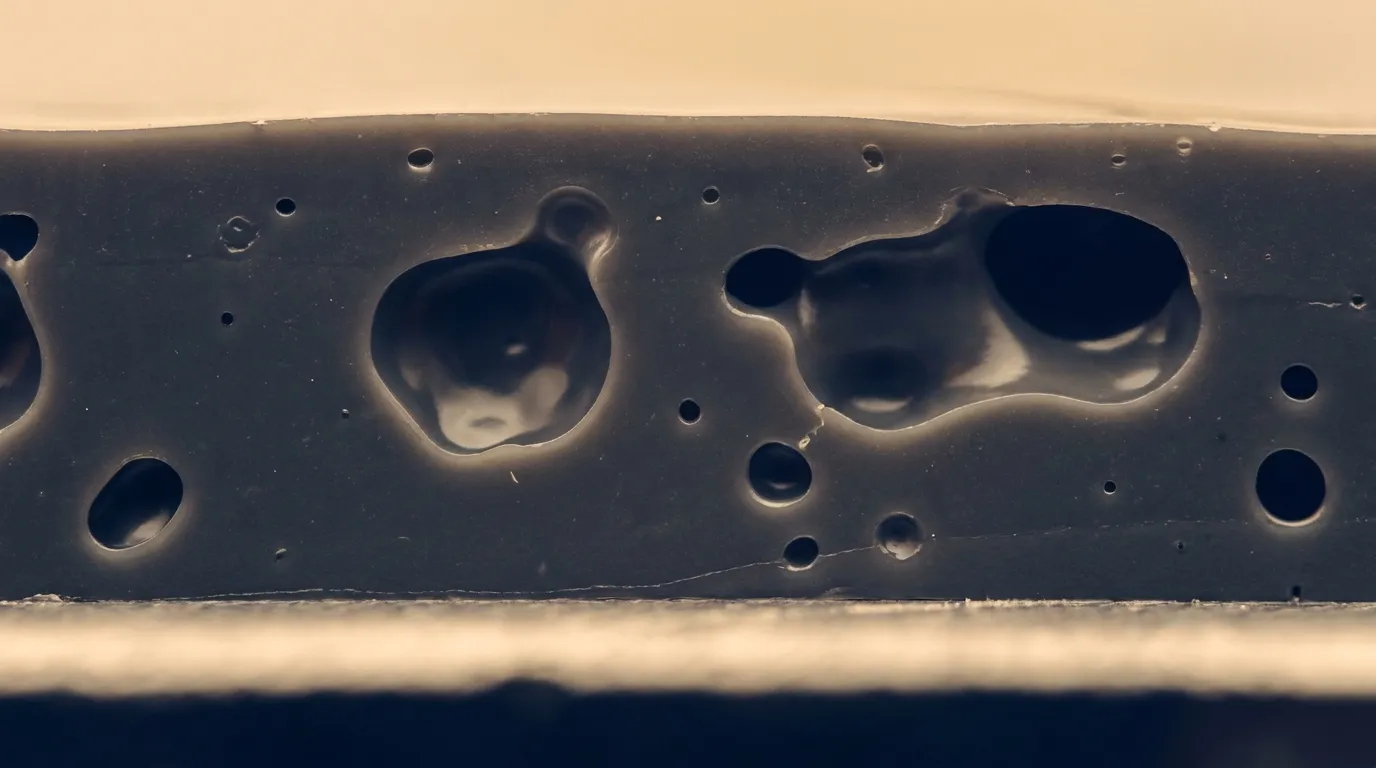
A waterborne coating runs clean in the lab, then on the airless line it dries with a field of pinholes and popping, and the obvious move makes it worse: drop in more defoamer and the craters get deeper, not shallower. The same thing happens to a UV coating on a roll coater and to an adhesive on a high-speed laminator.
The short version: surface macrofoam and occluded microfoam are two different problems, and they need two different additives. A defoamer breaks the bubbles that reach the surface. A deaerator drives the tiny entrained bubbles up and out of the wet film before it sets. High-speed application creates microfoam faster than a defoamer can clear it, and over-dosing a strong defoamer leaves its own craters. Match the additive to where the air is.
Macrofoam, microfoam, and entrained air
| Defect | What it is | The additive that fixes it |
|---|---|---|
| Macrofoam | large bubbles at the surface on mixing, pour, or roll | a defoamer, which ruptures the surface film |
| Microfoam / occluded air | 10 to 100 micron bubbles trapped in the wet film | a deaerator, which releases them up and out |
| Pinholes and popping | microfoam that could not escape before the film set | usually a deaeration problem, not more defoamer |
| Craters | a low-surface-energy defect, often an over-dosed or wrong defoamer | less or different defoamer; see fisheye |
Defoamer or deaerator?
A defoamer is built to destabilize and burst bubbles at the surface. A deaerator, often an organo-modified-siloxane or polyether type carried on fumed silica, is built to coalesce and lift the fine air entrained down in the film so it can leave before cure. The faster the application, the more the deaerator matters.
Airless and HVLP spray, curtain and roll coating, and 100-percent-solids UV systems pull air into the film faster than a defoamer alone can clear, and in a UV film the fast cure freezes whatever air is still trapped.
Often you need both: a defoamer to knock down surface foam in the can and on the line, and a deaerator to clear the microfoam that causes the pinholes. They are complementary, not interchangeable.
The over-dose trap
The instinct when a film pinholes is to add more of the strongest defoamer on the shelf. With entrained air that backfires. Excess PDMS or any incompatible defoamer migrates to the surface and craters the film, trading a microfoam problem for a fisheye and recoat problem. If a stronger defoamer makes the surface worse, the air was occluded, and the answer is a deaerator and lower defoamer dose, not more knockdown.
Pick by resin and application
The right grade depends on the binder and the line. A silicone-polyether gives tunable knockdown that recoats; a silicone-free polymeric or mineral-oil grade protects gloss and recoat in multi-coat systems; a dedicated deaerator handles the occluded-air pinholes. The honest rule is that the strongest defoamer for one binder is the defect-maker in another, so you screen on your own resin and at your own line speed, not from a generic chart. Hydrophobic silica is part of what makes these additives work, and part of why dose discipline matters.
Buying and sampling
The only reliable way to choose is to run the candidates in your formula at your line speed and check both foam knockdown and the side effects on gloss, clarity, and recoat. The surface-defect side of this, fisheyes and cratering from compatibility, is covered in why paint gets fisheyes, and the chemistry trade-offs in silicone vs. organic defoamers.
Frequently asked questions
What is the difference between a defoamer and a deaerator?
A defoamer ruptures bubbles at the surface; a deaerator releases the fine air entrained inside the wet film so it can escape before the film sets. Surface foam needs a defoamer; pinholes and popping from occluded air usually need a deaerator.
Why does my coating have pinholes and popping?
Fine air entrained during high-speed application, microfoam, that could not rise out of the film before it dried or cured. It is most common on airless or HVLP spray, roll and curtain coating, and fast-curing UV systems.
Will more defoamer fix entrained-air pinholes?
Usually not, and it often makes craters worse. Over-dosing a strong defoamer migrates to the surface and craters the film. For occluded air, switch to a deaerator and lower the defoamer dose.
What is the difference between macrofoam and microfoam?
Macrofoam is the large surface bubbles most defoamers break easily. Microfoam is 10 to 100 micron bubbles trapped in the film that dry in as pinholes and craters, and it is the harder problem that drives deaerator selection.
How do I choose between grades?
Screen candidates in your actual formula at your real line speed, and judge both foam control and the side effects on gloss, clarity, and recoat. A grade that clears foam in the can can still craters the film on the line.
Editorial note. This article is general guidance for coatings, ink, and adhesive formulators, written for industrial and professional use. Additive selection, dose, and side effects are formulation- and line-specific; figures are typical literature ranges to validate by trial, not guarantees. Confirm suitability and consult the product Safety Data Sheet (SDS) before use. Competitor product types are described generically. RawSource makes no warranty, express or implied, and assumes no liability for use of this information.
Search 1,300+ industrial chemicals by name or CAS, or send us your spec — we quote by the drum, tote, or container.
Browse the Chemical Index → Request a Quote