
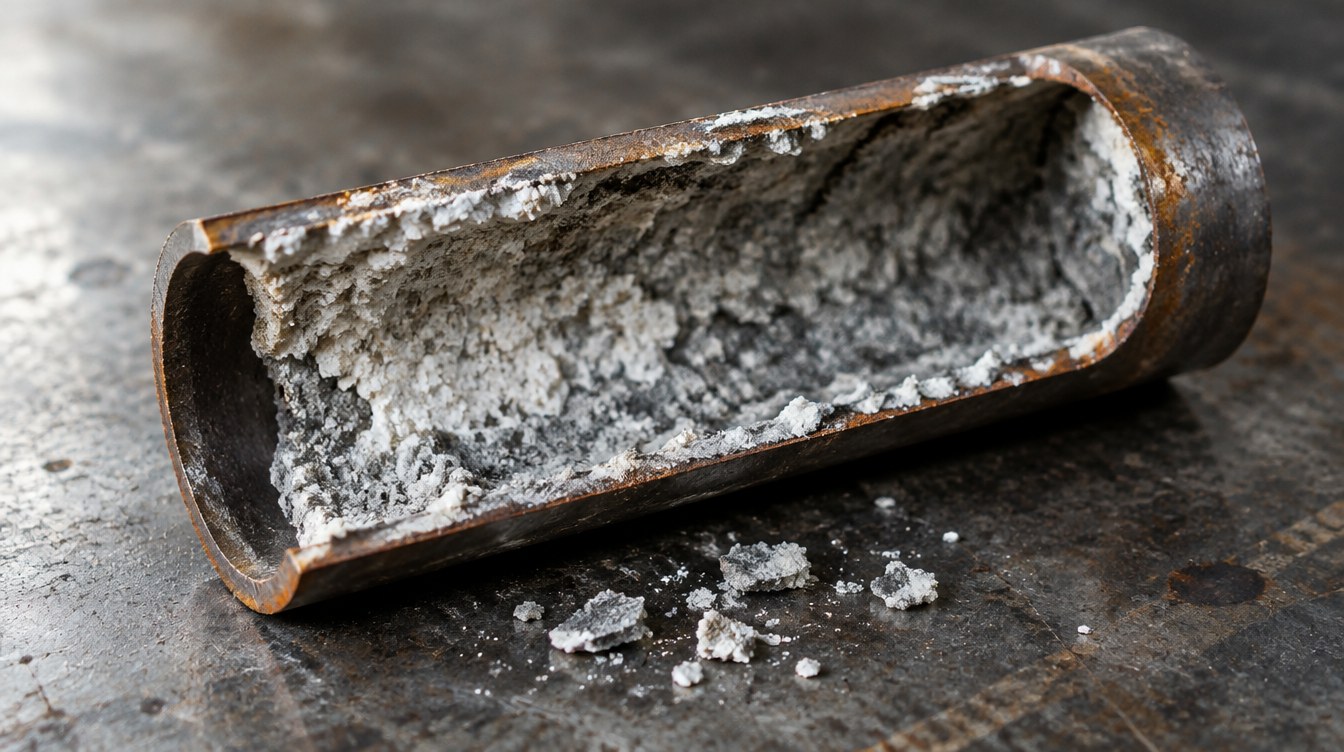
Can you stay on sodium sulfite if feedwater supplies your attemperation sprays?
Usually not, and drum pressure is not what decides it. Sodium sulfite is a non-volatile salt, and a desuperheater that takes spray water from the deaerated feedwater header injects that salt straight into the steam leaving the superheater. If you replace sulfite, the most common volatile alternative is carbohydrazide (CAS 497-18-7, 1,3-diaminourea). It is registered under REACH for boiler treatment (EC 207-837-2). Feed it to the deaerator storage section below the water line, not the drum.
The drum reads 600 psig. The spray line is the question.
The usual check runs like this. The engineer reads the drum gauge, sees 600 psig and treats sulfite as settled. Pressure alone does not settle it. Trace where the attemperation spray takes off. If the takeoff is downstream of the boiler feed pump on the same header as the economizer supply, the spray water carries whatever you dosed into the deaerator.
The concern that ASME and EPRI steam-purity guidance addresses is sulfite and its decomposition products (sulfur dioxide and hydrogen sulfide) reaching superheated steam, turbine internals and process users downstream of the desuperheater.
The limit of this pack should be stated plainly. It carries no ASME or EPRI ppm figure for spray-water solids, and it carries no dated sulfite pressure ceiling. The position in this piece rests on the path the water takes, not on a published number. Treat the steam-purity specification of your turbine or process OEM as the document that sets the threshold, and ask for it in writing.
Regulatory status for carbohydrazide in boiler service
REACH. The ECHA registration dossier for carbohydrazide (EC 207-837-2), lead dossier of the joint submission, lists industrial use 002 as “boiler treatment.” It is filed under product category PC 37 (water treatment chemicals) and sector of end use SU 23 (electricity, steam, gas, water supply and sewage treatment), with release category ERC4. For an EU-destined site, that is the registered use you need.
US program guidance. The Department of Defense Unified Facilities Criteria UFC 3-230-13, Industrial Water Treatment Operation and Maintenance (1 March 2023), Section 4-3.8, p. 85, lists the oxygen scavengers sometimes used at 600 to 900 psig: erythorbic acid, hydrazine, DEHA, carbohydrazide, hydroquinone and methylethylketoxime. Sulfite is not on that list. Above 900 psig (Section 4-2.6.2.2, p. 65) the list narrows to hydroxylamine, hydroquinone, carbohydrazide, hydrazine sulfate and erythorbic acid. At that pressure, Table 4-20 sets a condensate pH guideline of 7.5-9.3.
TSCA. The pack does not carry an Inventory or §6 record for carbohydrazide. Confirm active status on the TSCA Inventory before the first import, and ask the supplier for the certification statement on the shipping documents.
Discharge. EPA’s Clean Water Act Methods Update Rule (86 FR 27226, 19 May 2021, finalizing 84 FR 56590 of 22 October 2019) revised 40 CFR Part 136. Part 136 sets the test procedures your NPDES permit requires for blowdown analysis. If sulfite or sulfate residuals appear in your permit monitoring, removing sulfite changes what the lab reports. Check the permit parameters before you assume a reporting saving.
Specification guide: what to put on the RFQ
Two commercial forms matter. Sites with a dosing skid buy a dilute solution. Sites that blend in-house buy the solid.
| Form | Active / identity | Impurity that matters here | Dosing basis (source) | Price |
|---|---|---|---|---|
| Carbohydrazide solution | CH6N4O | Free hydrazine; other blended actives if not a straight solution | Product basis, per manufacturer bulletin | Contact for a current quote |
| Carbohydrazide solid (neat) | CAS 497-18-7; melts with decomposition | Free hydrazine | Active basis, per industry handbook | Contact for a current quote |
Put free hydrazine on the CoA as a line item with a maximum. That is where two lots of “carbohydrazide” can differ. The handbook’s 5.6 mg/L figure is printed alongside the phrase “about 2.5 times stoichiometric,” but by its own equation it is about 4 times stoichiometric. If a supplier’s dosing sheet quotes the multiple, ask which basis it uses.
Also ask the solution supplier to state the active percentage on every CoA, because a 23.0 ppm-per-ppm product dose only holds at the stated strength. Packaging formats are not in the pack. Specify drum or IBC, and state compatibility with your existing dosing pump materials.
Why carbohydrazide, and where it underperforms
Carbohydrazide is volatile in the sense that matters here. It adds no dissolved salt to spray water. That property earns it the attemperation duty. The simplified description, “it breaks down to nitrogen, water and CO2,” leaves out a step that the top search results rarely mention.
It passes through hydrazine. US Patent 4,269,717 (Slovinsky, 1981), Example 9, fed 100 ppm carbohydrazide at pH 8.0 and 600 psi for 14.5 minutes. Hydrolysis to hydrazine measured:
- 7.0% at 282 degF
- 60.5% at 343 degF
- 80.2% at 400 degF (83.0% at 15.0 minutes)
The Fujiwara (2006) kinetics predict about 90% decomposition at 343 degF, so the patent figures sit on the low side. Japanese patent JP 6457135 B1 states the conversion occurs at 120 degC or higher and 0.2 MPa or higher. The Rahman et al. paper (Water Resources and Industry 29, 100212, 2023) concludes that carbohydrazide “has the same limits” as hydrazine for this reason.
Carbohydrazide in spray water therefore puts residual hydrazine and ammonia chemistry into steam, not only inert gas. For most turbine specifications that is acceptable. For a process steam user with a hydrazine restriction, it is a question to put to them before you switch.
It is slow cold. Fujiwara et al. (CORROSION/97, OSTI 548556) found it stable below 373 K. The deaerator does the mechanical work, and the scavenger mops up what remains.
It costs pH. A PWR layup procedure set the pH lower limit at 9.2 with carbohydrazide against 9.8 with hydrazine, because CO2 from the reaction depresses pH. Expect to trim your neutralizing amine.
Dose is not linear below stoichiometric. In the patent’s Example 3 (7.7 ppm O2, about 227-239 degF, pH about 10.5), 5.0, 0.5 and 0.05 ppm scavenger per ppm O2 removed 98.7%, 57.4% and 14.3% of the oxygen. Under-feeding does not scale down gracefully.
| Scavenger | Adds dissolved solids to spray? | UFC 3-230-13 listing | Trade-off to check |
|---|---|---|---|
| Sodium sulfite | Yes, non-volatile | Not listed at 600-900 or above 900 psig | Solids and sulfur species into steam via sprays |
| Carbohydrazide | No | 600-900 and above 900 psig | Hydrazine intermediate; CO2 lowers pH |
| DEHA | No | 600-900 psig | Amine residual in steam and condensate |
| Erythorbic acid | No | 600-900 and above 900 psig | Check decomposition products against the process spec |
| MEKO | No | 600-900 psig | Evaluated with carbohydrazide at 2,800 psig (Stockdill and Reck, 1994) |
Where does spray water source determine feed point?
| Configuration | Spray water source | Sulfite acceptable? | Feed point | Risk if wrong |
|---|---|---|---|---|
| No attemperation | n/a | Possible, subject to your pressure guidance | Deaerator storage section | Standard sulfite program risks only |
| Sprays off feedwater header | Deaerated feedwater | No | Carbohydrazide to deaerator storage, below water line | Salts and sulfur species in superheated steam |
| Sprays off isolated demin or condensate line | Separate, unsulfited | Possibly, if isolation is verified | Sulfite to drum or a point that cannot reach the spray takeoff | Cross-tie or bypass valve reintroducing sulfite |
Two manufacturer bulletins agree on the feed point: the deaerator storage section (or feedwater tank), fed neat, continuously and unmixed with other chemicals. Drum-only feed protects neither the economizer nor the spray line, and it cannot keep sulfite off the spray takeoff.
What to check before you buy
- Walk the P&ID for cross-ties. The third row of the layout table fails through a single valve that a startup procedure can open.
- Set residual as the metric. Use 20-40 ppb at the deaerator outlet as the field reference, and trend it daily for the first month.
- Compare three consecutive CoAs. Check active percentage and free hydrazine on each. A drift outside the stated tolerance changes your ppm-product dose.
- Get the steam-purity spec in writing. The turbine OEM or process customer sets the acceptance limit. This pack does not.
- Watch deposits on high-duty HRSGs. IAPWS TGD7-16 (2016) shows a 1,860 psi HP evaporator tube on ammonia and carbohydrazide AVT(R) that carried 46.4 mg/cm2 after 12,000 hours. The switch does not remove the need for tube sampling.
Request pricing and specification
Request current pricing, availability, a specification sheet and a lot CoA showing active content and free hydrazine for carbohydrazide in solution or solid form.
Whether sulfite stays in your program comes down to one fact you can confirm this week. Trace the pipe that feeds the desuperheater and see whether it can ever carry water from the deaerator.
Related on RawSource
- Carbohydrazide product page: specifications, forms and pricing for the oxygen scavenger discussed throughout this article.
- Water treatment industry overview: context on boiler and cooling water chemistry programs.
- Isocyanate safety data before the polyurethanes conference: related hazardous-chemical compliance sourcing guide.
- GTP silicone oil: heat-transfer fluid sourcing reference for industrial utilities.
- Battery recycling and critical minerals sourcing strategies: adjacent industrial chemistry procurement topic.
Frequently asked questions
Does carbohydrazide lower condensate pH?
At what temperature does carbohydrazide start removing oxygen quickly?
Is carbohydrazide registered for boiler treatment under REACH?
How much residual should I expect at the deaerator outlet?
Sources & methodology
Figures are RawSource sourcing data unless attributed to a named source. Regulatory citations are current as of publication. Chemical identities verified by CAS number against the RawSource catalog.
Search 1,300+ industrial chemicals by name or CAS, or send us your spec — we quote by the drum, tote, or container.
Browse the Chemical Index → Request a Quote