
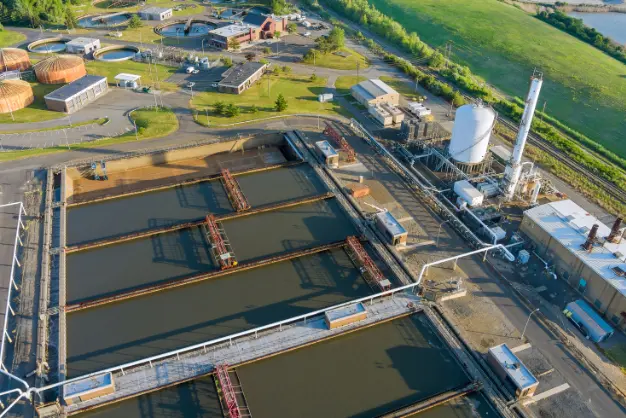
Aeration in water treatment is the process of bringing water into contact with air to add oxygen and strip out dissolved gases and volatile compounds. Operators use it to oxidize iron and manganese ahead of filtration, drive off carbon dioxide (CO2), hydrogen sulfide (H2S) and volatile organic compounds (VOCs), and supply the dissolved oxygen that aerobic bacteria need in biological treatment. It is one of the oldest and most cost-effective unit processes in both drinking-water and wastewater plants, and it almost always works alongside a treatment-chemistry program rather than replacing it.
It is also the single largest electricity consumer at a typical activated-sludge plant. Aeration commonly accounts for 50 to 60 percent of a wastewater facility’s power bill, so the design choices below are not academic. A few points of oxygen-transfer efficiency, or a dissolved-oxygen setpoint held half a milligram too high, compound into real operating cost over a 20-year asset life.
How aeration works
Aeration is gas transfer across the air-water interface. Whether a gas moves into the water or out of it depends on its concentration relative to equilibrium, a relationship described by Henry’s law: at a given temperature, the amount of a gas that dissolves is proportional to that gas’s partial pressure in the surrounding air. The practical takeaway is simple. Water that is short on oxygen pulls oxygen in from the air; water that is oversaturated with CO2 or H2S releases those gases out to the atmosphere.
Temperature drives the ceiling. Clean water at sea level holds about 9.1 mg/L of dissolved oxygen at 20 °C, but only roughly 7.5 mg/L at 30 °C. Warm summer water both holds less oxygen and carries a higher biological demand for it, which is exactly when aeration systems work hardest. The saturation value an operator designs around is not a constant; it shifts with temperature, elevation and salinity.
To move that transfer along, every aeration design does the same two things: it maximizes the surface area where air and water meet, and it keeps refreshing the interface so the water never reaches equilibrium and stalls. Fine bubbles, falling films, sprays and violent surface mixing are all just different ways of buying more interface per unit of energy. The trade-off runs straight through that energy budget. Fine-bubble diffusers transfer oxygen far more efficiently than coarse systems, but their membranes foul and need periodic cleaning or replacement, so the lowest-energy option is not automatically the lowest-cost one over an asset’s life.
Aeration methods compared
There is no single “best” aerator. The right choice depends on what you are trying to do (add oxygen, strip a gas, or both) and on flow rate, footprint and energy cost. The table below maps the systems you will actually see specified in municipal and industrial plants, with typical transfer efficiency where a published clean-water figure exists. Standard oxygen-transfer efficiency (SOTE) is measured in clean water at 20 °C, and field “alpha” factors in dirty water are commonly 0.4 to 0.65 of these numbers.
| Method | How it works | Typical clean-water SOTE | Best for |
|---|---|---|---|
| Fine-bubble diffused | Membrane or ceramic diffusers release 1–3 mm bubbles deep in a basin; high surface-area-to-volume ratio gives strong oxygen transfer. | ~25–40% overall (roughly 1.5–2.5% per foot of submergence); SAE 4–7 lb O2/hp·hr. | Activated-sludge aeration basins; highest oxygen-transfer efficiency where energy cost dominates. |
| Coarse-bubble diffused | Large bubbles from open orifices; lower transfer efficiency but strong mixing and far less prone to fouling. | ~10–15% overall; SAE 2–3 lb O2/hp·hr. | Mixing, channel aeration, and dirty or high-solids streams that would clog fine diffusers. |
| Mechanical / surface aerators | Rotors, brushes or paddles churn the surface, throwing water into the air and entraining oxygen. | SAE ~2–4 lb O2/hp·hr. | Lagoons, oxidation ditches and basins where simple, robust equipment is preferred. |
| Cascade / waterfall | Water flows over steps or weirs in thin sheets, gaining oxygen and releasing CO2 with no blower power. | Passive; no blower energy. | Low-energy CO2 removal and re-oxygenation, often on treated drinking water. |
| Spray | Nozzles atomize water into fine droplets, exposing huge surface area to air. | Pump energy only; high interface area. | Iron and manganese oxidation and quick degassing at modest flows. |
| Packed-tower air stripping | Water trickles down through packing media while a counter-current air stream sweeps volatiles out. | >99% removal of high-Henry’s-constant VOCs at adequate air-to-water ratio. | Targeted removal of VOCs, radon and H2S from groundwater and contaminated supplies. |
One number on that table is easy to misread: the SOTE gap between fine and coarse bubbles. Fine-bubble systems move roughly twice the oxygen per unit of air and cut blower energy on the order of 40 to 50 percent, which is why they dominate new activated-sludge designs. The catch is fouling. Membrane diffusers stiffen and lose efficiency as biofilm and inorganic scale build, so the design SOTE is a clean-and-new number you should expect to chase with periodic cleaning, not a fixed property.
What aeration actually does
Aeration earns its place because one process delivers several treatment outcomes at once. Each line below maps a mechanism to the result an operator is after, and several of them feed directly into a downstream filtration or chemical step.
- Adds dissolved oxygen (DO): supplies the oxygen aerobic bacteria consume to break down organic load, the engine of activated-sludge and biological filtration. Most aeration basins are run to hold roughly 2 mg/L DO; many plants now use dissolved-oxygen control to trim that setpoint, because over-aerating past about 2 to 3 mg/L wastes blower energy for little treatment gain.
- Oxidizes iron and manganese: converts soluble ferrous iron to insoluble ferric iron (Fe2+ → Fe3+) and oxidizes manganese, so both drop out as particles a filter can capture. Iron oxidizes readily by aeration above about pH 7. Manganese oxidizes far more slowly and usually needs pH above roughly 9.0 to 9.5, or a chemical oxidizer, to finish the job within a practical contact time.
- Strips CO2 and raises pH: driving off carbonic-acid CO2 lifts pH, which both reduces corrosivity and cuts the amount of caustic needed for stabilization downstream.
- Removes H2S and odor: strips the “rotten-egg” hydrogen sulfide that triggers taste-and-odor complaints (a detection threshold near a few parts per billion) and corrodes infrastructure.
- Strips radon and VOCs: packed-tower aeration removes volatile organics and radon from groundwater, often as the primary treatment barrier for those contaminants, with removal exceeding 99% for high-volatility compounds at a sufficient air-to-water ratio.
- Reduces corrosivity: by removing CO2 and H2S and raising pH, aeration makes finished water less aggressive toward pipes and equipment.
Where aeration is used
The same physics shows up across very different facilities, but the goal changes with the setting:
- Municipal drinking water: oxidizes iron and manganese, strips H2S and CO2, and removes VOCs and radon before filtration and disinfection.
- Wastewater / activated sludge: the aeration basin is where most of the biological treatment happens, holding dissolved oxygen for the microbial community that digests organic load and ammonia.
- Groundwater remediation: air stripping pulls chlorinated solvents and other VOCs out of contaminated aquifer water.
- Industrial process water: conditions boiler feed, cooling and process streams, often paired with iron removal and pH control.
- Aquaculture: maintains the dissolved oxygen that fish and shellfish stock need to survive at density, generally above 5 mg/L for most species.
The chemistry connection
Aeration is a physical process, but it rarely stands alone. In practice it sets up, or relies on, a chemical program, and the two are designed together. Where aeration alone cannot finish a reaction or hit a discharge limit, treatment chemicals close the gap. The table pairs the common gap with the chemistry operators reach for, named by CAS so a procurement team can specify it directly.
| Treatment gap | Chemistry (CAS) | Role alongside aeration |
|---|---|---|
| Manganese won’t finish oxidizing | Potassium permanganate, CAS 7722-64-7; sodium hypochlorite, CAS 7681-52-9 | Completes Mn oxidation that aeration starts too slowly, or handles iron and sulfide when contact time is short. |
| pH too low for Fe/Mn oxidation, or corrosive finished water | Sodium hydroxide (caustic soda), CAS 1310-73-2; soda ash, CAS 497-19-8; calcium hydroxide (lime), CAS 1305-62-0 | Sets the pH window where iron and manganese drop out, and keeps finished water non-corrosive. |
| Oxidized particles too fine to filter | Ferric chloride, CAS 7705-08-0; aluminum sulfate (alum), CAS 10043-01-3; polymer flocculants | Binds oxidized iron and manganese into floc that filters and clarifiers actually capture. |
| Persistent basin and clarifier foam | Silicone or polyglycol antifoams | Controls foam that fouls blowers and risks basin overflow. |
That pairing is the practical reason aeration and chemical dosing show up on the same plant flow diagram: the aerator does the cheap bulk work, and a targeted chemical does the part physics cannot. Where the water enters drinking-water distribution, those chemicals should carry NSF/ANSI 60 certification for direct addition to potable water.
Sourcing water-treatment chemicals in bulk
For potable-water duty, specify NSF/ANSI 60 certification and request a certificate of analysis per lot. For background on the vertical and the full product range, see our water-treatment industry page, and for procurement mechanics our comprehensive guide to chemical procurement.
Requesting a quote is straightforward. Send the chemistry (product name or CAS number), the grade and certification you need, the volume you move (drums, totes, or bulk), and your delivery point, and we will come back with sourcing and pricing. Specifications and contaminant targets vary plant to plant, so we scope each request to the application rather than quoting a generic price.
Methodology and sources
Identity and technical context in this guide is anchored to the US EPA drinking-water program, the primary regulatory context for municipal treatment chemistry. Always defer to the supplier's current SDS and CoA for the specific grade and lot you handle.
Frequently Asked Questions
What is aeration in water treatment?
Aeration is the process of bringing water into contact with air to add oxygen and drive off dissolved gases and volatile compounds. It is used to oxidize iron and manganese ahead of filtration, strip CO2, H2S, radon and VOCs, and supply the dissolved oxygen that aerobic bacteria need in biological treatment.
Why is aeration important in water treatment?
Aeration delivers several outcomes from one process: it oxidizes iron and manganese so filters can remove them, strips odor- and corrosion-causing gases, raises pH by removing CO2, and supplies oxygen for biological treatment. It is also the largest power load at most activated-sludge plants, typically 50 to 60 percent of facility electricity, so its efficiency drives operating cost. Without it, biological wastewater systems would not function and many groundwater contaminants would pass through untreated.
What does aeration remove from water?
Aeration removes dissolved gases and volatiles: carbon dioxide, hydrogen sulfide (the rotten-egg odor), radon and many volatile organic compounds. It also converts dissolved iron and manganese into insoluble particles that a downstream filter then removes. It does not remove dissolved solids, salts or most non-volatile contaminants, which need other processes.
What are the main types of aeration?
The common methods are diffused aeration (fine- and coarse-bubble), mechanical or surface aerators, cascade and waterfall aerators, spray aeration, and packed-tower air stripping. Diffused fine-bubble systems give the highest oxygen-transfer efficiency for activated sludge, roughly twice that of coarse-bubble at a clean-water SOTE around 25 to 40 percent, while packed towers are chosen specifically for stripping VOCs and radon from groundwater.
Does aeration remove iron from water?
Yes. Aeration oxidizes soluble ferrous iron to insoluble ferric iron (Fe2+ → Fe3+), which precipitates as particles that a filter captures. It is one of the most common ways to treat iron in groundwater and works readily above about pH 7. Manganese oxidizes by the same route but much more slowly, and typically needs pH above 9.0 to 9.5 or a chemical oxidizer to finish.
Is aeration the same as oxygenation?
Not quite. Oxygenation only describes adding oxygen to water. Aeration is broader: it is two-way gas transfer that adds oxygen and simultaneously strips out unwanted gases such as CO2 and H2S. Oxygenation is therefore one of the things aeration accomplishes, but aeration also does degassing that pure oxygenation does not.
How does aeration differ in wastewater versus drinking water?
In wastewater, aeration mainly supplies dissolved oxygen to the bacteria in activated sludge that digest organic load and ammonia, usually held around 2 mg/L. In drinking water, the priority is usually the reverse: stripping out CO2, H2S, radon and VOCs and oxidizing iron and manganese ahead of filtration. Same physics, opposite emphasis, with one side adding oxygen and the other removing contaminants.
Search 1,300+ industrial chemicals by name or CAS, or send us your spec — we quote by the drum, tote, or container.
Browse the Chemical Index → Request a Quote