
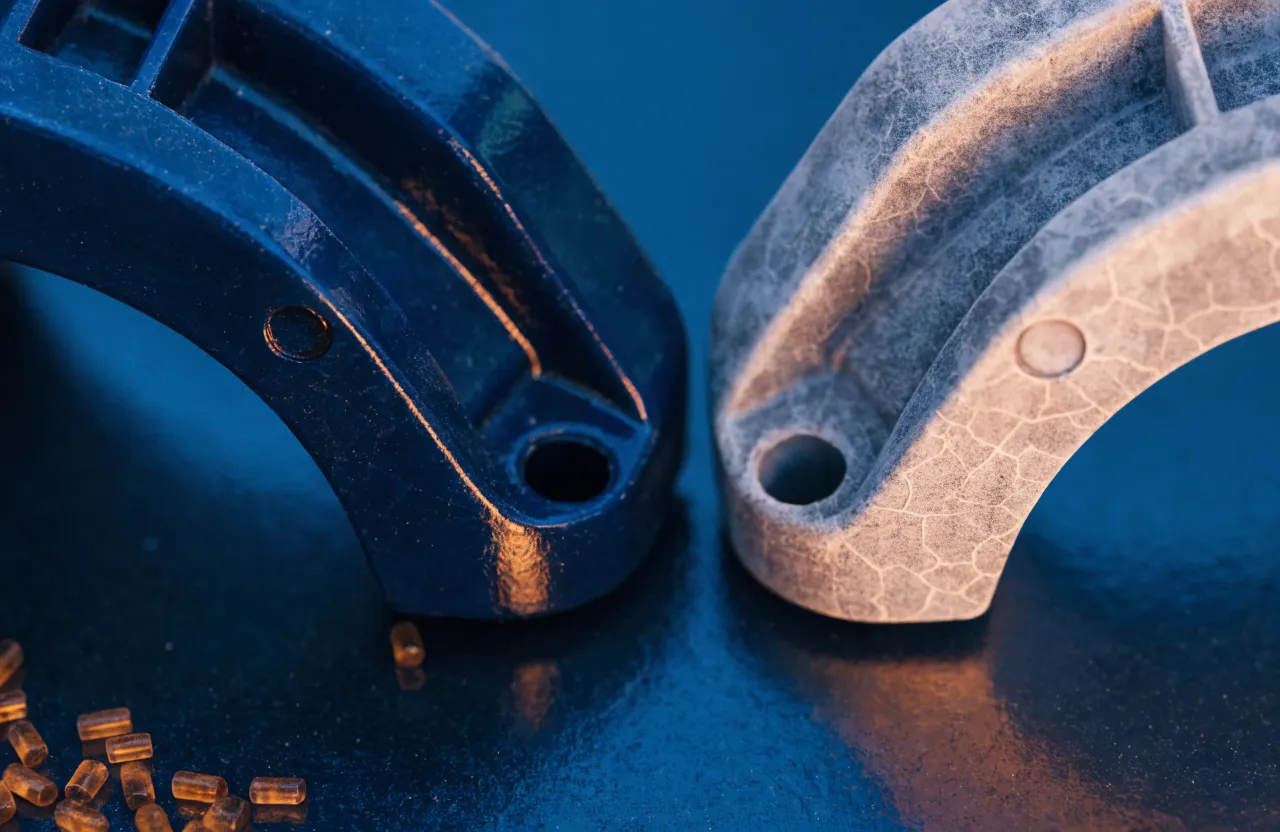
A polypropylene part comes off the tool looking perfect, ships, and twelve to eighteen months outdoors later it has gone chalky, faded, and brittle enough to crack when you flex it. Unstabilized polypropylene is one of the least UV-durable commodity plastics in the catalog, and the failure is not the molder’s fault or the resin grade; it is the chemistry of the polymer meeting sunlight. The fix is a light-stabilizer package, and for polyolefins that package is built around a hindered amine light stabilizer (HALS). Below is why PP degrades the way it does, how HALS differs from UV absorbers and antioxidants, and how to pick a grade for your part.
The short version: Polypropylene is especially UV-sensitive because every repeat unit carries a tertiary carbon–hydrogen bond that is easily abstracted, kicking off a hydroperoxide-driven photo-oxidation chain that cascades into chalking, fading, and cracking. The most effective stabilizer for polyolefins is a hindered amine light stabilizer (HALS), which scavenges the radicals in that chain and regenerates itself rather than being consumed; it is usually run alongside an antioxidant (protects during melt processing and thermal aging) and sometimes a UV absorber (screens UV in thicker sections). Grade selection turns on two levers. The first is molecular weight: low-MW monomeric HALS act fast but can be volatile and extractable, while high-MW polymeric HALS resist migration and suit thin films and fibers. The second is N-substitution, where NOR-HALS (N–OR) tolerate the acidic and agrochemical environments that deactivate ordinary HALS. Loading is typically a fraction of a percent up to a percent-plus, and it must be validated in your own polymer, thickness, and climate.
Why polypropylene degrades faster than almost any other polyolefin
Polyolefins all photo-oxidize, but polypropylene does it faster than polyethylene, and the reason is structural. Each PP repeat unit has a tertiary carbon: a backbone carbon bonded to a methyl group and carrying a single hydrogen. That tertiary C–H bond is the weak point. It is abstracted far more readily than the secondary C–H bonds that make up polyethylene, so PP forms carbon-centered radicals more easily under UV and heat. A comparison of the UV-degradation chemistry of PP, PE, and other polymers shows this difference plays out directly in oxidation rate.
Once a radical forms, oxygen adds to it to make a peroxy radical, which abstracts another hydrogen to form a hydroperoxide and a new radical. The hydroperoxide is the troublemaker: UV light and heat split it into two more radicals, so each absorbed photon can launch several new chains. This is autocatalytic: the more it degrades, the faster it degrades. The chain ends in carbonyl groups (ketones, aldehydes, acids), and those carbonyls absorb UV and fragment further through Norrish reactions, breaking the polymer backbone.
What you see is the downstream damage: loss of gloss and chalking, yellowing then fading, microcracking, and a steep drop in elongation and impact strength as molecular weight falls. (For the full mechanism across plastics, see why plastics yellow, chalk, and crack under UV.) Polyethylene runs the same chemistry more slowly because it lacks the tertiary site, so HDPE UV resistance is better than PP’s out of the box but still inadequate for long outdoor service. The practical takeaway: PP needs a deliberate stabilizer package for any sustained sun exposure, and PE needs one for multi-year outdoor life.
Three jobs, three additives, and why you run them together
“UV stabilizer” is often used loosely for three different additive classes that do different jobs. They are complementary, not interchangeable.
| Additive class | What it does | When it runs out |
|---|---|---|
| Antioxidant (hindered phenol + phosphite) | Stops oxidation during melt processing and thermal aging; protects the pellet through extrusion and molding | Consumed over time; limited standalone outdoor durability |
| UV absorber (UVA) (benzotriazole, benzophenone, triazine) | Absorbs UV photons and dissipates them as heat before they break bonds | Slowly consumed; needs path length, so weak in thin films and fibers |
| HALS (hindered amine light stabilizer) | Scavenges the free radicals in the oxidation chain and regenerates through a nitroxyl radical cycle | Effectively non-consumed; works in thin sections; the workhorse for polyolefins |
The reason HALS dominates polyolefin stabilization is that it does not simply absorb light; it interrupts the radical chain and recycles. The hindered amine forms a nitroxyl radical that traps a carbon-centered radical; that adduct later releases the nitroxyl again, so a small amount keeps working over many cycles. That regeneration is also why HALS protects thin films and fibers where a UV absorber has too little material depth to screen effectively.
You combine them because each covers a gap the others leave: the antioxidant keeps the resin intact through processing, the UV absorber cuts the photon dose in thicker pigment-light parts, and the HALS handles the radical chemistry over the long haul. A documented study of UV stabilizers on polypropylene outdoors shows the synergy of HALS-plus-absorber systems versus either alone. One honest caveat: certain sulfur-containing thioester antioxidants can antagonize HALS, so the package has to be designed as a system, not assembled part by part.
The two levers that decide HALS performance: molecular weight and N-substitution
Within the HALS family, two structural choices drive which grade fits your part.
Molecular weight sets the trade-off between speed and permanence. Low-molecular-weight monomeric HALS (a few hundred g/mol, for example bis(2,2,6,6-tetramethyl-4-piperidyl) sebacate) are mobile and give fast, efficient protection, but they are more volatile during high-temperature processing, more easily extracted by water or solvents, and prone to blooming to the surface. High-molecular-weight oligomeric/polymeric HALS (roughly 2,000–4,000 g/mol) move more slowly but stay put: low volatility, high resistance to extraction and migration, and good performance in thin sections. That permanence matters in thin films, in high-surface-area fibers and tapes, in parts that contact water or solvents, and in food-contact-adjacent applications, though you must independently confirm food-contact status for your specific application and jurisdiction.
N-substitution, meaning what sits on the piperidine nitrogen, sets acid tolerance. Standard N–H HALS are basic, and that basicity is a liability when the polymer sees acids: acidic pesticide residues, elemental sulfur, halogenated flame retardants, acidic catalyst residues, or combustion gases can neutralize the amine and shut it down. N–CH3 (N-methyl) grades have reduced basicity. N–OR grades, the NOR-HALS, carry an alkoxyamine and have very low basicity, so acids and agrochemicals do not deactivate them; the pre-formed alkoxyamine also feeds the protective nitroxyl cycle directly.
Selection table: matching a HALS grade to a polyolefin application
The grades below are the common polyolefin HALS chemistries.
| HALS chemistry | Type / N-class | Molecular weight | Best-fit PP / polyolefin application | Why |
|---|---|---|---|---|
| Bis(2,2,6,6-tetramethyl-4-piperidyl) sebacate | Monomeric, N–H | Low (~480) | General-purpose PP, thicker molded sections; fast onset; often co-formulated | Mobile and efficient radical scavenger; trade-off is volatility and extractability; can bloom and is weaker where extraction or thin-section permanence matters |
| Oligomeric succinate-piperidine HALS | Oligomeric, N–H | High (~3,000–4,000) | PP/PE film and fiber; also contributes long-term heat stability | Low volatility and migration; extraction-resistant; doubles as a thermal stabilizer in polyolefins |
| Polymeric triazine HALS | Oligomeric/polymeric, N–H | High (~2,000–3,100) | PP/PE thin film, tape, raffia, fiber, geotextile, thin molded parts | The polyolefin workhorse for thin sections; strong extraction and migration resistance; long outdoor life |
| Block-oligomeric triazine HALS | Block oligomeric, N–H | High (~2,600–3,400) | PP, PE, EVA, and PP/elastomer (TPO) blends; thin and thick parts; demanding weathering | Narrow molecular-weight distribution, very high extraction resistance, low pigment interaction and melt-flow control; spans thin film to thick section |
| Bis(1,2,2,6,6-pentamethyl-4-piperidyl) sebacate | Monomeric, N–CH3 (liquid) | Low | Coatings on polyolefin substrates and liquid-additive systems; lower-basicity needs | Liquid handling; reduced basicity versus N–H grades; primarily a coatings stabilizer rather than a melt-compounded polyolefin grade |
| N-alkoxy (NOR) HALS | N–OR alkoxyamine | Low–mid (liquid) | Agricultural and greenhouse film with pesticide/sulfur exposure; acid-interacting systems | Very low basicity resists acids, agrochemicals, and sulfur that deactivate ordinary HALS; alkoxyamine feeds the nitroxyl cycle |
A few mapping rules fall out of the table. For thin films, tapes, and fibers, favor the high-MW grades (the triazine and succinate-piperidine HALS) because surface area drives extraction and volatility losses. For thicker injection-molded PP, a monomeric grade like the tetramethylpiperidyl sebacate can be effective and is often blended with a high-MW grade for both fast onset and permanence. For automotive TPO (bumpers, fascia, cladding), a high-MW triazine HALS paired with a UV absorber is the typical exterior package, frequently with NOR chemistry where acid or pigment interactions are in play. For agricultural film exposed to pesticides, sulfur, or disinfectants, NOR-HALS is the chemistry that survives the environment.
Loading guidance: general ranges, validate in your system
Treat the following as starting ranges, not a specification. Effective loading depends on the polymer, part thickness, pigments, the rest of the additive package, and the service climate.
- General PP and PE, moderate exposure: roughly 0.1–0.5% HALS is a common starting band.
- Demanding outdoor life, thin film, agricultural film: higher loadings, often up to ~1.0–1.4%, sometimes split between two HALS or a HALS/UVA blend.
- Automotive exterior TPO: HALS commonly in the ~0.3–0.5% range alongside a UV absorber.
- HALS-to-UV-absorber ratio in PP/HDPE often lands near 75:25 in favor of HALS, but this is system-dependent.
One quantitative wrinkle: in polypropylene, weathering performance rises roughly linearly with HALS concentration over the useful range, whereas in HDPE it tracks closer to the square root of concentration, so PE needs proportionally more HALS for the same incremental gain. Qualify the final loading with accelerated weathering (for example xenon-arc per the relevant ASTM/SAE method) and, where you can, real outdoor exposure in your climate. There is no lifetime guarantee from any additive; service life depends on the polymer, thickness, color, formulation, and the local UV and heat load.
Buying UV stabilizers and matching grade to part
See the bis(2,2,6,6-tetramethyl-4-piperidyl) sebacate product page. Tell us the polymer (PP, HDPE, LLDPE, EVA, TPO), the part geometry, the exposure (general outdoor, automotive, agricultural with agrochemicals), and any acid, sulfur, or flame-retardant interactions, and request samples to qualify the grade and loading on your own system.
Frequently asked questions
What is the best UV stabilizer for polypropylene?
For most polypropylene the best UV stabilizer is a hindered amine light stabilizer (HALS), usually run with an antioxidant and, in thicker parts, a UV absorber. There is no single best grade: choose by part geometry and environment. High-molecular-weight polymeric triazine HALS suit thin film and fiber because they resist extraction and migration; a low-MW monomeric grade such as bis(2,2,6,6-tetramethyl-4-piperidyl) sebacate gives fast protection in thicker molded sections; and an N-alkoxy (NOR) HALS is the choice where acids or agrochemicals are present.
What is a hindered amine light stabilizer (HALS) and how does it work?
A HALS is a light stabilizer built on a hindered piperidine ring. Rather than absorbing UV light, it interrupts the photo-oxidation chain by scavenging the free radicals that drive degradation, forming a nitroxyl radical that traps carbon-centered radicals and then regenerates. Because it recycles instead of depleting, a small amount keeps working over long exposure, and it works even in thin sections where a UV absorber has too little depth to screen.
HALS vs UV absorber: what’s the difference?
A UV absorber (UVA) soaks up UV photons and releases the energy as heat, reducing the dose reaching the polymer; it needs material depth to work and is slowly consumed. A HALS does not absorb UV; it scavenges the radicals produced once degradation starts, and it regenerates rather than depleting. UVAs suit thicker, lightly pigmented parts; HALS works across thin and thick sections. The two are commonly combined for synergy, with HALS as the primary protectant in polyolefins.
How much HALS should I add to polypropylene?
As a general starting range, roughly 0.1–0.5% HALS covers moderate PP exposure, rising toward 1.0–1.4% for demanding outdoor or agricultural film, sometimes split with a UV absorber near a 75:25 HALS-to-UVA ratio. In PP, performance rises roughly linearly with HALS loading over the useful range; HDPE generally needs proportionally more. These are starting points only; validate the final loading with accelerated and, ideally, real-climate weathering on your own formulation.
When should I use a NOR-HALS instead of a standard HALS?
Use a NOR-HALS (N–OR alkoxyamine) when the polymer sees acids or agrochemicals that would deactivate an ordinary N–H HALS: agricultural and greenhouse film exposed to pesticides, elemental sulfur, or disinfectants, and systems with acidic catalyst residues, halogenated flame retardants, or acidic combustion gases. NOR-HALS have very low basicity, so those acids do not neutralize them.
Why does polypropylene degrade in sunlight faster than polyethylene?
Polypropylene’s backbone carries a tertiary carbon–hydrogen bond on every repeat unit, abstracted much more readily than the secondary C–H bonds in polyethylene. Easier hydrogen abstraction means faster formation of hydroperoxides, which split under UV and heat into more radicals, driving an autocatalytic oxidation chain. Polyethylene runs the same chemistry more slowly because it lacks the tertiary site, so HDPE has better baseline UV resistance than PP, though both need stabilization for long outdoor service.
Editorial note. This article is general technical guidance for plastics compounders, masterbatch producers, and polyolefin converters. Stabilizer selection, loading, and weathering performance depend on your specific polymer, grade, part thickness, pigments, the full additive package, and your service climate, and must be validated on your own system; the Certificate of Analysis governs the grade you buy. Confirm food-contact status, regulatory compliance, and suitability for your application and jurisdiction independently, and review the current Safety Data Sheet (SDS) before handling. Products are sold for industrial and professional use only. Nothing here is a medical, health, safety, or environmental-benefit claim. RawSource makes no warranty, express or implied, and assumes no liability for use of this information.
Search 1,300+ industrial chemicals by name or CAS, or send us your spec — we quote by the drum, tote, or container.
Browse the Chemical Index → Request a Quote