
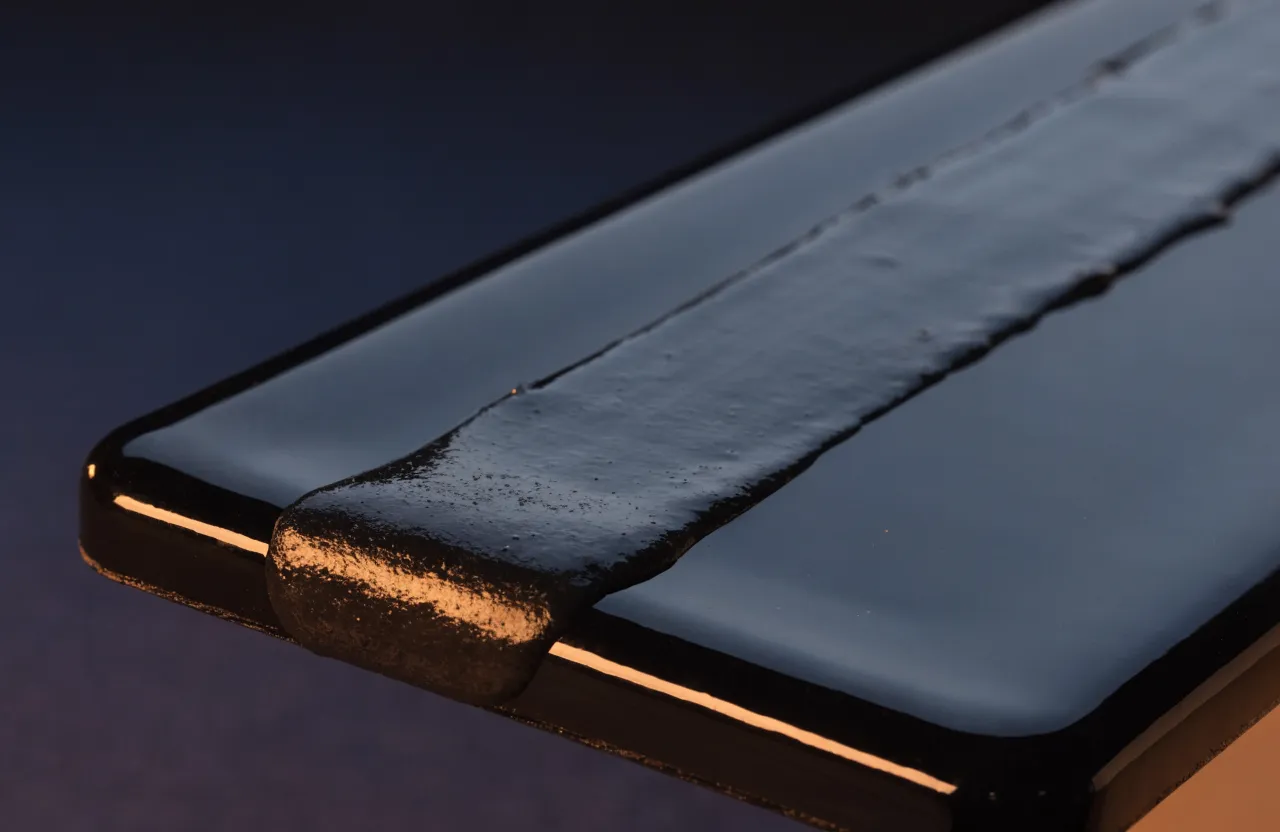
You ran the part under the lamp, the dose readout looks right, and the surface still feels tacky. Wipe it and your glove comes away sticky. The bulk feels hard, but the top skin never set. In a free-radical UV system (acrylate or methacrylate coatings, inks, adhesives, and most 3D-print resins), that sticky skin is almost always oxygen inhibition. Sometimes it sits on top of a second problem: the wrong photoinitiator for your lamp, or simply not enough cure energy reaching the surface. Both are fixable once you can tell them apart.
The short version: A tacky surface after UV cure is usually oxygen inhibition. At the air interface, atmospheric oxygen reacts with the photoinitiator-generated free radicals faster than those radicals can add to monomer, forming sluggish peroxy radicals that stall the growing chain. What you are left with is a thin, under-crosslinked, low-molecular-weight skin that stays soft while the resin underneath cures hard. You beat it four ways: exclude the oxygen (nitrogen inerting, or a film/lamination cover), overwhelm it (higher UV intensity and dose, shorter-wavelength output, slower line speed), formulate around it (a surface-cure photoinitiator such as a hydroxyketone plus a tertiary-amine synergist, or a wax that blooms to the surface and seals out air), and confirm your photoinitiator actually absorbs at your lamp’s wavelength. If the skin is fine but the depth stays soft, the cause is the opposite end of the film: light not reaching through a thick or pigmented build, which calls for a photobleaching initiator like TPO or BAPO.
What oxygen inhibition actually is
A free-radical UV coating cures because the photoinitiator absorbs UV photons, splits into radicals, and those radicals add across the carbon-carbon double bonds of acrylate monomers and oligomers to build a crosslinked network. Oxygen breaks that chain. A propagating carbon radical reacts with dissolved or in-diffusing O₂ far faster (on the order of two to three magnitudes faster) than it reacts with an acrylate double bond, converting the reactive carbon radical into a peroxy radical. Peroxy radicals are sluggish toward acrylate, so propagation stops and you get short, lightly crosslinked chains.
Those short chains are exactly what your finger feels: a soft, oily, low-molecular-weight layer sitting on a properly cured bulk. The practical reading is simple. If only the surface is tacky and the body of the part is hard, suspect oxygen first, before you start changing your photoinitiator package or blaming the resin.
Why is the tackiness only on the surface?
Oxygen inhibition is skin-deep for a structural reason: oxygen concentration is highest at the air interface and drops off with depth as the curing network consumes it and slows further diffusion. The first few microns take the hit; everything below cures normally.
That geometry tells you where the risk concentrates. Thin films, large open flat panels, slow low-intensity LED passes, and any cure run in still air are the worst cases, because each gives oxygen more exposed area and more time to diffuse back in. A 2-mil clearcoat on a wide web fights oxygen far harder than the same chemistry poured deep in a mold. Measure tack where it appears, at the top surface, not by probing the cured underside, which misleads you on the cure.
The other reason a cure stays tacky: under-cure
Oxygen is the usual suspect, but a uniformly soft film, soft on top and underneath, points somewhere else. That is under-cure: not enough effective UV energy is reaching the photoinitiator to drive the network to completion. Several independent faults produce it.
| Cause of a tacky cure | What is happening | The tell |
|---|---|---|
| Oxygen inhibition | O₂ scavenges radicals at the air interface | Surface tacky, bulk hard; worse in thin films and open air |
| Photoinitiator / wavelength mismatch | The PI does not absorb at the lamp’s peak | Slow or incomplete cure even at high dose; whole film soft |
| Too little photoinitiator | Too few radicals generated to finish the network | Dose-hungry; never quite hardens off |
| Insufficient dose (weak or aged lamp, line too fast) | Total UV energy below the cure threshold | Soft throughout; improves the moment you slow the line |
| Thick or pigmented / filled film | Light absorbed or scattered before it reaches depth | Surface cures, depth stays soft; under-cure at the bottom |
Two of these quietly worsen over time. Mercury arc lamps lose output across their rated life, and LED arrays drift down as they age and heat, so a line that cured fine last quarter can slip below the dose threshold with no formula change. Measure, do not guess: put a radiometer or dosimeter strip in the web and confirm both peak irradiance (mW/cm²) and total dose (mJ/cm²) at the surface. A tacky line right after a lamp change is almost always a fallen irradiance number, not a resin problem.
Match the photoinitiator to your lamp
This is the failure people miss most often. A photoinitiator only generates radicals at the wavelengths it absorbs, and a mismatch of even 10 to 20 nm between the lamp’s peak emission and the photoinitiator’s peak absorption sharply cuts photon capture: slow kinetics, incomplete cure, and a soft film no amount of extra exposure fully rescues.
Two variables drive the choice. First, the lamp. A medium-pressure mercury arc emits broadband with strong lines including the 365 nm i-line, so it feeds most photoinitiators. UV-LED systems are narrowband, emitting in a tight cluster at 365, 385, 395, or 405 nm, and they only excite a photoinitiator that absorbs there. Second, the photoinitiator mechanism:
- Type I initiators cleave directly into radicals on absorbing light. Hydroxyketones (2-hydroxy-2-methylpropiophenone and 1-hydroxycyclohexyl phenyl ketone) and the acylphosphine oxides (TPO, BAPO) are Type I.
- Type II initiators (benzophenone, thioxanthones) do not cleave; they abstract a hydrogen from a co-initiator, a tertiary-amine synergist, to form the initiating radical. Without the amine, a Type II package barely cures.
| Photoinitiator | Type | Best lamp match | What it is for |
|---|---|---|---|
| Hydroxyketone: 2-hydroxy-2-methylpropiophenone, 1-hydroxycyclohexyl phenyl ketone | I | Mercury, 365 nm LED | Fast surface cure, low yellowing, clear coats and overprint varnish |
| TPO | I (acylphosphine oxide) | 385 / 395 / 405 nm LED, mercury | Through-cure; absorption tail into the long-UV/near-visible, photobleaching |
| BAPO | I (bisacylphosphine oxide) | 365–420 nm, mercury and LED | Deep, thick, and pigmented / white systems |
| Benzophenone or thioxanthone + amine | II | Mercury; thioxanthone reaches LED range | Surface cure; useless without an amine synergist |
TPO is the workhorse for 395–405 nm LED lines precisely because its absorption tail reaches into that near-visible band where hydroxyketones go blind. Both TPO and BAPO also photobleach: they absorb strongly at first, then lose that absorption as they react, so light keeps reaching deeper layers as the surface cures. That is what makes them the right choice for thick films and pigmented or white coatings, where the pigment competes with the photoinitiator for every photon.
For high-opacity white, an aminoketone such as 2-methyl-4′-(methylthio)-2-morpholinopropiophenone is a common partner. Real formulations rarely pick one: a typical clear UV coating blends a hydroxyketone for the surface with an acylphosphine oxide for depth, so you cover both ends of the film.
The action is concrete. Pull the emission spectrum from your lamp’s datasheet and the absorption curve from the photoinitiator Technical Data Sheet (TDS), and overlay them. A 365-nm hydroxyketone package run under a 405-nm LED will under-cure no matter how long you expose it.
Beating oxygen inhibition
Once you have confirmed the photoinitiator matches the lamp and the dose is real, attack the oxygen directly. The fixes climb in cost, so work down the list.
1. Exclude the oxygen. Nitrogen inerting is the most reliable lever; purge the cure zone to a few hundred ppm O₂ and the surface goes tack-free at a noticeably lower dose. Where a chamber is impractical, cover the wet film with a clear film or laminate and cure through it, then peel; air never reaches the surface. For 3D-print parts, post-curing submerged in water or under an inert blanket does the same job. 2. Overwhelm it. Drive peak irradiance up (high-intensity lines run well above 1,000 mW/cm²) so radicals are generated faster than oxygen can re-diffuse and consume them. Short-wave mercury output (down to 254 nm) hammers the very surface. Slowing the line raises total dose. Bumping photoinitiator loading at the surface helps, within limits. 3. Formulate around it. Put a surface-cure hydroxyketone (the methylpropiophenone or the cyclohexyl phenyl ketone) at the top of the package, then add a tertiary-amine synergist. The amine pulls double duty: it donates the hydrogen a Type II system needs, and it scavenges oxygen by converting peroxy radicals back into chain-starting radicals. An acrylated amine is better than a free amine because it reacts into the network instead of migrating out later. A small fraction of paraffin wax that blooms to the surface during cure forms a physical barrier that seals air out.
Every one of these carries a trade-off, and naming them up front saves a requalification later. Nitrogen costs gas and enclosure engineering. Amine synergists can yellow the film, raise odor, and (if you use a non-reactive grade) migrate to the surface over time, which is the argument for picking an acrylated amine. Paraffin-wax barriers cut gloss and can ruin intercoat adhesion, so they belong on a topcoat, never on a basecoat you intend to recoat.
High-intensity short-wave output adds ozone and heat load. Acylphosphine oxides photobleach well, but both they and amine synergists can contribute initial color in a water-clear system, so confirm yellowing on your own substrate before committing a clearcoat line.
Buying photoinitiators
Tell us your lamp type and peak wavelength (mercury, or 365 / 395 / 405 nm LED), your film build and whether it is clear or pigmented, and your tack and yellowing targets, and request a sample to qualify cure on your own line. Chasing a different surface defect on the epoxy side? See our guide to amine blush in epoxy.
Frequently asked questions
Why is my UV resin still sticky after curing?
The most common cause is oxygen inhibition: atmospheric oxygen at the surface reacts with the photoinitiator’s free radicals faster than they can build the polymer network, leaving a thin, soft, under-crosslinked skin while the bulk cures hard. If the whole part is soft, top and bottom, the cause is instead under-cure: too little dose, too little photoinitiator, or a photoinitiator that does not absorb at your lamp’s wavelength.
How do I get a tack-free surface without a nitrogen chamber?
Cure the wet film under a clear film or laminate and peel it after exposure, which keeps air off the surface entirely. You can also raise peak UV intensity and total dose, add a surface-cure hydroxyketone with a tertiary-amine synergist (or an acrylated amine), or include a small amount of surface-blooming paraffin wax. For a 3D print, post-cure submerged in water or under an inert blanket.
Which photoinitiator should I use for a 395 nm or 405 nm LED?
Reach for an acylphosphine oxide such as TPO, whose absorption tail extends into the 385–420 nm near-visible band where hydroxyketones such as 2-hydroxy-2-methylpropiophenone and 1-hydroxycyclohexyl phenyl ketone absorb very little. For thick, pigmented, or white films at those wavelengths, BAPO gives deeper cure thanks to photobleaching. Many formulations pair an acylphosphine oxide for depth with a hydroxyketone for the very surface.
What does an amine synergist do?
A tertiary amine acts as a hydrogen donor that Type II photoinitiators (benzophenone, thioxanthones) require to form radicals at all. It also reduces oxygen inhibition by converting sluggish peroxy radicals back into chain-propagating radicals, which improves surface cure. Acrylated amine synergists react into the polymer network, so they migrate less, cut odor, and lower the surface tack that free amines can leave behind.
Why is the surface cured but the inside still soft?
That is under-cure at depth, the opposite of oxygen inhibition. In thick films, or films loaded with pigment or filler, the upper layers absorb and scatter the UV before it can reach the bottom, so the surface sets while the interior never gets enough photons. Switch to a photobleaching initiator like TPO or BAPO, which loses absorbance as it reacts and lets light drive deeper, and verify your dose is high enough for the build.
Does a tacky surface mean the resin is defective?
Usually not. Oxygen inhibition and under-cure are process and formulation conditions, not signs that the resin or photoinitiator is bad. Confirm the photoinitiator matches your lamp wavelength, measure the dose at the surface, then address oxygen or light penetration as needed. Validate cure on your own equipment before you conclude a material is off-spec; the Certificate of Analysis governs the grade you bought.
Editorial note. This article is general technical guidance for coatings, ink, adhesive, and 3D-resin formulation professionals. Cure speed, surface tack, through-cure, and yellowing depend on your specific resin and oligomer, photoinitiator package, lamp type and wavelength, film thickness, pigmentation, line speed, and curing atmosphere, and must be validated on your own system; the Certificate of Analysis (CoA) governs the grade you buy. Photoinitiators and amine synergists are industrial chemicals; review the current Safety Data Sheet (SDS) and use appropriate PPE before handling. Products are sold for industrial and professional use only. Nothing here is a medical, health, or safety claim. RawSource makes no warranty, express or implied, and assumes no liability for use of this information.
Search 1,300+ industrial chemicals by name or CAS, or send us your spec — we quote by the drum, tote, or container.
Browse the Chemical Index → Request a Quote