
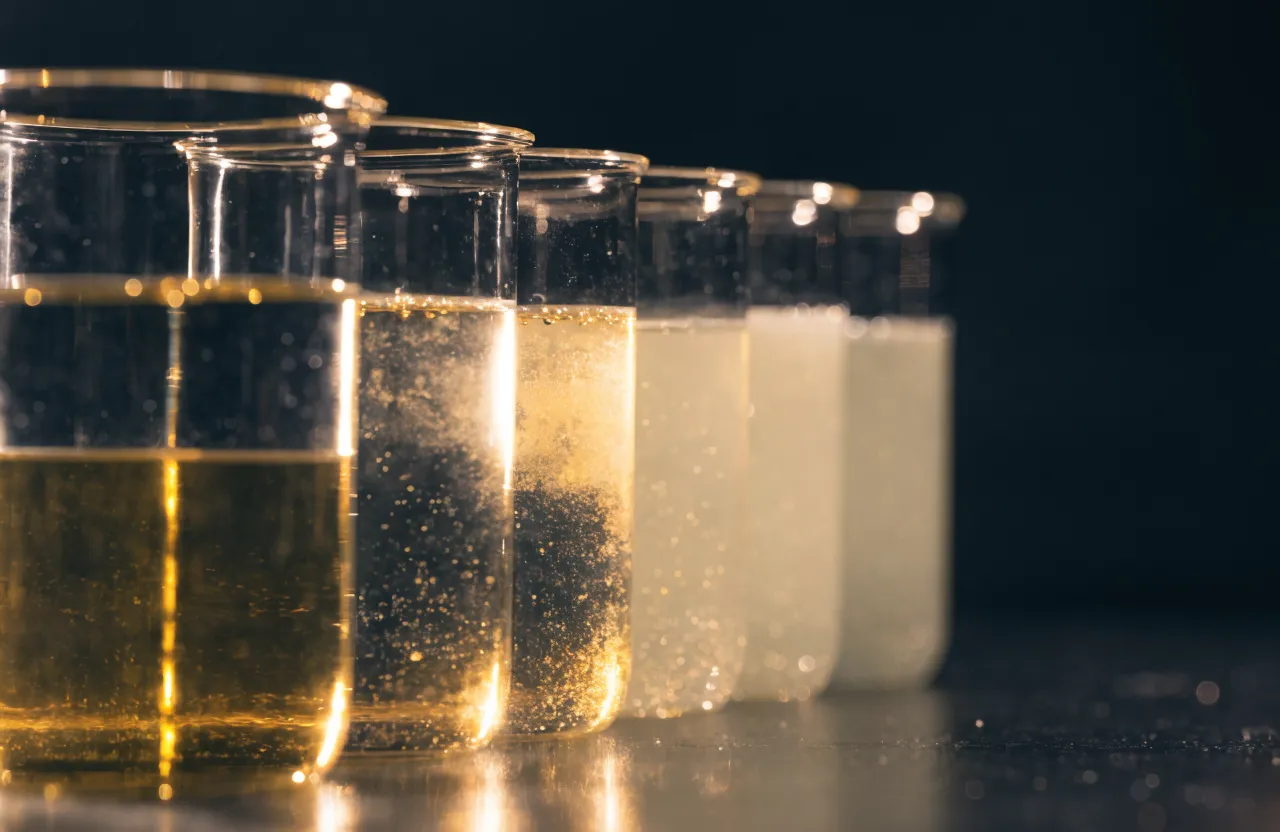
Your oil phase and your water phase will not stay mixed. You ran a batch, it looked fine off the mixer, and by the next morning a clear layer of oil had floated to the top or a cream ring had formed at the surface. The reflex is to add more emulsifier, or to switch to whatever worked on the last product. There is a faster way to narrow the field before you touch the lab bench: the HLB system turns “which emulsifier?” into an arithmetic problem you can solve on paper.
The short version: HLB (hydrophilic-lipophilic balance) is a 0-20 number that describes how water-loving versus oil-loving a nonionic surfactant is. Low HLB (3-6) suits water-in-oil (W/O) emulsions; high HLB (8-18) suits oil-in-water (O/W) emulsions; values around 7-9 are wetting agents and 15-18 are solubilizers. Separately, every oil has a required HLB, the HLB an emulsifier system needs to emulsify it. You choose an emulsifier (or blend two) whose HLB matches the required HLB of your oil phase. To hit a target you blend a high-HLB emulsifier like Polysorbate 80 (HLB 15.0) with a low-HLB one like sorbitan monooleate (HLB 4.3) using a weighted average. HLB narrows the field to a few candidates; it does not guarantee a stable emulsion, so you still confirm on your own system.
What HLB actually is
HLB is a single number, from roughly 0 to 20, that scores the balance between a surfactant’s water-loving (hydrophilic) head and its oil-loving (lipophilic) tail. William C. Griffin introduced the concept in 1949 at the Atlas Powder Company specifically for nonionic surfactants such as the sorbitan esters and their ethoxylated polysorbate counterparts. A value near 0 means the molecule is almost entirely oil-soluble. A value near 20 means it is almost entirely water-soluble. The midpoint near 10 is the crossover.
Griffin’s method computes HLB from composition: roughly the mass fraction of the molecule that is hydrophilic, scaled to 0-20 (for an ethylene-oxide-only hydrophile, HLB ≈ weight-percent ethylene oxide ÷ 5). You do not need to run that calculation, because the values for standard emulsifiers are published and consistent across suppliers. What matters in the lab is that HLB is additive: blend two emulsifiers and the mixture behaves, to a first approximation, like a single emulsifier at the weight-averaged HLB. That additivity is the property that makes the whole system work.
What the HLB ranges mean
The number tells you what a surfactant is good for. These bands are the practical map of the scale:
| HLB range | Primary function | Solubility behavior |
|---|---|---|
| 1-3 | Antifoam | Oil-soluble |
| 3-6 | Water-in-oil (W/O) emulsifier | Oil-soluble |
| 7-9 | Wetting and dispersing agent | Disperses / weakly water-soluble |
| 8-18 | Oil-in-water (O/W) emulsifier | Water-soluble |
| 13-15 | Detergent | Water-soluble |
| 15-18 | Solubilizer / hydrotrope | Clearly water-soluble |
The single most useful split is at 10: below it the emulsifier prefers the oil phase and stabilizes water droplets dispersed in oil; above it the emulsifier prefers water and stabilizes oil droplets dispersed in water. So the first decision is the emulsion type you want. A skin lotion, a metalworking coolant, and most agrochemical sprays are O/W and call for high-HLB emulsifiers (8-16). A heavy protective cream or a water-in-oil drilling fluid is W/O and calls for low-HLB emulsifiers (3-6). Decide the emulsion type first; it sets the half of the scale you are shopping in.
HLB values of common polysorbate and sorbitan grades
The polysorbate (ethoxylated sorbitan ester) and sorbitan ester families are the workhorse nonionic pair for HLB formulating because they span the scale and blend cleanly. The values below are the standard published figures used across the industry:
| Grade (generic name) | Chemistry | HLB | Tends toward |
|---|---|---|---|
| Polysorbate 20 | Ethoxylated sorbitan monolaurate | 16.7 | O/W, solubilizing |
| Polysorbate 40 | Ethoxylated sorbitan monopalmitate | 15.6 | O/W |
| Polysorbate 80 | Ethoxylated sorbitan monooleate | 15.0 | O/W |
| Polysorbate 60 | Ethoxylated sorbitan monostearate | 14.9 | O/W |
| Polysorbate 85 | Ethoxylated sorbitan trioleate | 11.0 | O/W (lower), coupling |
| Sorbitan laurate | Sorbitan monolaurate | 8.6 | Wetting, low-end O/W co-emulsifier |
| Sorbitan isostearate | Sorbitan monoisostearate | 4.7 | W/O |
| Sorbitan monostearate | Sorbitan monostearate | 4.7 | W/O |
| Sorbitan monooleate | Sorbitan monooleate | 4.3 | W/O |
| Sorbitan tristearate | Sorbitan tristearate | 2.1 | W/O |
Two patterns are worth reading off the table. First, ethoxylating a sorbitan ester (adding the polyoxyethylene chain that turns a sorbitan into a polysorbate) jumps the HLB by roughly 10 points, which is exactly why these two families pair so well: one high, one low, same backbone. Second, adding fatty-acid tails drops HLB sharply, so a tri-ester like sorbitan tristearate (2.1) sits far below the mono-ester sorbitan monostearate (4.7). When you need a high-HLB partner, reach for a polysorbate; for the low-HLB partner, a sorbitan ester of the same or a complementary fatty acid keeps the chemistry consistent.
Required HLB: every oil has a target number
Here is the concept that ties it together. Each oil, wax, or oil-phase component has a required HLB (sometimes written RHLB): the HLB value an emulsifier system needs to emulsify it into a stable emulsion. Match the emulsifier system’s HLB to the oil’s required HLB and you are in the zone where a stable emulsion is achievable. Miss it by a few points and droplets coalesce and the batch separates. Required HLB is determined experimentally (you emulsify the oil with a series of blends at stepped HLB values and find which gives the tightest, most stable emulsion), and published values vary a little between sources, so treat these as well-established starting points rather than exact constants:
| Oil-phase component | Typical required HLB (for O/W) |
|---|---|
| Petrolatum | 7-8 |
| Silicone fluid (dimethicone) | 5-9 |
| Mineral oil, light | 10 |
| Mineral oil, heavy | 10-11 |
| Paraffin wax | 10 |
| Beeswax | 9-11 |
| Isopropyl myristate | 11.5 |
| Castor oil | 14 |
| Cetyl alcohol | 13-15.5 |
| Stearic acid | 15-17 |
A real oil phase is rarely one ingredient, so its required HLB is the weighted average of its components’ required HLBs, by oil-phase weight. That gives you one target number to aim the emulsifier blend at. Recommendation: when a component is missing from published tables, run a quick HLB ladder (blends from about 8 to 16 in steps of 1-2) and read the stability off the result instead of guessing the value.
The blend calculation, worked
Two emulsifiers almost always outperform one, because a high-HLB and a low-HLB surfactant partition to opposite sides of the oil-water interface and pack it more tightly than either alone. The math is two short steps.
Step 1: find the oil phase’s required HLB. Suppose an O/W lotion has an oil phase that is, by total formula weight, 15% light mineral oil (required HLB 10) and 5% cetyl alcohol (required HLB 15.5). Within the 20% oil phase, mineral oil is 0.75 of the oil and cetyl alcohol is 0.25. Weight-average their required HLBs:
“ Required HLB (oil phase) = (0.75 x 10) + (0.25 x 15.5) = 7.5 + 3.875 = 11.4 “
Step 2: blend two emulsifiers to that target. Pick a high-HLB and a low-HLB emulsifier that bracket 11.4. Polysorbate 80 (HLB 15.0) and sorbitan monooleate (HLB 4.3) bracket it nicely. The fraction of the high-HLB emulsifier in the blend is:
“ fraction(high) = (target HLB - low HLB) / (high HLB - low HLB) = (11.4 - 4.3) / (15.0 - 4.3) = 7.1 / 10.7 = 0.66 “
So the emulsifier blend is about 66% Polysorbate 80 and 34% sorbitan monooleate. Check it with the weighted average: (0.66 x 15.0) + (0.34 x 4.3) = 9.9 + 1.5 = 11.4. The blend HLB lands on the oil phase’s required HLB.
Step 3: set the total emulsifier load. HLB tells you the *ratio*, not the *amount*. A common starting trial is a total emulsifier load near a quarter of the oil-phase weight, which here (20% oil phase) means roughly 5% total emulsifier, split in the 66/34 ratio: about 3.3% Polysorbate 80 and 1.7% sorbitan monooleate. That is a starting point to optimize, not a final answer; dial the total load up or down by stability and feel.
A selection workflow you can repeat
1. Pick the emulsion type. O/W or W/O? This sets whether you need a high-HLB system (8-16) or a low-HLB system (3-6). 2. Calculate the oil phase’s required HLB as the weight-averaged required HLB of every oil-phase component. 3. Choose a high/low emulsifier pair that brackets the target, ideally from a matched chemistry family (a polysorbate plus a sorbitan ester). 4. Solve the blend ratio with the fraction formula above, then back-check with the weighted average. 5. Set a trial total load (a quarter of the oil-phase weight is a reasonable first cut) and split it by the ratio. 6. Make it, then test it. Run an HLB ladder of a few points around your target and an accelerated stability check, because the calculated value is the center of your search, not the finish line. For the failure modes you are watching for, see why emulsions separate.
Where HLB stops, and what it cannot tell you
HLB is a starting guide, not a guarantee. It is a property of the surfactant’s structure alone, so it ignores everything else that controls a real emulsion: temperature, electrolyte content, the phase ratio, processing shear, and the molecular fit between the emulsifier’s tail and the specific oil. Two emulsifiers can share an HLB of 12 and perform very differently because one has a tail that matches your oil and the other does not. HLB also does not address ionic surfactants well (its clean additive behavior is a nonionic story), and the optimum HLB for a given oil shifts with temperature, which is why the related PIT (phase inversion temperature) approach exists for temperature-sensitive systems. The honest trade-off: HLB cuts your candidate list from dozens to a handful in an afternoon at a desk, but the final pick is still earned at the bench. Use it to choose what to test first, not what to ship.
Sourcing polysorbate and sorbitan emulsifiers
Tell us your oil phase and target HLB and request samples of a high/low pair to run your own HLB ladder.
Frequently asked questions
What is HLB (hydrophilic-lipophilic balance)?
HLB is a number from about 0 to 20 that scores how water-loving versus oil-loving a nonionic surfactant is, based on the balance between its hydrophilic head and lipophilic tail. It was introduced by William Griffin in 1949. Low values (toward 0) are oil-soluble; high values (toward 20) are water-soluble; the crossover is near 10.
What is required HLB?
Required HLB is the HLB value an emulsifier system needs in order to emulsify a particular oil into a stable emulsion. Each oil, wax, or oil-phase ingredient has its own required HLB (for example, light mineral oil is about 10 and beeswax about 9-11 for O/W). You match the emulsifier blend’s HLB to the oil phase’s required HLB. It is determined experimentally and published values vary slightly between sources.
How do I calculate the HLB of a blend?
Use a weight-weighted average: HLB(blend) = (fraction A x HLB A) + (fraction B x HLB B). To find the proportion of the high-HLB emulsifier needed to hit a target, rearrange to fraction(high) = (target HLB – low HLB) / (high HLB – low HLB). Example: to reach HLB 11.4 with Polysorbate 80 (15.0) and sorbitan monooleate (4.3), fraction(high) = (11.4 – 4.3) / (15.0 – 4.3) = 0.66, so 66% Polysorbate 80 and 34% sorbitan monooleate.
What is the difference between polysorbate and sorbitan HLB?
Polysorbates are ethoxylated sorbitan esters, and the polyoxyethylene chain makes them strongly hydrophilic, so they carry high HLB values (Polysorbate 80 is 15.0, Polysorbate 20 is 16.7) and act as O/W emulsifiers. The base sorbitan esters lack that chain, so they are lipophilic with low HLB values (sorbitan monooleate 4.3, sorbitan monostearate 4.7) and act as W/O emulsifiers or low-HLB partners. Because they share a backbone, a polysorbate and a sorbitan ester make a natural high/low pair.
Which HLB do I need for an oil-in-water versus a water-in-oil emulsion?
For oil-in-water (O/W), where oil droplets sit in a continuous water phase, you need a high-HLB emulsifier system, typically 8-18 and most often 8-16. For water-in-oil (W/O), where water droplets sit in a continuous oil phase, you need a low-HLB system, typically 3-6. Decide the emulsion type first because it sets which half of the scale you select from.
Does matching the HLB guarantee a stable emulsion?
No. HLB narrows the candidate emulsifiers to the right region and is the best paper-only screen available, but it ignores temperature, electrolytes, phase ratio, processing shear, and how well the emulsifier’s tail matches the specific oil. Two emulsifiers with the same HLB can behave differently. Treat the calculated HLB as the center of your experimental search and confirm stability on your own system.
Editorial note. This article is general technical guidance for industrial and formulation professionals. HLB values are well-established published figures and are listed here as a selection aid; the exact required HLB of an oil phase, the optimum emulsifier ratio, and final emulsion stability depend on your specific ingredients, phase ratio, temperature, and processing, and must be validated on your own system. The Certificate of Analysis (CoA) governs the grade you buy. Polysorbates and sorbitan esters are semi-synthetic nonionic surfactants; review the current Safety Data Sheet (SDS) and use appropriate handling for your application. Products are sold for industrial and professional use only. Nothing here is a medical, health, safety, or efficacy claim. RawSource makes no warranty, express or implied, and assumes no liability for use of this information.
Search 1,300+ industrial chemicals by name or CAS, or send us your spec — we quote by the drum, tote, or container.
Browse the Chemical Index → Request a Quote