
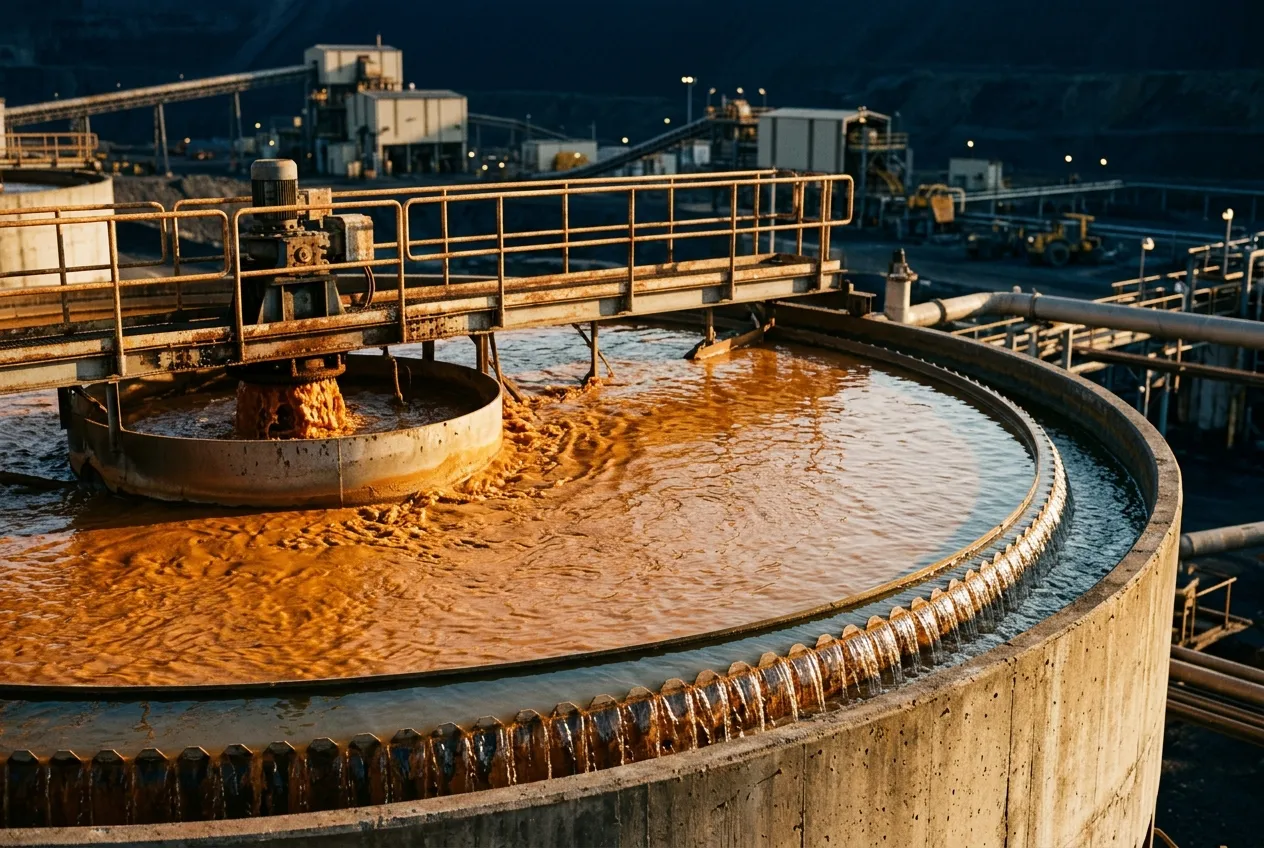
A concentrator only runs as fast as it can separate solids from water. When the tailings will not settle in the thickener, the underflow comes out too dilute to pump to the dam or filter, the overflow is too dirty to recycle, and water recovery falls. When mine water and process water stay cloudy, you cannot reuse them and you risk a discharge problem. The polymer that breaks these bottlenecks is anionic polyacrylamide.
The short version: mineral solids, tailings, ore fines, silt, and clay, carry a negative surface charge, so the right flocculant for mining is almost always anionic polyacrylamide. Its high molecular weight bridges the fine mineral particles into large, dense, fast-settling flocs, which speeds thickening, thickens the underflow, clarifies the overflow for water recovery, and cleans up mine and process water. The grade and dose are matched to the ore and the slurry, and confirmed by settling tests.
Why mining slurries won’t settle on their own
Finely ground ore produces particles so small and so similarly charged that they repel each other and stay suspended almost indefinitely. No amount of settling time clears them. Anionic polyacrylamide (CAS 9003-05-8, PubChem) solves this by bridging: a single long polymer chain attaches to many particles at once and pulls them into a large floc that settles fast under gravity. The charge-type reasoning is in anionic vs cationic vs nonionic polyacrylamide.
The mining jobs it does
| Problem | What anionic PAM does |
|---|---|
| Tailings won’t settle in the thickener | Bridges fines into fast-settling flocs; speeds throughput |
| Thickener underflow too dilute | Denser settled bed, higher underflow solids to pump or filter |
| Overflow too dirty to recycle | Clarifies the supernatant for water recovery |
| Cloudy mine and process water | Settles suspended mineral solids for reuse or discharge |
| Concentrate and tailings filtration | Flocculated feed filters and dewaters faster |
Charge type and grade still matter
While anionic is the default for mineral solids, the right anionicity (charge degree) and molecular weight depend on the mineralogy, the pH, and the water chemistry. High-charge anionic grades suit some ores; lower-charge or nonionic grades suit others, and a few high-organic streams in metallurgy call for cationic. Settling tests on the actual slurry, across a few grades and doses, are how the polymer is chosen. Related metals-industry separation is covered in polyacrylamide in metal finishing and metallurgy.
Dose and handling
Flocculant is dosed at low concentration on a well-dissolved make-down, and the dose is optimized to the lowest level that gives the target settling rate and underflow density; overdosing wastes polymer and can produce a bulky, water-holding floc. Spilled product and polymer solution are extremely slippery underfoot, a real safety point around thickeners and pumps.
Buying polyacrylamide for mining
See the Polyacrylamide Flocculant product page. Tell us your ore, slurry, and water chemistry, and request samples to run settling tests on your own tailings.
Frequently asked questions
What polyacrylamide is used for mining tailings?
Almost always anionic polyacrylamide, because mineral tailings carry a negative charge and the high-molecular-weight anionic polymer bridges the fines into large, fast-settling flocs for thickening and dewatering. The exact charge degree and molecular weight are matched to the ore.
How does polyacrylamide help mine water treatment?
It flocculates the suspended mineral solids that keep mine and process water cloudy, settling them into a clear supernatant you can recycle or discharge. Anionic grades suit most mineral solids; the dose is set by settling tests.
Why is my thickener underflow too dilute?
The fines are not settling densely enough. A correctly selected anionic flocculant builds a denser settled bed and a higher-solids underflow, so it pumps and filters better. Optimize grade and dose by settling test.
Can polyacrylamide improve tailings filtration?
Yes. A flocculated feed forms a more permeable cake, so flocculated tailings and concentrates filter and dewater faster on a filter press or vacuum filter. The grade is matched to the filtration step.
How much flocculant do I use for tailings?
Dose is kept low and optimized to the target settling rate and underflow density, on a well-made-down polymer. Run settling tests across a few grades and doses; the best is the lowest dose that meets the separation target.
Editorial note. This article is general technical guidance for mining and minerals professionals. Charge-type, grade, and dose guidance is general and must be validated by settling and filtration tests on your own slurry; the Certificate of Analysis governs the grade you buy. Polyacrylamide polymer has low toxicity per its SDS and is not classified as hazardous for transport, but residual acrylamide monomer is a regulated concern for potable use; confirm requirements for any water you discharge or reuse. Spilled product and polymer solution are extremely slippery when wet. Always consult the current Safety Data Sheet (SDS) before handling. RawSource makes no warranty, express or implied, and assumes no liability for use of this information.
Search 1,300+ industrial chemicals by name or CAS, or send us your spec — we quote by the drum, tote, or container.
Browse the Chemical Index → Request a Quote