
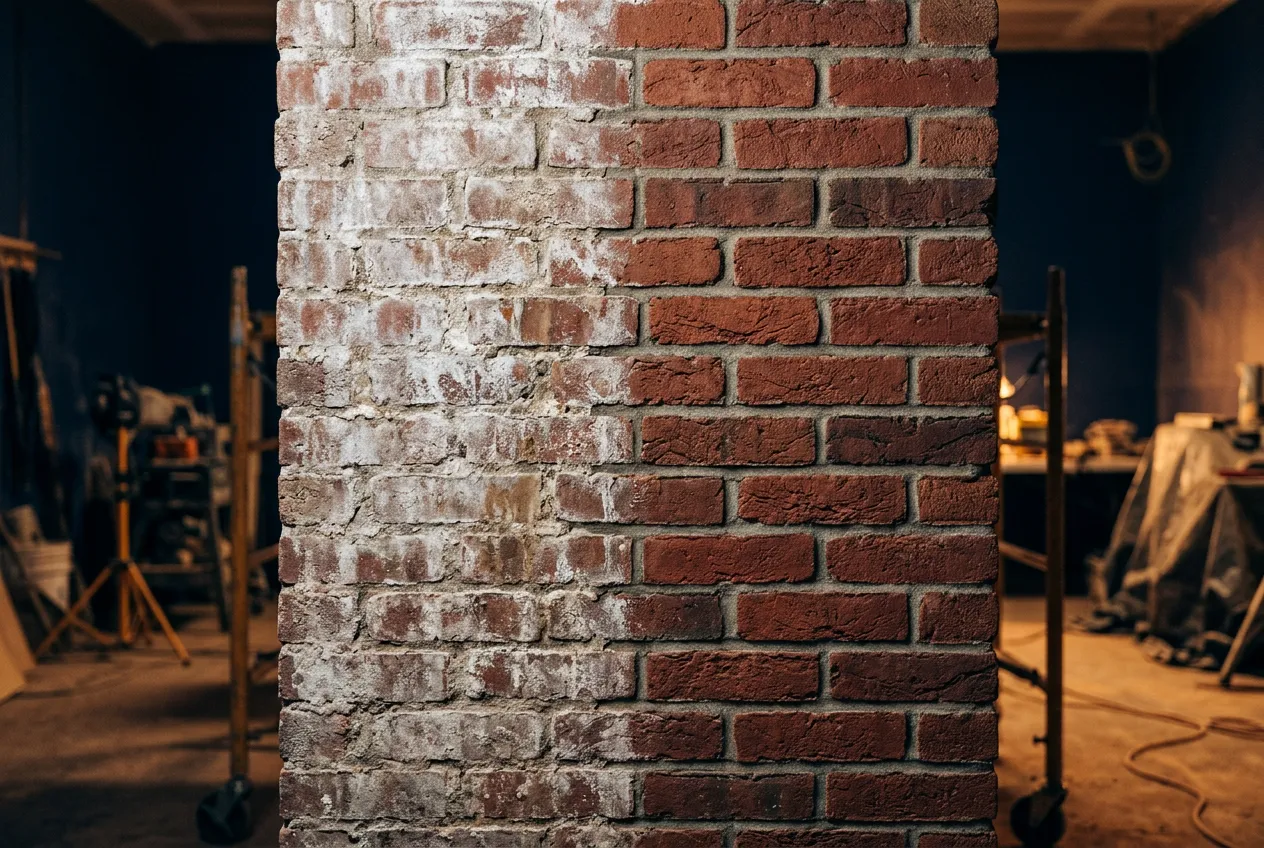
A precast plant ships clean panels that arrive streaked with white haze. A restoration crew strips a glazed-brick facade and the mortar smear will not lift with ordinary cleaner or even muriatic acid. The problem is mineral, not dirt, and the workhorse that removes it is an ammonium bifluoride cleaner. It works because fluoride does something acids alone cannot, and like every fluoride product, it has to be handled with respect.
The short version: ammonium bifluoride (ABF) removes efflorescence, mortar haze, and concrete stains from brick, block, precast, and masonry. The fluoride it releases converts the surface carbonate deposits to insoluble calcium fluoride that brushes and rinses away (CaCO3 + 2 HF gives CaF2 + CO2 + H2O).
It is used at roughly 1 to 3% in the working solution, is economical on large concrete structures, and is the traditional choice for glazed brick and terra cotta. It is also corrosive, toxic, and liberates HF, so it is not safe, only effective.
What efflorescence and mortar haze are
Efflorescence is the white, powdery deposit that appears when soluble salts in masonry, mortar, or concrete migrate to the surface with moisture and crystallize, mostly as calcium carbonate and calcium sulfate. Mortar haze and concrete smear are related films of cementitious residue left on the face of the unit. Both are mineral deposits bonded to the surface, which is why a detergent does nothing and why even strong mineral acids can struggle on carbonate-rich haze.
How ammonium bifluoride removes it
When ABF dissolves in water it releases hydrogen fluoride, and the fluoride reacts with the carbonate deposit:
CaCO3 + 2 HF gives CaF2 + CO2 + H2O
The carbonate is converted to insoluble calcium fluoride and carbon dioxide, breaking the deposit’s bond to the surface so it can be agitated and rinsed away. The same fluoride action cuts mortar smear and concrete haze that ordinary acids leave behind, which is why ABF (CAS 1341-49-7, PubChem CID 14935) is the active in many commercial masonry cleaners.
Working concentration and application
Masonry cleaners use ABF at roughly 1 to 3% in the working solution. The surface is pre-wetted so the cleaner stays on the face and does not drive into the pores, the solution is applied and given a short dwell, the deposit is agitated, and the surface is rinsed thoroughly and often neutralized. Pre-wetting and a full rinse are what keep the cleaner from burning the surface or leaving its own residue. These are typical ranges to validate on the actual substrate.
Where it is used
ABF masonry cleaners are used on new and restored brick, block, and precast, on glazed brick and terra cotta, on parking structures and large concrete surfaces where its economy matters, and on stone and masonry where carbonate haze and mortar smear have to come off. It originated as a cleaner for glazed surfaces that other acids would dull.
Surface cautions
Fluoride is aggressive, so the cleaner is not universal. Always test an inconspicuous area first. ABF can etch glass and dull polished surfaces, can corrode metal trim and fixtures, and can damage acid-sensitive stone such as marble and limestone. It also etches glass and corrodes metals per the authoritative reactivity references (CAMEO/NOAA), so adjacent glazing, anodized aluminum, and polished stone must be protected and rinsed. Match the cleaner to the substrate, not the other way around.
The hazard reality
ABF is effective on masonry and not safe to handle. It is toxic, causes severe skin and eye burns, and liberates hydrofluoric acid on contact with moisture, so masonry crews using it need HF-grade PPE, controlled application, and calcium gluconate on hand, with fluoride-bearing rinse water captured and treated before discharge. The full properties and first-aid context are in understanding ammonium bifluoride.
Buying ammonium bifluoride in bulk
See the Ammonium Bifluoride product page. Tell us your substrate, the deposit you are removing, and your formulation, and we will help you specify the grade. Its companion use brightening aluminum is in aluminum brightening and fleet acid wash with ABF.
Frequently asked questions
What removes efflorescence from brick and concrete?
Efflorescence is a carbonate and sulfate salt deposit. Ammonium bifluoride cleaners remove it because the fluoride converts the carbonate to insoluble calcium fluoride that rinses away, cutting haze that detergents and even some mineral acids leave behind. Typical use is 1 to 3% with thorough rinsing.
How does ammonium bifluoride clean masonry?
It releases hydrogen fluoride in water, and the fluoride reacts with carbonate deposits (CaCO3 + 2 HF gives CaF2 + CO2 + H2O), breaking the bond of efflorescence, mortar haze, and concrete smear to the surface so they can be agitated and rinsed off.
Will ammonium bifluoride damage masonry or glass?
It can if misused. It can etch glass, dull polished surfaces, corrode metal trim, and damage acid-sensitive stone such as marble and limestone. Pre-wet, test an inconspicuous area, protect adjacent glass and metal, and rinse thoroughly.
What concentration of ABF is used for masonry cleaning?
Commercial masonry cleaners typically use about 1 to 3% ABF in the working solution, adjusted to the deposit and substrate. Validate the concentration and dwell on a test area before full application.
Is ammonium bifluoride masonry cleaner dangerous?
Yes. It is toxic, causes severe burns, and liberates HF, so it is for trained, equipped professional use only, with HF-grade PPE, calcium gluconate on-site, and treated effluent. It is not a consumer product.
Editorial note. This article is general technical guidance for industrial, restoration, and professional users and is not safety or treatment advice. Ammonium bifluoride is hazardous: it is toxic, causes severe skin and eye burns, and liberates hydrofluoric acid (HF) on contact with moisture, so it carries HF-type hazards despite being a solid, and it is not “safe.” Hazard, reactivity, and antidote references (PubChem, CAMEO/NOAA, supplier SDS) are sourced facts to verify and apply through your own SDS, EHS program, and qualified professionals. ABF is for industrial and professional use only by trained personnel with appropriate controls, including calcium gluconate availability. Use concentrations are typical values to validate on the substrate; the Certificate of Analysis governs the material you buy. Always consult the current Safety Data Sheet (SDS) before handling. RawSource makes no warranty, express or implied, and assumes no liability for use of this information.
Search 1,300+ industrial chemicals by name or CAS, or send us your spec — we quote by the drum, tote, or container.
Browse the Chemical Index → Request a Quote