
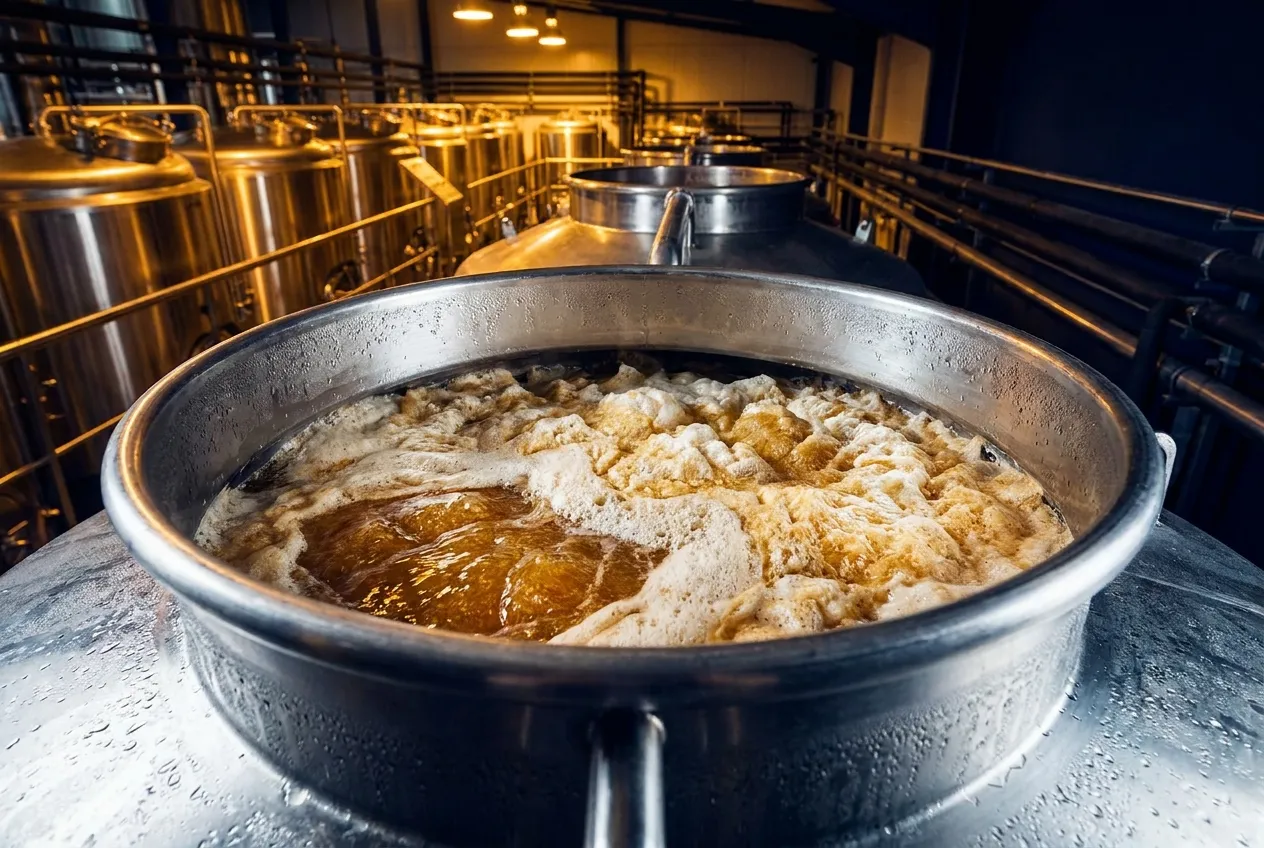
A production fermenter foams into the headspace and the foam-probe is dosing antifoam every cycle. The fermentation scientist wants the foam gone. The downstream team wants to know what it is doing to the ultrafiltration membranes. Purchasing wants to know which chemistry, at what dose, and whether it clears for a food or beverage product. Those three answers do not always point at the same drum.
The short version: silicone (PDMS) is the fastest foam knockdown, but it is a process impurity that fouls UF and hollow-fiber membranes and persists into product. Polyether (EO/PO) controls foam more slowly, survives sterilization, and is removed more readily. Neither is automatically the safe choice, and the right one is driven by your downstream and your substrate, not by which knocks foam down hardest. The honest answer is to carry both and pick per process.
Why commercial fermenters foam
Active microbes throw off a steady stream of carbon dioxide while proteins, glycoproteins, and other compounds in the wort, mash, or media act as surfactants that stabilize the foam. Aeration and sparging add the gas-liquid surface. It gets worse with warm temperature, high-gravity or high-solids media, vigorous strains, and a vessel filled too full to leave headspace for the foam to rise into.
Silicone vs polyether: pick by your downstream
| Factor | Silicone (PDMS / simethicone) | Polyether (EO/PO, PPG) |
|---|---|---|
| Knockdown speed | fastest, lowest dose per drop | slower, needs somewhat more |
| Membrane / UF fouling | fouls; one perfusion study reported complete fouling at 500 ppm | fouls far less |
| Sterilization (SIP / autoclave) | emulsions can destabilize | generally survives |
| Persistence / removal | persists; removed by filtration or centrifugation | more readily removed and biodegradable |
| Oxygen transfer (kLa) | cuts it; a small addition reduced kLa by ~50% in one study | dose-dependent reduction |
| Food / beverage compliance | food-grade grades under 21 CFR 173.340 / E900 | food-grade grades available |
One caveat that kills the lazy “just go non-silicone” answer: in one study a specific non-silicone antifoam was more cytotoxic to CHO cells than silicone. Non-silicone is not automatically biocompatible. Match the chemistry to the cell line, the membrane, and the product, and validate it.
Does antifoam quietly cost you kLa and yield?
Yes, if you over-dose it. A small silicone addition cut the oxygen mass-transfer coefficient (kLa) by roughly 50% in one study, and a mechanical foam-breaker delivered several times the kLa of chemical antifoam in another. Industrial antifoams have been shown in peer-reviewed work to impair ethanol fermentation and stress yeast. Effective doses are low, in the tens of ppm; past that, you penalize oxygen transfer, cell health, and downstream filtration faster than you buy foam control.
The honest implication is that antifoam is sometimes the wrong first move. Headspace, a blow-off or vent strategy, and mechanical foam-breakers should carry the load they can, with chemical antifoam dosed to the minimum the foam-probe actually needs.
Dosing and where to add it
Most commercial fermentation runs antifoam at roughly 0.01 to 0.1 percent by volume, often tens to a couple hundred ppm, dialed in by substrate and strain and controlled by a foam probe rather than a fixed standing dose. Corn, molasses, grain, and media all behave differently, so treat any published figure as a starting point to validate on your own ferment.
Food and beverage compliance
For a food or beverage fermentation, food-grade PDMS is permitted under FDA 21 CFR 173.340 at up to 10 ppm in finished food and listed as E900, with an EFSA ADI of 17 mg/kg. As with any processing aid, 173.340 sets a residue cap and “reasonably required” minimization, not a removal mandate.
Buying for fuel-ethanol, distilleries, and breweries
Fuel-ethanol plants, distilleries, breweries, and bioprocess producers buy antifoam by the drum, tote, and IBC, and the wrong chemistry costs more in fouled membranes and lost yield than it ever saves on price.
See the Silicone Antifoam Emulsion (10-50% active) product page. The same selection logic governs frying and edible-oil foam, and the broader chemistry comparison is in silicone vs. organic defoamers. Ask for both chemistries as samples and qualify them on your own process before you commit.
For bulk supply, emulsion versus compound, dose logic by system, and packaging from pails to IBC totes, see the silicone antifoam supplier page.
Frequently asked questions
Silicone or polyether antifoam for fermentation?
Silicone knocks foam down fastest at the lowest dose but fouls membranes and persists into product; polyether survives sterilization and is removed more readily. Choose by your downstream sensitivity and substrate, and validate; neither is automatically the safe choice.
Does antifoam reduce oxygen transfer or yield?
It can. A small silicone addition cut kLa by about 50% in one study, and industrial antifoams have been shown to impair ethanol fermentation. Keep the dose to the minimum the foam-probe needs, and lean on headspace and mechanical foam control first.
How much antifoam do I dose?
Typically 0.01 to 0.1 percent by volume, tens to a couple hundred ppm, dialed in by substrate and strain under foam-probe control. Treat published figures as starting points to validate on your own ferment.
Does antifoam stay in the product?
Silicone persists and is removed by filtration or centrifugation; polyether is removed more readily. For food or beverage, the binding limit is the 21 CFR 173.340 cap of 10 ppm, not a “no residue” claim.
Is fermentation antifoam food-grade?
Food-grade silicone and non-silicone grades exist, permitted under 21 CFR 173.340 (≤10 ppm) and listed as E900. Confirm the specific grade’s documentation and any kosher, halal, or allergen requirements for your product.
Editorial note. This article is general guidance for commercial fermentation producers, written for industrial and professional use. It is not health or dietary advice. Single-study figures (kLa reduction, membrane fouling) are cited as individual study results, not universal constants, and dose figures are ranges to validate by trial. Regulatory references are compliance facts, not guarantees or health claims. Follow the product Safety Data Sheet (SDS) and label, and confirm compliance for your application. RawSource makes no warranty, express or implied, and assumes no liability for use of this information.
Search 1,300+ industrial chemicals by name or CAS, or send us your spec — we quote by the drum, tote, or container.
Browse the Chemical Index → Request a Quote