
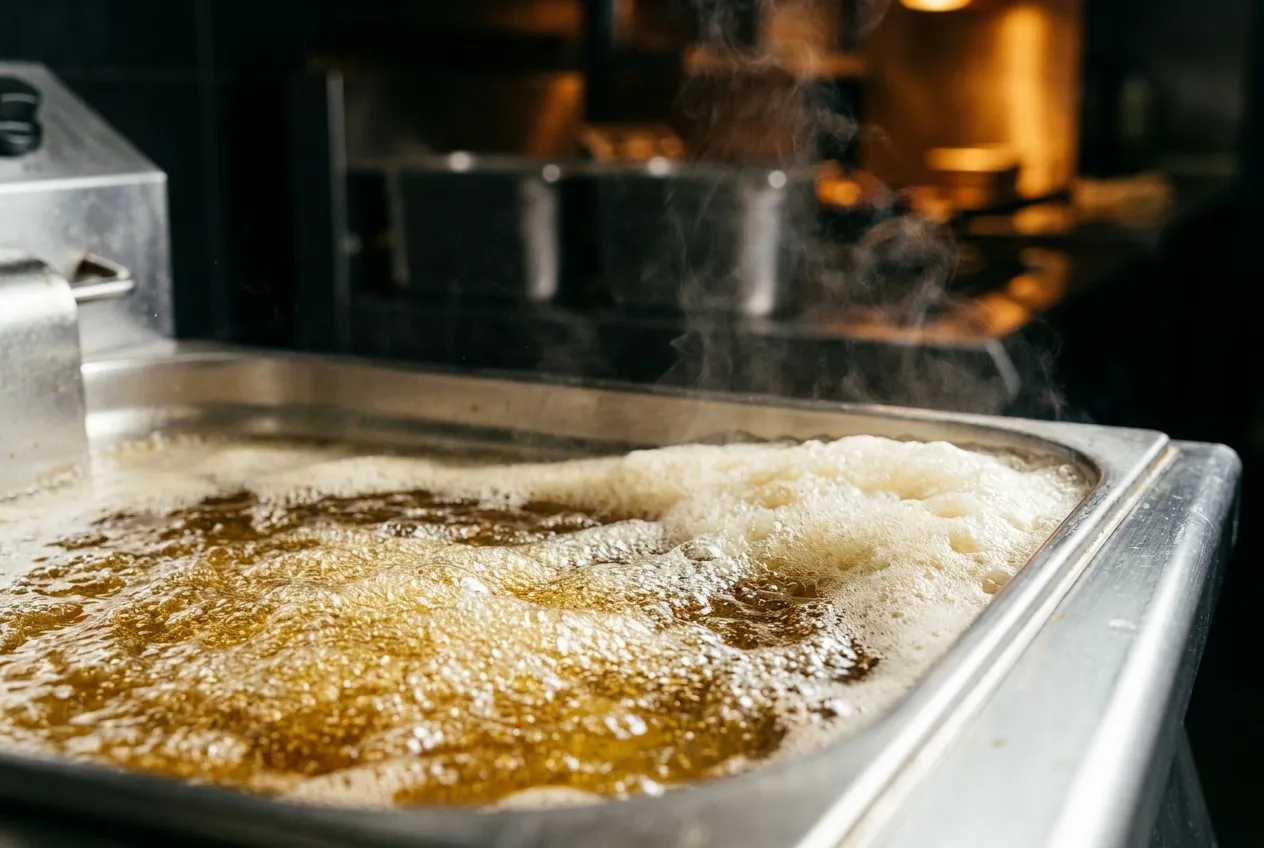
A continuous fryer running thousands of pounds a shift starts pushing foam over the weir, the oil darkens faster than the change schedule predicted, and QA wants to know exactly what is going into the oil and whether it clears 21 CFR. The same question lands on an edible-oil refiner at the deodorizer and on a potato or snack line at the par-fry.
The short version: frying and edible-oil foam comes from three things — moisture flashing to steam, food particles and batter (starch and protein) acting as surfactants, and the oil itself breaking down with reuse and heat into compounds that foam. Oil management handles the basics. A food-grade silicone (PDMS, E900) antifoam at a few ppm controls the rest, and the only question that decides whether you can use it is whether the dose stays inside the FDA 21 CFR 173.340 limit of 10 ppm in finished food.
Why frying and edible-oil lines foam
| Cause | What is happening | Plant signal |
|---|---|---|
| Moisture on incoming product | water flashes to steam and whips the oil into foam | foam spikes at high throughput or wet product |
| Food particles, batter, starch, protein | dissolved solids act as surfactants that stabilize bubbles | foam tracks with fines and batter carryover |
| Oil breakdown (reuse, high heat, FFA rise) | free fatty acids and oxidized polymers raise surface tension | oil darkens, foams on every batch, FFA climbs |
| Long oil life past the change point | accumulated breakdown products | foam that no filtration fixes |
The food-grade compliance gate (and the math QA actually checks)
This is the go/no-go for a food plant, so lead with it. Food-grade polydimethylsiloxane is permitted as a defoaming agent under FDA 21 CFR 173.340 at up to 10 ppm in finished food. It is listed in Europe as E900, and EFSA’s 2020 re-evaluation set an acceptable daily intake of 17 mg per kg of body weight.
Two points QA cares about that competitors gloss over. First, 173.340 sets a residue cap plus a “reasonably required” minimization — it is not a removal mandate, and “zero residue” is marketing, not the rule.
Second, the limit is on active silicone, so do the arithmetic: a 10%-active emulsion dosed at 100 ppm of product leaves 10 ppm active, right at the line; a 30%-active concentrate hits the same 10 ppm active at about 33 ppm of product. Pick the active grade and dose so active stays at or below 10 ppm.
How processors control fryer foam
Manage the oil first: filter fines between batches, hold temperature, track FFA, and change oil on condition rather than only on a calendar. Then a food-grade silicone antifoam carries the rest. PDMS paired with hydrophobic silica spreads across the oil and ruptures the foam film at parts-per-million, cutting boil-overs and splatter and extending oil life. It is the same dimethylpolysiloxane many oils already carry from the refiner to control splatter.
When silicone is not the answer
For most fryer and edible-oil duty, food-grade silicone is the right tool at a very low dose. The exceptions are downstream: where a finished product needs the silicone filtered or centrifuged out for clarity, or where a customer spec or a kosher, halal, or allergen requirement points to a particular grade. That is a selection question, not a reason to avoid antifoam, and it is why carrying both silicone and non-silicone food-grade grades matters.
Buying food-grade antifoam in bulk
Snack and potato processors, edible-oil refiners, and foodservice oil-management programs buy by the drum, tote, and IBC, and they buy on compliance documentation as much as on price.
The same chemistry controls foam in commercial fermentation, and the silicone-versus-non-silicone trade-offs are in silicone vs. organic defoamers. Trial a sample on your own oil before you commit to a tote.
Frequently asked questions
Why does frying oil foam at plant scale?
Moisture flashing to steam, food particles and batter acting as surfactants, and oil breakdown from reuse and heat. The more an oil is reused and the more fines it carries, the more readily it foams, until eventually it foams on every batch and needs replacing.
Is the antifoam food-safe, and what does 21 CFR 173.340 require?
Food-grade PDMS is permitted under 21 CFR 173.340 at up to 10 ppm in finished food, listed as E900, with an EFSA ADI of 17 mg/kg. The rule sets a residue cap and “reasonably required” minimization; it does not require removal, and it is not a health claim.
How much antifoam can I use?
Keep active silicone at or below 10 ppm in the finished food. Work back from the grade’s active percentage: a 10%-active emulsion reaches 10 ppm active at 100 ppm of product. Dose the minimum that controls foam, and validate on your own line.
Does the antifoam stay in the product?
Some remains as residue within the 10 ppm cap; some is removed by filtration or centrifugation depending on the process. Anchor any residue statement to the CFR limit rather than to a “no residue” claim.
Why does reused oil foam more than fresh oil?
Reuse and heat break the oil down into free fatty acids and oxidized polymers that raise surface tension and stabilize foam, so older oil foams more readily and eventually foams on every batch regardless of antifoam.
Editorial note. This article is general guidance for food and edible-oil processors, written for industrial and professional use. It is not health or dietary advice. Regulatory references (21 CFR 173.340, E900, EFSA ADI) are stated as compliance facts, not product guarantees or health claims. Confirm food-contact compliance and certifications for your application and jurisdiction, and follow the product Safety Data Sheet (SDS) and label. Dose figures are typical literature ranges to validate by trial. RawSource makes no warranty, express or implied, and assumes no liability for use of this information.
Search 1,300+ industrial chemicals by name or CAS, or send us your spec — we quote by the drum, tote, or container.
Browse the Chemical Index → Request a Quote