
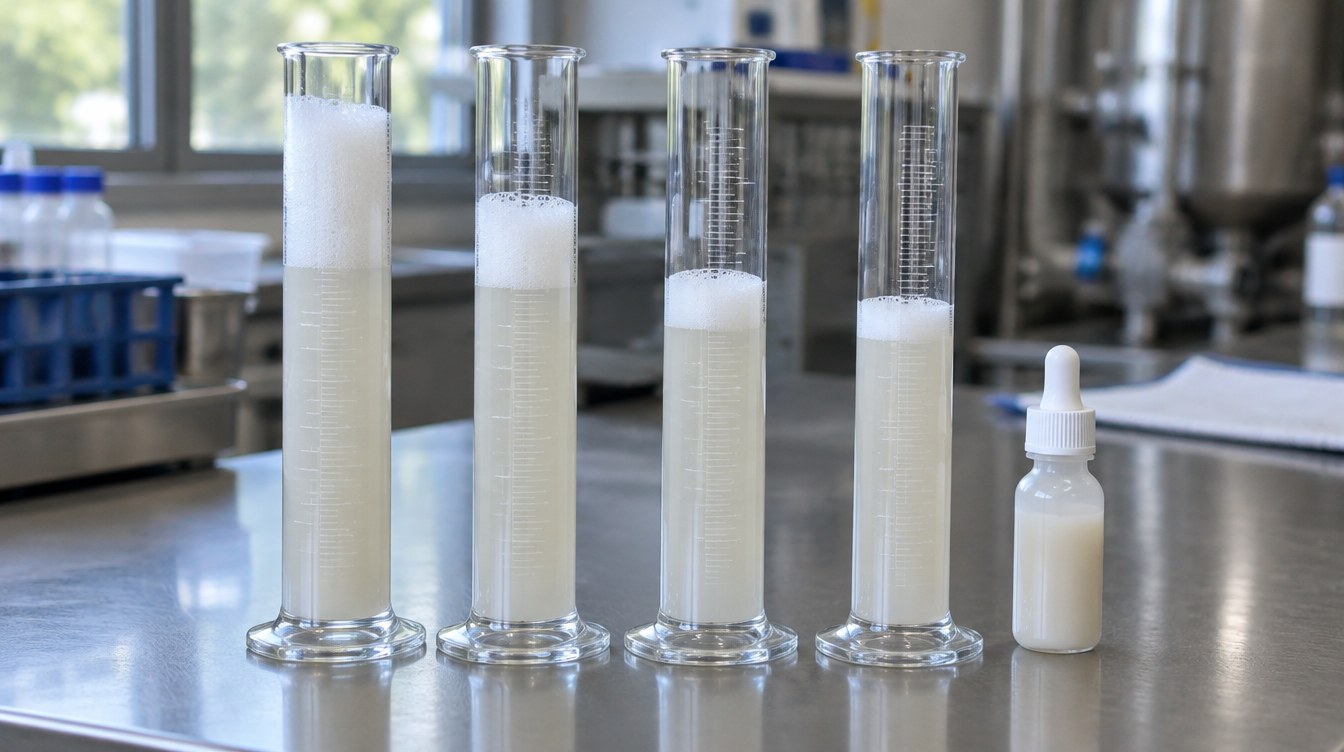
Three requests for “defoamer” reach purchasing in the same week. The wastewater operator wants the aeration basin to stop foaming over the walkway. The produce line wants the wash flume quiet. The cleaning-chemicals plant wants a machine detergent that does not foam in the spray arms. One silicone antifoam emulsion would knock down all three foams in a jar. As bought, it is ready for only one of those processes: the produce line needs documents the drum does not carry, and the detergent needs proof the defoamer survives its concentrate.
The process picks the family of defoamer; a jar test then picks the product and the dose inside that family. Reverse the order and you compare products that should never have been on the same quote.
What are defoamers, and which type suits which process?
A defoamer is an insoluble liquid, often carrying water-repellent particles, that enters foam bubble walls and ruptures them. Choose the type from the process. Water-based foam starts with a silicone emulsion. Oil-phase foam, such as foam in crude oil, starts with a silicone fluid. Lines where silicone must stay out start with an organic or polyether grade, and dry blends take one of these actives in powder form.
In plant and trade use, defoamer and antifoam are interchangeable names. Dosed onto a standing head of foam, the product is defoaming; metered in upstream before foam forms, it acts as an antifoam. The film-breaking physics, and why hydrophobic silica makes it fast, are set out in how silicone antifoam works. For a buyer, one requirement matters: the active must stay undissolved in the foaming liquid, which is why no single family covers every process.
Three families, and the question that separates them
Three families of active appear on quotes for industrial defoamers. Silicone defoamers use polydimethylsiloxane (PDMS), the polymer with the repeat unit (C2H6OSi)n, with hydrophobic silica dispersed in it for water-based foam. Organic defoamers use mineral oil, fatty alcohols, or esters and vegetable oils. Polyether defoamers use polyglycols or ethylene oxide/propylene oxide block copolymers, which come out of solution above their cloud point.
A powder defoamer is one of these actives on a dry carrier, for blends wetted later: a form, not a fourth family. Where an oil dissolves a silicone fluid, the usual answer is a fluorosilicone.
The question that separates them is where the active ends up after the foam is gone. Silicone stays silicone on a paint film, a metal part or a membrane. The comparison of silicone and organic defoamers goes deeper; the working rule is simpler. If nothing downstream minds silicone, start with silicone. If something does, start organic or polyether, and price the trial at the dose that family needs, not the dose silicone needed.
On quotes the silicone product travels under several names: PDMS antifoam, silicone defoamer and polydimethylsiloxane antifoam are catalog synonyms for silicone antifoam emulsion (10-50% active). CAS 63148-62-9 identifies its silicone (PDMS) active, not the emulsion as a whole, which also carries water and emulsifiers.
Which defoamer for which process?
| Process | What foams | Family to start from | Check before you buy |
|---|---|---|---|
| Wastewater aeration basins and digesters | Water carrying detergent and biological surfactants | Silicone antifoam emulsion | For membrane systems, the membrane maker’s list of compatible antifoams |
| Vegetable washing and food processing | Wash water carrying starch, protein and plant juice | A grade documented for direct food contact; specify on the RFQ | Technical Grade is not food-contact documentation |
| Fermentation | Broth under aeration and agitation | Specify on the RFQ: silicone or polyether | What the antifoam does to downstream filtration and recovery |
| Waterborne paints, inks and adhesives | The product during mixing, filling and application | A silicone grade selected for coatings, or silicone-free | Craters and recoat failure on a drawdown at your highest dose |
| Cleaning products for machines, CIP and parts washers | Surfactant solution under spray and pump agitation | Specify on the RFQ: silicone emulsion or polyether; silicone-free for washers whose parts go on to paint or plating | Stability in the concentrate, then performance at use dilution |
| Crop protection: water-based concentrates and spray tanks | Tank mix during filling and agitation | Silicone antifoam emulsion (not for oil- or solvent-based concentrates, which need a water-free grade) | A jar test of the full tank mix in its order of addition, and written confirmation of permitted use from the supplier and the registrant |
| Crude oil and gas separation | Oil-phase foam in the separator | Silicone fluid, picked by viscosity | Water-based emulsions are built for water, not oil |
| Amine gas treating | Amine solution fouled by hydrocarbons or solids | Specify on the RFQ: silicone or polyglycol | The contaminant causing the foam, before the antifoam |
| Detergent powders | Wash liquor once the powder dissolves | Powder defoamer on a carrier | How the powder disperses as it wets out |
| Dry-mix mortars | Air entrained during mixing, a deaerator case, not foam | Powder defoamer on a carrier, as a deaerator | Air content of the fresh mortar |
Silicone antifoam emulsion is cataloged at 10%, 20%, 30%, 40% and 50% active silicone, as a Technical Grade, for aqueous foam control in chemical processing, water treatment and coatings. A higher active level means less water shipped per kilogram of silicone, not a stronger product, so compare quotes per kilogram of active on one stated basis.
Fine bubbles trapped inside a lubricating oil, a hydraulic fluid or a coating are entrained air, not foam, and a foam inhibitor that holds down surface foam can slow the release of that air. Read defoamer vs deaerator before adding more defoamer to a fluid that is already foam-free on top.
Can an antifoam go into vegetable wash water?
Only a grade documented for that use. Vegetable wash water foams because cutting and washing release starch, protein and plant juice, and flume pumps and drops whip them into a head. Any antifoam added to that water reaches the food, so the buying question is not which antifoam breaks the foam fastest but which one is documented for direct contact with produce in your market.
Silicone antifoam emulsion (10-50% active) is cataloged as Technical Grade, and Technical Grade is not that documentation. Put the requirement on the RFQ in plain words: direct food contact, the produce, the wash step and whether a rinse follows. Then require the regulation’s citation and date in writing from the supplier, not a “food grade” adjective on a data sheet.
Check the water before the chemistry. Foam that rises and falls with the solids load in the flume points to water exchange or solids removal as the fix, and either one cuts foam without adding anything that touches the food. The same order covers silicone antifoams in other food applications, from evaporators to fermenters: the documented grade comes first, performance second.
Silicone foam control in cleaning products and crop sprays
In cleaning products, the defoamer has two jobs at two concentrations. It must stay dispersed in the concentrate for the product’s shelf life, through whatever alkali, salt or solvent the cleaner carries, and it must still break foam after the buyer dilutes it. Test the finished concentrate after storage at your warehouse’s warmest and coldest conditions, then test the use solution at its use temperature.
Keep silicone out of washers whose parts go on to paint, plating or bonding, because residue on the metal shows up later as craters or poor adhesion. Products sold on their foam, such as hand cleaners, need no defoamer at all.
Silicone foam control on crops works at two points, and each has its own test. Built into a water-based concentrate, the emulsion faces the cleaning-product problem: it must stay dispersed through shelf life and still work after dilution in the tank. Added by the applicator, it meets a tank mix that changes with every product list, so the jar test belongs to the mix, run in your order of addition, with the crop protection product’s label deciding what may be mixed.
At either point, get written confirmation from the supplier and the crop protection product’s registrant that the antifoam is permitted for that use, as for vegetable wash water.
How do you judge defoaming performance before you buy?
Measure two things in your own liquor at process temperature. Knockdown is the foam height a set time after dosing, or the time a standing head takes to collapse. Persistence is how long the foam stays down while aeration or agitation continues. A product that wins on knockdown but fades within the shift needs a heavier, steadier feed than one that is slower and holds.
Rank products within one family at equal active dose, not equal product weight; across families, compare cost at the dose each needs to hold the foam down. Setting the dose itself is covered in the defoamer dosing guide.
Product dosed beyond what the liquor needs does not stay in the foam. It travels downstream as craters, membrane film or residue. A polyether grade used below its cloud point fails differently: it dissolves and behaves like one more surfactant.
What the RFQ should carry:
-
The process and the foaming medium: water-based, oil-phase or a dry blend, with temperature and pH.
-
The family, or what must stay out, written as “silicone-free, including treated particles and emulsifiers” where that applies.
-
The form: an emulsion at a stated percent active with its basis, a neat fluid called out by viscosity, or a powder.
-
For food contact, the documented grade with the regulation’s citation and date.
-
What sits downstream: a paint line, a membrane, a plating tank or a discharge permit.
-
Storage limits from the technical data sheet (TDS), because emulsions can break if they freeze or overheat, plus the current safety data sheet (SDS).
-
The trial result you accepted, and a certificate of analysis (CoA) tied to each lot.
Methodology: identity data (CAS Registry Number 63148-62-9, the (C2H6OSi)n repeat unit, the catalog synonyms, the 10% to 50% active range and the Technical Grade designation) come from the catalog record for silicone antifoam emulsion. Process guidance is general colloid and process chemistry, stated without figures because no product test data were used.
Frequently asked questions
What should an antifoam for vegetable washing come with before it reaches the line?
Can one defoamer cover every foaming problem in a plant?
Which defoamer is used in oil and gas?
Why does a defoamer that won the lab test fail on the line?
Sources & methodology
Figures are RawSource sourcing data unless attributed to a named source. Regulatory citations are current as of publication. Chemical identities verified by CAS number against the RawSource catalog.
Search 1,300+ industrial chemicals by name or CAS, or send us your spec — we quote by the drum, tote, or container.
Browse the Chemical Index → Request a Quote