
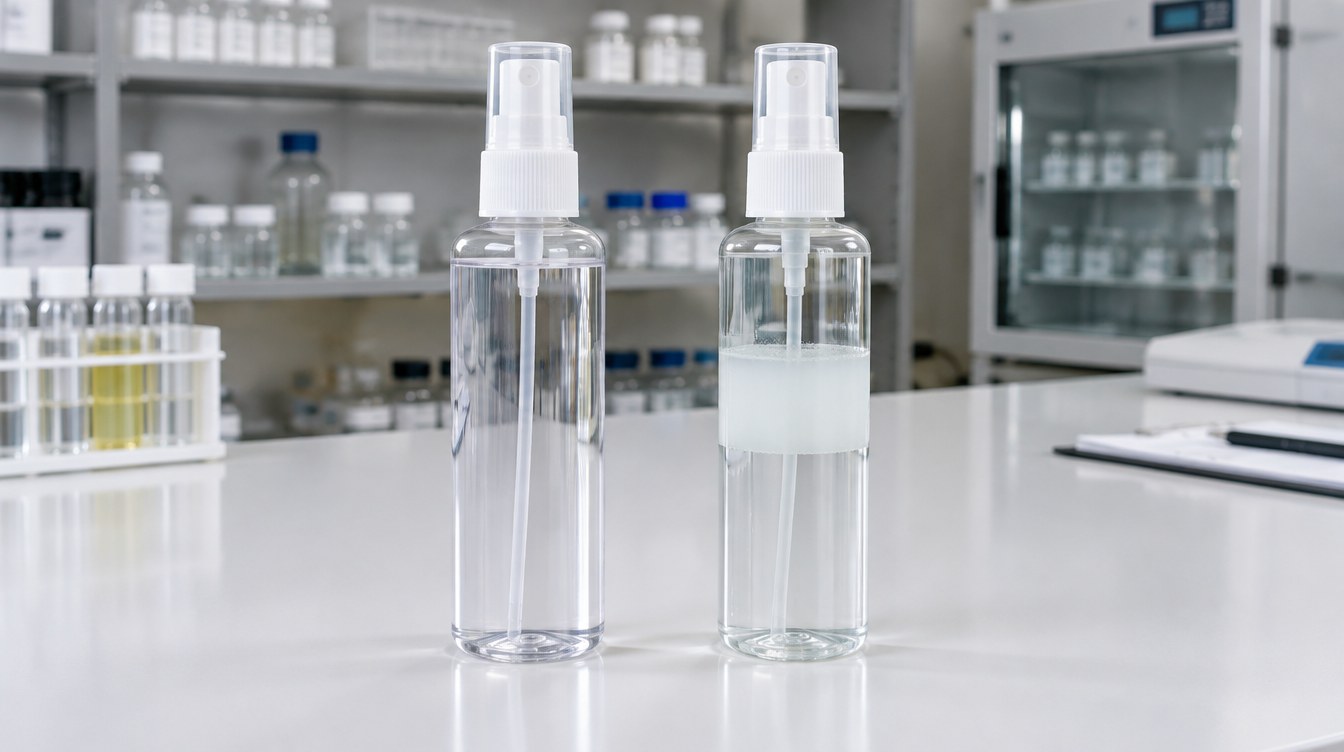
A clear, water-thin hair mist separates in its first stability check, and the trail leads to purchasing. The formula specifies PEG-12 dimethicone, but someone shortened the item-master line to plain dimethicone, a name that looks almost the same on a label and belongs to a silicone that does not dissolve in water.
The two names share a silicone backbone and sit side by side on ingredient lists, yet they do opposite jobs in water. Mixing them up is the obvious mistake. The quieter one is assuming that the name PEG-12 dimethicone, or its CAS number, fixes the grade you receive.
What is PEG-12 dimethicone, and is it water-soluble?
PEG-12 dimethicone (CAS 68937-54-2) is dimethicone with polyethylene glycol chains grafted onto its silicone backbone, which makes it a water-soluble or water-dispersible, nonionic silicone surfactant. In hair and skin formulas it emulsifies water and silicone phases, wets surfaces and pigments, and adds a conditioning silicone feel. Its HLB and use level belong to the grade, not the name.
On its own, PEG-12 is the INCI name of a polyethylene glycol. In INCI naming, the number after PEG is the average count of ethylene oxide units the definition assigns, so PEG-12 means an average of twelve. PEG-12 dimethicone attaches polyethylene glycol to a dimethicone backbone, and the result is amphiphilic: the siloxane segment prefers oil and silicone, while the polyether segment prefers water.
The name stops there. It does not say how long the silicone backbone is, how many polyether chains are attached, or where they sit. Those choices decide where a grade lands between silicone character and water solubility, and so whether it works better as an emulsifier or as a wetting agent.
That is why HLB is a grade property. The HLB a supplier reports reflects the balance of polyethylene glycol to silicone in its own polymer, so two drums labeled PEG-12 dimethicone can carry different values. Ask for the HLB on the Technical Data Sheet (TDS) with the method behind it, and never borrow a number from another supplier’s grade.
Use level follows the same logic. Take the starting range from the TDS of the exact grade, then confirm it with a ladder trial in your own base before you commit to volume. A level that gives clean wetting in a cleanser says little about the level needed to hold a silicone phase in emulsion.
Is dimethicone water-soluble? No, and that decides where it goes
Dimethicone (CAS 9006-65-9) is linear polydimethylsiloxane, a silicone fluid with no polyether attached, and it does not dissolve in water. The EU CosIng record for dimethicone (2023) lists antifoaming and emollient functions. Outside cosmetics the same chemistry is used as an antifoam in aqueous systems and as a slip agent for films, yarn and fillers.
Because it cannot dissolve, dimethicone enters a water-based product only as an emulsion or as droplets held in suspension. The antifoam listing adds a second reason to check lather on any shampoo that carries it.
In hair care, a 2025 review of silicones in hair care describes dimethicone as a first-generation, water-insoluble silicone that gives hair shine, and notes that prolonged use of water-insoluble silicones such as dimethicone can build up on the hair shaft.
A 1994 review of two-in-one shampoo technology explains why a neutral silicone suits a shampoo. In its framing, a cationic conditioner in an anionic surfactant base complexes with the surfactant, so neither cleansing nor conditioning is fully achieved; the review’s answer was charge-neutral dimethicone suspended as microfine droplets in a crystal lattice and released on rinsing. Later two-in-one shampoos also use cationic polymers on purpose, to help deposit the silicone.
PEG-12 dimethicone answers a different question. It dissolves instead of sitting in the base as droplets, so it can go into a clear product, and it rinses away more readily than dimethicone. That makes it the wetting agent and emulsifier of the pair, not the silicone you count on for a film that stays behind.
Which silicone does which job in a hair formula?
Dimethicone, PEG-12 dimethicone and an amino silicone differ in charge as much as in water behavior, and the table sets them side by side.
| Dimethicone | PEG-12 dimethicone | Amodimethicone | |
|---|---|---|---|
| What it is | Linear polydimethylsiloxane | Dimethicone with polyethylene glycol chains grafted on | Siloxane polymer carrying amino functional groups |
| Charge | Neutral | Nonionic | Cationic conditioning class |
| In water | Insoluble; needs an emulsion or a suspension | Soluble or dispersible, by grade | Insoluble as a fluid; formulated as an emulsion |
| Job in the formula | Slip, shine, a persistent film | Wetting, emulsifying, conditioning feel | Hair conditioning |
| Watch point | Build-up with prolonged use | HLB and use level differ by grade | Complexing with anionic surfactants |
| Buy on | Viscosity grade | INCI name plus the grade’s TDS values | Amine value and viscosity; active content and particle size for an emulsion |
Read the table by the phase your formula is built on. A clear shampoo, a water-thin mist or a gel needs either a silicone that dissolves, such as PEG-12 dimethicone, or a silicone supplied as a microemulsion fine enough to stay clear. Neat dimethicone fluid is neither. An anhydrous serum, or the oil phase of a leave-on cream, takes dimethicone directly.
A conditioner or a two-in-one shampoo can use both: dimethicone as the silicone that stays on the fiber, held by the conditioner’s gel network or the shampoo’s suspending system, and PEG-12 dimethicone as a co-emulsifier or wetting aid.
Decide the continuous phase first and pick the silicone second. Specifying plain dimethicone fluid into a water-thin base, on the strength of a similar name, gives you a batch that separates on the shelf.
For scale on the silicone that stays behind, two published data points help. The 2023 test conditioner described below carried 2% amino silicone, and US Patent 10,285,925 (2019) claims 3% to 25% amodimethicone by weight in a concentrated rinse-off conditioner, substantially free of high-melting-point fatty alcohols and dispensed as foam, made as a nanoemulsion with amodimethicone particles from 1 nm to 100 nm.
Patent ranges are published claims, not a recommendation to work inside them (check freedom to operate before copying a patented formula), and none of these figures is a use level for PEG-12 dimethicone or dimethicone.
Does the hair type change how much silicone deposits?
A 2023 study in the International Journal of Cosmetic Science measured hair surfaces with chemical-force microscopy and contact angles. Virgin hair came out hydrophobic, with a polar surface-energy component close to zero. Platinum-bleached hair carried a polar component of 42.1 mJ/m2 and behaved as hydrophilic. The authors conclude that hydrophobic interaction drives deposition on virgin hair, while electrostatic interaction matters most on bleached hair.
Deposition followed the surface. The authors added 2% of a 10,000 cps amino silicone, which they label amodimethicone, to a cationic conditioner base of cetyl and stearyl alcohols with stearamidopropyl dimethylamine. After three wash cycles, measured silicone on virgin hair rose from 71 to 1273 micrograms per gram of hair, with a spread of plus or minus 676. On bleached hair the same addition reached only 74 micrograms per gram, against 10 for the base alone.
That is one study, with three fiber samples from each of three tresses behind the virgin-hair figure and wide scatter, and neither PEG-12 dimethicone nor dimethicone was tested. The gap is still too large to ignore.
A reading, not a finding of that paper: neither dimethicone nor PEG-12 dimethicone carries a charge, so on bleached hair neither has the electrostatic route the authors found most important there. If your line is sold for bleached hair, run feel and deposition panels on bleached tresses as well as virgin ones before you settle the silicone package.
How to write PEG-12 dimethicone on a purchase order
The CAS number alone will not do it, and neither will the name. The INCI name sets the average ethylene oxide count, not the silicone chain length or the number of polyether chains, and printing a CAS number beside it adds no HLB and no use level. Those numbers belong to one supplier’s polymer, so they have to come from the grade’s TDS and be written on the line.
Write the line so a supplier cannot answer a different question:
-
Identity: the INCI name as written in your approved formula, PEG-12 dimethicone, with CAS 68937-54-2 as a supporting field, not the primary one.
-
Grade data: the HLB with its method, the clarity of a solution in water at your use level, and the role the supplier designs the grade for, emulsifier or wetting agent.
-
Qualification: a sample from the grade you will buy, tested in your own base at your use level and fill temperature before you commit to volume.
-
Documents: a Certificate of Analysis (CoA) for every lot and the current Safety Data Sheet (SDS) for the exact grade. Take hazard and handling information from that SDS.
-
Dimethicone on the same order: the viscosity grade written on the line, never the bare name.
Methodology: CAS numbers 68937-54-2 and 9006-65-9 from catalog identity records; dimethicone functions from the EU CosIng record; hair-surface and deposition data from a 2023 study in the International Journal of Cosmetic Science (PubMed Central); hair-care context from a 2025 review in Skin Appendage Disorders and a 1994 review of two-in-one shampoo technology.
Frequently asked questions
Is dimethicone water soluble?
Is PEG-12 dimethicone the same as dimethicone?
What does PEG-12 dimethicone do in hair products?
What is the HLB of PEG-12 dimethicone?
How much PEG-12 dimethicone should a formula use?
Sources & methodology
Figures are RawSource sourcing data unless attributed to a named source. Regulatory citations are current as of publication. Chemical identities verified by CAS number against the RawSource catalog.
Search 1,300+ industrial chemicals by name or CAS, or send us your spec — we quote by the drum, tote, or container.
Browse the Chemical Index → Request a Quote