Caustic soda (sodium hydroxide, NaOH) is one of the highest-volume commodity chemicals globally, essential for alumina refining, pulp and paper production, water treatment, and chemical synthesis. Procurement teams working with a bulk chemical supplier for NaOH container-load orders must verify grade, form, and origin before placing a purchase order: those three decisions drive cost per MT, supply continuity, and quality consistency.
This guide covers everything a senior sourcing manager needs to decide where to buy caustic soda, what grade to specify, which form fits your operation, and how to structure a reliable supply contract for bulk quantities.
Caustic Soda Forms: Flakes, Pearls, and Liquid
Caustic soda is supplied in three physical forms, each with different cost, handling, and logistics implications. The right choice depends on your production equipment, storage capacity, and downstream processing.
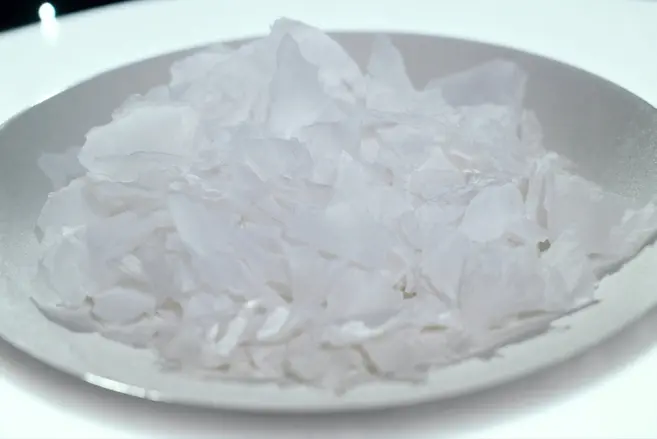
Flakes (Solid): Flakes are irregular, angular crystals produced by cooling molten NaOH. They are the most commonly traded form for international bulk commerce. Typical container-load density is 21-24 MT per 20-foot FCL. Flakes require drums or big bags for safe handling. Cost per MT is lowest among all forms, typically $280-380/MT FOB depending on origin and purity grade. Storage requires dry conditions; flakes absorb moisture rapidly.
Pearls (Solid): Pearls are spherical granules, easier to handle than flakes and less prone to dust generation during loading/unloading. Pearls command a 5-15% price premium over flakes due to manufacturing costs. They are preferred for automated dosing systems and higher-hygiene applications. Container loads average 20-23 MT for 20-foot FCL.
Liquid (Aqueous Solution): Liquid caustic soda is supplied in 45-50% aqueous solution. It eliminates solid handling and dust concerns but requires tanker transport (ISO tanks, flexitanks, or specialized drums). Liquid pricing is quoted per MT of NaOH content, not per ton of solution. Landed cost per MT of NaOH is typically 15-25% higher than flakes due to water weight and specialized logistics. Liquid is ideal for large-volume end users with continuous production (water treatment chemicals plants, pulp mills, chemical synthesis facilities).
Form decision framework: Use flakes or pearls for batch operations, chemical manufacturing, or where you have 3+ month inventory turnover. Use liquid only for operations with monthly-plus NaOH consumption where dosing automation and dust elimination justify the 15-25% cost premium.
Caustic Soda Grades: 98%, 99%, and Specialty
Purity specifications directly affect price and suitability for downstream use. Most global commodity trading revolves around three grades.
98% Minimum (Standard Industrial Grade): This is the most widely traded grade. “98% min” means the product contains at least 98% NaOH; the remaining 2% is typically sodium chloride (NaCl), sodium carbonate (Na2CO3), and water. This grade suits alumina production, pulp bleaching, and general chemical synthesis. Pricing: $280-350/MT FOB major exporting ports. Lead time from India/China: 4-6 weeks FCL.
99% Minimum (Purified Industrial Grade): Higher purity commands a 10-20% price premium. Impurity content is tightly controlled. This grade is mandatory for food processing applications, pharmaceutical intermediate production, and soap/detergent manufacturing. Pricing: $320-420/MT FOB. Sourcing lead time increases slightly; additional QC testing adds 1-2 weeks.
99.5% and Higher (Specialty/Reagent Grade): Used for electronics manufacturing, semiconductor processing, and specialized chemical synthesis. Prices exceed $500/MT FOB and are rarely sourced in container-load quantities by standard procurement teams. Skip this grade unless your application explicitly requires it.
Grade specification strategy: Verify with your quality team the minimum acceptable purity. Over-specifying (e.g., buying 99% when 98% suffices) wastes 10-20% annually. Under-specifying risks production failures, batch rejections, or regulatory non-compliance. Confirm your specification in writing before issuing an RFQ.
Caustic Soda Pricing Dynamics and Cost Drivers
Caustic soda pricing is volatile, driven by feedstock costs, production capacity utilization, and regional supply/demand balance. For a broader context on how commodity chemical prices shift in response to market shocks, see our analysis of the 2026 petrochemical price shock.
Primary cost drivers:
Salt (NaCl) feedstock prices directly impact production costs. Chlor-alkali facilities electrolyze salt brine to produce chlorine gas and caustic soda. Rising salt prices translate to higher NaOH costs within 4-8 weeks. Monitor salt prices (tracked on commodity exchanges) as an early indicator of NaOH price movement.
Electricity costs are the second largest operating expense in chlor-alkali production. Energy-intensive regions (China with coal-fired power, India with natural gas access) have lower production costs. European caustic soda production costs are 20-30% higher due to energy costs, making European production non-competitive for bulk commodity export.
Production capacity utilization affects pricing significantly. When global capacity is 85%+ utilized, prices firm up. When utilization falls below 70%, price pressure increases. Track major producer announcements (SABIC, Xinjiang local producers, India-based capacity) for planned maintenance or new production lines.
Regional supply/demand imbalances create pricing opportunities. North America (concentrated production near Houston) supplies US and Americas markets. Middle East producers (SABIC) export globally at competitive FOB prices. Indian and Chinese producers supply Asia-Pacific and downstream markets. Arbitrage opportunities exist when regional prices diverge by more than freight and duty costs.
Price ranges and trends (Q1 2026 reference):
- FOB India (flakes, 98%): $300-340/MT
- FOB China (flakes, 98%): $285-320/MT
- FOB Middle East/Saudi Arabia (flakes, 98%): $310-360/MT
- FOB USA (flakes, 98%): $350-420/MT (domestic-focused, minimal export availability)
- CIF major importing ports (Asia): Add $40-70/MT for freight depending on origin
Pricing negotiation tactic: Don’t compare FOB prices in isolation. Always calculate landed costs (FOB + freight + duty + port charges + inland transport). A supplier with a $5/MT lower FOB price can become more expensive after duty. Request pricing in CIF format (Cost, Insurance, Freight included) to compare apples to apples.
Supply Geography: Where to Source Caustic Soda
The caustic soda supply base is concentrated in a small number of producing regions. Sourcing strategy should account for lead times, reliability, and geopolitical risk.
China (Largest Exporter): Xinjiang province is the global epicenter of caustic soda production due to abundant salt reserves and coal-based electricity. Major producers: Kashgar Chemical, Xinjiang Tianye, Liaoning Swanson Chemicals. Lead time: 4-5 weeks FCL from Shanghai/Qingdao ports. Pricing is typically lowest globally but faces anti-dumping duty exposure in India, EU, and certain other markets. Quality is generally reliable; verify CoA issuing lab credentials before first order. Risk: Environmental enforcement actions occasionally trigger unexpected production shutdowns.
India (Second-Largest Exporter): Major production: Tamil Nadu, Gujarat. Producers: Caustic Chemicals Limited, Tronox Alkali, local regional producers. Lead time: 3-4 weeks FCL from Mundra, JNPT, or Paradip ports. Pricing: typically $10-25/MT premium to China but often avoids anti-dumping duty exposure. Quality consistency is strong; Indian producers operate under BIS certification. Risk: Port congestion at JNPT affects reliability; Mundra is more reliable but has lower throughput.
Middle East (Saudi Arabia, UAE, Oman): SABIC (Saudi Basic Industries) is the leading producer; additional capacity in UAE and Oman. Lead time: 4-6 weeks FCL from Jebel Ali (Dubai), Jubail (Saudi Arabia). Pricing: competitive with China but often avoids trade duty exposure depending on your import market. Reliability is high; SABIC has global distribution and strong documentation. Minimum order quantity: 50-100 MT typical; Raw Source can structure smaller container loads via consolidation.
North America (USA, Canada): Concentrated around Houston/Texas Gulf Coast. Producers: Olin Corporation, Westlake Chemical, Axiall. Lead time: 5-6 weeks from Houston/Corpus Christi ports. Pricing: significantly higher ($350-420/MT FOB) due to higher production costs. Sourcing North America only makes sense if you have tariff relief or anti-dumping duty exposure to other origins.
Europe: Limited production (BASF, Solvay, Akzo Nobel). Extremely high costs ($450-550/MT FOB) make European sourcing uncompetitive for standard commodity bulk orders. Source Europe only for specialty grades or if proximity to your consumption site eliminates freight costs.
Geographic sourcing strategy: For the lowest cost, source China with anti-dumping duty analysis. For reliable, duty-free supply, establish a secondary source in India or Middle East. For mission-critical supply, maintain a third source. This three-source portfolio ensures supply continuity if one origin faces disruption.
Caustic Soda Specification and Quality Verification
Receiving off-spec caustic soda can halt production for days. Before placing a first order, define your specification clearly and establish incoming quality testing.
Specification essentials: Define purity (% NaOH minimum), moisture content (max %), sodium chloride (max %), sodium carbonate (max %), iron content (max ppm), and any other critical parameters for your application. Request a Certificate of Analysis (CoA) showing results for all parameters and the test methods used.
Certificate of Analysis verification: CoA fraud is common in caustic soda trading. Before accepting a CoA as proof of compliance:
- Verify the testing laboratory is NABL-accredited (India) or equivalent in origin country
- Confirm the lab is independent (not the manufacturer’s own lab, which introduces bias)
- Request a recent CoA for review before order; compare against supplier’s historical COAs for consistency
- For first orders, mandate pre-shipment inspection by SGS, Bureau Veritas, or Intertek ($400-600 per shipment)
- For ongoing suppliers, conduct incoming testing at destination at least quarterly
Incoming testing setup: Use titration or HPLC to verify NaOH content. Karl Fischer analysis confirms moisture. Atomic absorption spectroscopy checks iron and other trace metals. Establish an SOP with your lab so that first-arrival testing happens before goods are released to production.
Caustic Soda Purchase Contract: Essential Clauses
A well-structured contract protects you from quality failures, delivery delays, and price disputes.
Quality specification clause: Specify purity grade, test method, acceptable variance, and inspection procedure. Example: “Product shall be 98% NaOH minimum by titration (ASTM D2777 or equivalent). Buyer reserves the right to conduct independent verification testing within 72 hours of discharge. Non-compliance >1% NaOH shall entitle buyer to reject shipment or request credit note equivalent to [X]% of invoice value.”
Certificate of Analysis requirement: Mandate that supplier provides CoA before shipment. Specify that CoA must be issued by an independent, accredited laboratory, not by supplier’s own QC. Set out that CoA must include test method references and date of testing.
Delivery and penalty clause: Specify delivery timeline, acceptable lead time variance, and supplier obligations if delivery is delayed. Example: “Delivery within [X] days of order confirmation. Delays beyond [Y] days entitle buyer to cancel order without penalty. Delays of 7-14 days trigger [X]% price credit.”
Force majeure and supply interruption: Specify that force majeure events (natural disasters, government actions, war) do not exempt supplier from timely notice and mitigation efforts. Supplier must notify buyer within 48 hours and provide alternative sourcing options within 5 days.
Price adjustment clause: If sourcing on a spot or quarterly price, specify the reference price index (e.g., “Quarterly average FOB China spot price published by ICIS Chemical Business”) and the adjustment mechanism. Avoid unlimited price revision rights; cap adjustments at +/- 5-10% per order.
Payment terms: Standard payment is 30-40% advance against order confirmation; 60% against signed shipping documents (Bill of Lading); 10% upon receipt and acceptance of goods. LC (Letter of Credit) at sight is common for new suppliers; TT (Telegraphic Transfer) is preferred for established relationships.
Lead Times and Logistics Planning
Caustic soda sourced internationally requires 4-6 week lead times. Plan procurement accordingly.
Order-to-discharge timeline:
- Week 1-2: Supplier receives order, confirms production schedule.
- Week 2-4: Production and quality testing.
- Week 4: Container loading and export documentation.
- Week 4-6: Ocean transit (typically 3-4 weeks depending on origin and destination port).
- Week 6+: Customs clearance (1-2 weeks depending on documentation and port congestion).
- Total: 6-8 weeks from order to warehouse receipt.
Inventory planning formula: Safety stock = (4-week lead time × monthly consumption) + (1 month buffer for supply disruption). For a plant consuming 100 MT/month, maintain 400-600 MT working inventory.
Container logistics: One 20-foot FCL holds 21-24 MT of flakes depending on density. One 40-foot FCL holds 24-26 MT. Caustic soda is classified as hazardous cargo (Class 8, corrosive) under the IMDG Code; containers require proper placarding and documentation. Shipping costs are $1,000-2,500 per FCL depending on origin and destination (India to India domestic: lower; China to Europe: higher).
How Raw Source Sources Caustic Soda in Container Loads
For procurement teams sourcing caustic soda in container loads, supplier qualification and quality assurance are non-negotiable. The margin between competitive pricing and reliable supply is narrow, and a single off-spec shipment cascades into production downtime, quality rejections, and internal cost pressure. This is where most procurement teams struggle: finding suppliers who consistently deliver CoA-backed, specification-matched material at competitive pricing without surprises.
Raw Source specializes in caustic soda sourcing across the full geography of lowest-cost origins. We maintain relationships with manufacturers and traders across India, China, and the Middle East, all pre-qualified on quality, documentation, and delivery reliability. For each order, we conduct CoA verification before shipment, coordinate pre-shipment inspection if needed, and manage complete logistics from discharge to your warehouse. Our model removes the friction of supplier hunting, qualification, and dispute resolution.
When you source through Raw Source, you get: Direct access to real-time pricing across multiple origins so you negotiate from strength with alternative suppliers, pre-vetted suppliers with documented quality compliance (no certificate-of-analysis guessing), transparent landed cost calculations that account for duty exposure and freight volatility, and dedicated logistics management that eliminates demurrage and port hold disputes. For container-load orders, we also offer supply chain flexibility: consolidation options if your volume doesn’t fill a full container, seasonal volume adjustments without penalty, and advance payment term negotiation so you optimize working capital.
Caustic soda pricing is volatile, but sourcing strategy doesn’t have to be. Request a bulk quote for your annual container-load requirements, and we’ll provide competitive pricing with transparent sourcing options across origins, grades, and delivery terms. Whether you’re evaluating new sources, consolidating suppliers, or locking forward supply, we’ll structure the deal to support your procurement goals.
How many questions should I ask a new chemical supplier before placing a first order?
All 50 questions in this checklist represent the minimum due diligence for a first container-load order from an overseas supplier. In practice, some questions will be answered by documentation the supplier provides upfront. The goal is complete answers to all 50 before any purchase order is issued.
What is the most important section of a chemical supplier audit?
The quality documentation section (Questions 19-28) and the commercial terms section (Questions 44-50) are the most frequently neglected and carry the highest financial risk. Most procurement teams ask about certifications and delivery times but skip the questions about what happens when something goes wrong.
Should I conduct an on-site audit before placing my first chemical order?
For orders above a certain volume threshold or for chemicals with critical specifications, on-site audits are strongly recommended. However, for most first-order situations, a thorough document-based audit using this checklist combined with a pre-shipment inspection by a third-party agency (SGS, Bureau Veritas, Intertek) provides adequate protection.
What is a pre-shipment inspection and how does it protect bulk chemical buyers?
A pre-shipment inspection (PSI) is a third-party verification of the goods at the origin facility before the container is loaded. The inspector verifies the product against specification, confirms packaging compliance, and witnesses the container loading process. PSI costs $300-800 per shipment and eliminates most quality disputes for new supplier relationships.
How do anti-dumping duties affect chemical supplier selection?
Anti-dumping duties (ADD) are import duties imposed when a country determines that a foreign supplier is selling a chemical below fair market value, causing harm to domestic producers. ADD rates can add 10-40% to the landed cost of an imported chemical. Always verify the current ADD status for the specific chemical and origin country before comparing supplier prices.
What should I do if a supplier refuses to answer audit questions?
Refusal to answer specific questions, particularly about certifications, testing methods, and contractual obligations, is itself a qualification result. A supplier unwilling to provide transparent answers before the first order will not provide transparent answers during a quality dispute. Document the refusal and proceed to the next qualified supplier.