
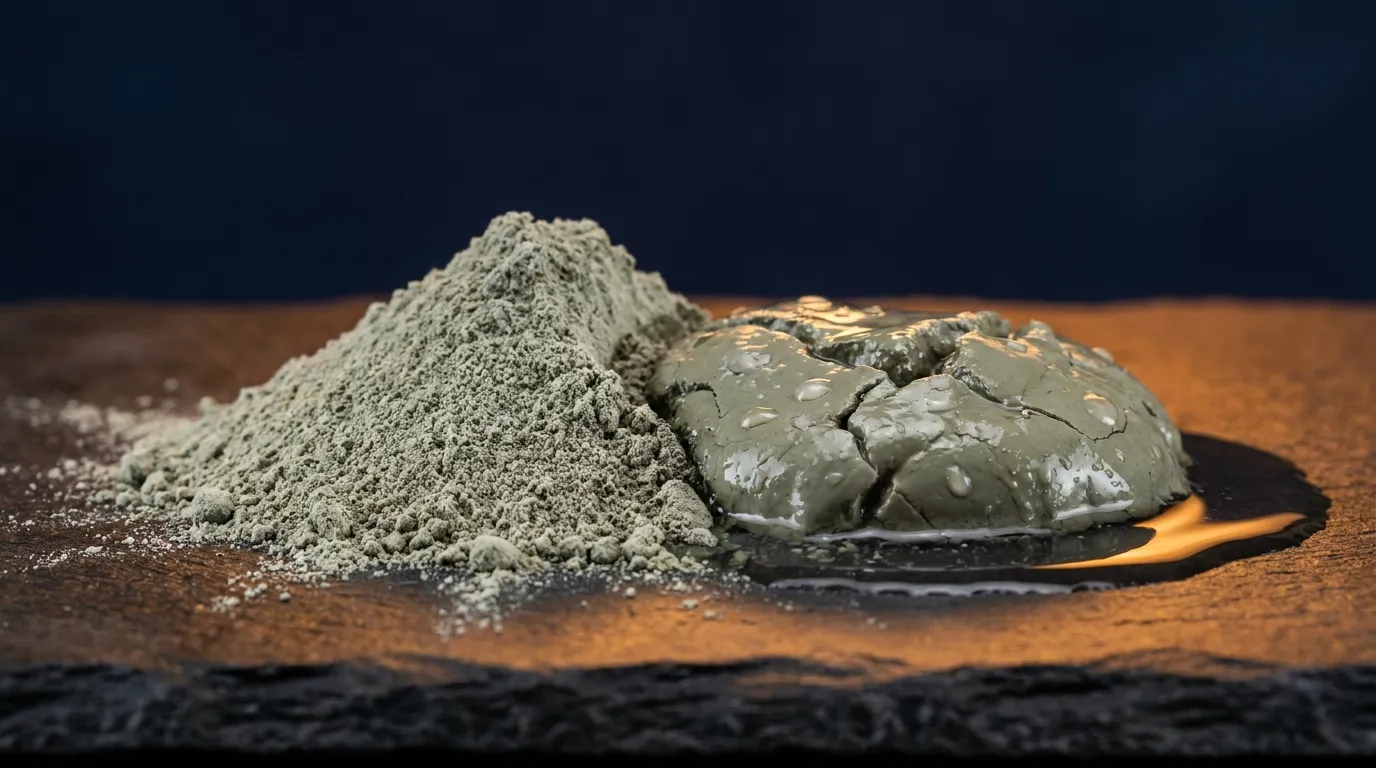
What Is Sodium Bentonite?
Sodium bentonite (CAS 1302-78-9) is a smectite clay whose active mineral is sodium montmorillonite. Its defining trait is swell: when wetted, the sodium-charged interlayers hydrate and the clay can expand 12–15 times its dry volume, forming a low-permeability gel. That single property drives almost every commercial use, from drilling fluids to landfill liners to foundry molds. The premium natural source is Wyoming-type sodium bentonite; calcium bentonite is “activated” with soda ash to behave more like the sodium grade. For a buyer, “bentonite” is not one product. It ships as drilling grade, foundry grade, civil/sealing grade (often as a geosynthetic clay liner, GCL), and high-purity pharma/cosmetic grade, each held to a different test standard and priced accordingly. Order by grade and test spec, not by name.Grades, Specs, and How to Specify Them
The table below compares the grades you will see on a quote and the standard each is tested against. Values are typical reference figures; the supplier CoA governs.| Grade | Controlling standard | Key spec | Typical mesh | Primary use |
|---|---|---|---|---|
| Drilling (API) | API 13A / ISO 13500 | 600-rpm reading ≥30 cP, YP/PV ≤3, filtrate ≤15 mL | 200 mesh (75 µm) | Drilling mud, HDD, slurry walls |
| Foundry (green sand) | AFS green compressive strength | Green strength ≥~7 psi, low LOI | 200 mesh | Metal-casting mold binder |
| Civil / GCL sealing | ASTM D5890 (swell), ASTM D5887 (flux) | Free swell ≥24 mL/2g | Granular or powder | Pond/landfill liners, waterproofing |
| Pharma / cosmetic | USP/NF or supplier purity | Montmorillonite ≥90%, low grit/heavy metals | 325 mesh (45 µm) | Suspensions, masks, carriers |
Properties That Drive the Spec
Swell and Permeability
Sodium montmorillonite’s stacked silicate sheets carry a net negative charge balanced by exchangeable sodium. Water and hydrated sodium force the layers apart (osmotic swelling), producing the 12–15x volume increase and a hydraulic conductivity in compacted liners on the order of 1×10⁻⁹ cm/s or lower. Calcium-form clay swells far less, which is why calcium bentonite is soda-ash activated for sealing duty.Cation Exchange Capacity (CEC)
Montmorillonite has a high CEC, roughly 80–150 meq/100 g, which underpins its use in adsorption, soil amendment, and as a mycotoxin binder in feed. CEC also explains a real failure mode: in calcium- or salt-rich groundwater, sodium can exchange off the clay (cation exchange to the calcium form), collapsing swell and raising liner permeability over time. For aggressive leachate or brackish water, polymer-modified or higher-spec bentonite is the honest answer.Rheology
In water, bentonite builds viscosity and a thixotropic gel that suspends solids at rest and thins under shear. That is what carries drill cuttings up a borehole and keeps weighting agents in suspension. It is also why over-dosing a slurry can over-thicken it; dose to a target funnel viscosity, not by feel.Formation, Mining, and Processing
Bentonite forms from the in-situ alteration of volcanic ash in alkaline water over geologic time, producing montmorillonite-rich beds. It is open-pit mined, then crushed, dried to a controlled moisture (typically 8–12%), and milled to the target mesh. Sealing and pharma grades may be wet-processed or beneficiated to lift montmorillonite content; foundry and some civil grades are blended to hit a green-strength or swell target. Calcium ores are dry- or extrusion-activated with soda ash (Na₂CO₃) to convert them toward the sodium form.Applications by Sector
- Drilling and HDD: the viscosifier and filtration-control base in water-based mud; specify API 13A / ISO 13500.
- Foundry: green-sand mold binder; specify by AFS green compressive strength and low loss-on-ignition.
- Civil and environmental: pond, canal, and landfill sealing, slurry-wall and GCL liners; specify ASTM D5890 swell and ASTM D5887 flux.
- Iron-ore pelletizing: binder for taconite pellets, a very large tonnage pool.
- Cat litter and absorbents: clumping litter exploits the swell-and-bind behavior.
- Feed and agriculture: anti-caking and pellet binder; mycotoxin-binder use is regulated and grade-specific.
Handling and Safety
Bentonite is a low-acute-hazard mineral, but the dust is the real concern. Respirable crystalline silica may be present in some deposits, so the relevant exposure controls are for nuisance/respirable dust and, where applicable, crystalline silica (OSHA 29 CFR 1910.1053 PEL 50 µg/m³ for respirable silica). Use dust extraction or wet handling, NIOSH-rated respirators, and eye protection during transfer. Store dry and sealed; the powder will hydrate and cake on contact with moisture, and wetted spills become slick. Do not flush spills to drains, where the clay swells and blocks lines. It is a stable mineral, not biodegradable; manage it as inert solid waste under local rules.Regulatory and Transport Snapshot
- DOT/transport: bentonite is generally not classified as a hazardous material for transport; confirm for your specific product and shipment.
- OSHA: respirable dust and crystalline-silica controls apply (29 CFR 1910.1053 where silica is present).
- Drilling: API 13A / ISO 13500 define the drilling-grade test methods.
- Civil: ASTM D5890 (swell index) and ASTM D5887 (flux/permeability) govern liner grades.
- Food/feed/pharma: specify the applicable USP/NF, FCC, or feed-additive grade and request supporting documentation.
Sourcing and RFQ Guidance
To get clean, comparable quotes, state on your RFQ:- Grade (drilling/API, foundry, civil/GCL, pharma-cosmetic).
- Controlling test spec and target value (API 13A 600-rpm reading, ASTM D5890 free swell, AFS green strength).
- Mesh / particle size (200 mesh, 325 mesh, granular).
- Sodium natural vs soda-ash activated, if it matters for your application.
- Moisture and montmorillonite content limits.
- Packaging and volume (bulk, supersack/FIBC, 50-lb bag) and annual tonnage.
- Water-chemistry exposure for liner duty (calcium/salt content of contacting water), so the supplier can flag exchange risk.
Buying bentonite by the ton? The bulk bentonite supplier page covers sodium versus calcium grades, API 13A drilling grade, packaging, and what to specify on a purchase order.
FAQs
How much sodium bentonite to seal a pond?
USDA-NRCS Conservation Practice Standard 521C (Arizona) sets the default rates when no lab data exist: 0.345–0.700 lb of finely ground bentonite per square foot for each inch of compacted liner, graded by soil class, with clays at the low end and clean sands and gravels at the top. The finished mixed liner must be at least 6 inches thick, which works out to roughly 2 lb/ft² over tight clays and close to 4 lb/ft² over sands or gravels. The standard specifies sodium bentonite with a free swell of at least 22 mL per ASTM D5890; run a lab permeability test on your site soil before committing tonnage.
What are the disadvantages of bentonite waterproofing?
A bentonite seal works only while it stays confined, hydrated, and undisturbed. NRCS liner criteria require at least 6 inches of soil cover plus protection against desiccation cracking, frost action, wave action, and surface erosion; strip that protection and performance falls off. Dosage is soil-specific, placement needs dry and controlled conditions, and in calcium- or salt-rich water the swell that does the sealing fades by cation exchange, the failure mode covered above. Repair means draining and excavating, which is why aggressive duties pair bentonite with a geomembrane in a composite liner.
How long does bentonite last?
Dry and sealed, it does not expire. Bentonite is a geologically stable mineral, so shelf life is a packaging question: bags that pick up moisture cake and stop flowing long before the clay itself changes. In service, life is set by protection. NRCS criteria direct designers to guard liners against desiccation cracking, frost action, water-level fluctuations, and erosion. A covered, wetted liner matched to its water chemistry carries no fixed replacement interval.
Where do I get sodium bentonite?
U.S. supply centers on Wyoming, which the state geological survey calls the nation’s leader in bentonite production; USGS estimates U.S. production (sold or used) at 4.1 million metric tons for 2025. Mine-direct programs fit truckload and railcar volume. Distributors handle mixed or smaller orders in 50-lb bags, supersacks (FIBC), or bulk. State the controlling spec on the RFQ, API 13A for drilling mud or ASTM D5890 free swell for sealing, and require the matching CoA; RawSource quotes sodium bentonite by the bag, supersack, or truckload.
What is the CAS number of sodium bentonite?
Bentonite carries CAS number 1302-78-9. Its active mineral, montmorillonite, has its own CAS number (1318-93-0).
Reviewed and updated July 2026 by the RawSource technical team.
How is bentonite quality measured?
For sealing grades, the swell index per ASTM D5890 (free swell, target ≥24 mL/2g) is the primary quality proxy. For drilling grades, API 13A rheology applies: a 600-rpm reading ≥30 cP, YP/PV ratio ≤3, and API filtrate ≤15 mL.
How much does sodium bentonite swell?
Sodium bentonite typically swells 12–15 times its dry volume in fresh water. Calcium-form bentonite swells far less, which is why it is often soda-ash activated for sealing use.
What is the difference between drilling grade and foundry grade bentonite?
Drilling grade is qualified on rheology under API 13A (viscosity and filtration). Foundry grade is qualified on green compressive strength (AFS test) and low loss-on-ignition for use as a sand-mold binder. They are not interchangeable.
In a water-based mud, bentonite handles viscosity and filtration control while density is set separately with a weighting agent — typically barite, dosed to the mud weight the well program calls for.
Can bentonite liners fail?
Yes. In calcium- or salt-rich water, sodium can exchange off the clay (cation exchange), reducing swell and raising permeability over time. For aggressive leachate, bentonite is often used in a composite liner with an HDPE geomembrane, or as a polymer-modified grade.
Is sodium bentonite biodegradable?
No. Bentonite is a naturally occurring, chemically stable mineral, not an organic material, so it does not biodegrade. It is generally managed as inert solid waste under local regulations.
What mesh size should I order?
Drilling and foundry grades are typically 200 mesh (75 µm). Pharma and cosmetic grades are often finer, around 325 mesh (45 µm), to disperse smoothly and limit grit. Specify mesh to match your dispersion equipment.
Search 1,300+ industrial chemicals by name or CAS, or send us your spec — we quote by the drum, tote, or container.
Browse the Chemical Index → Request a Quote