
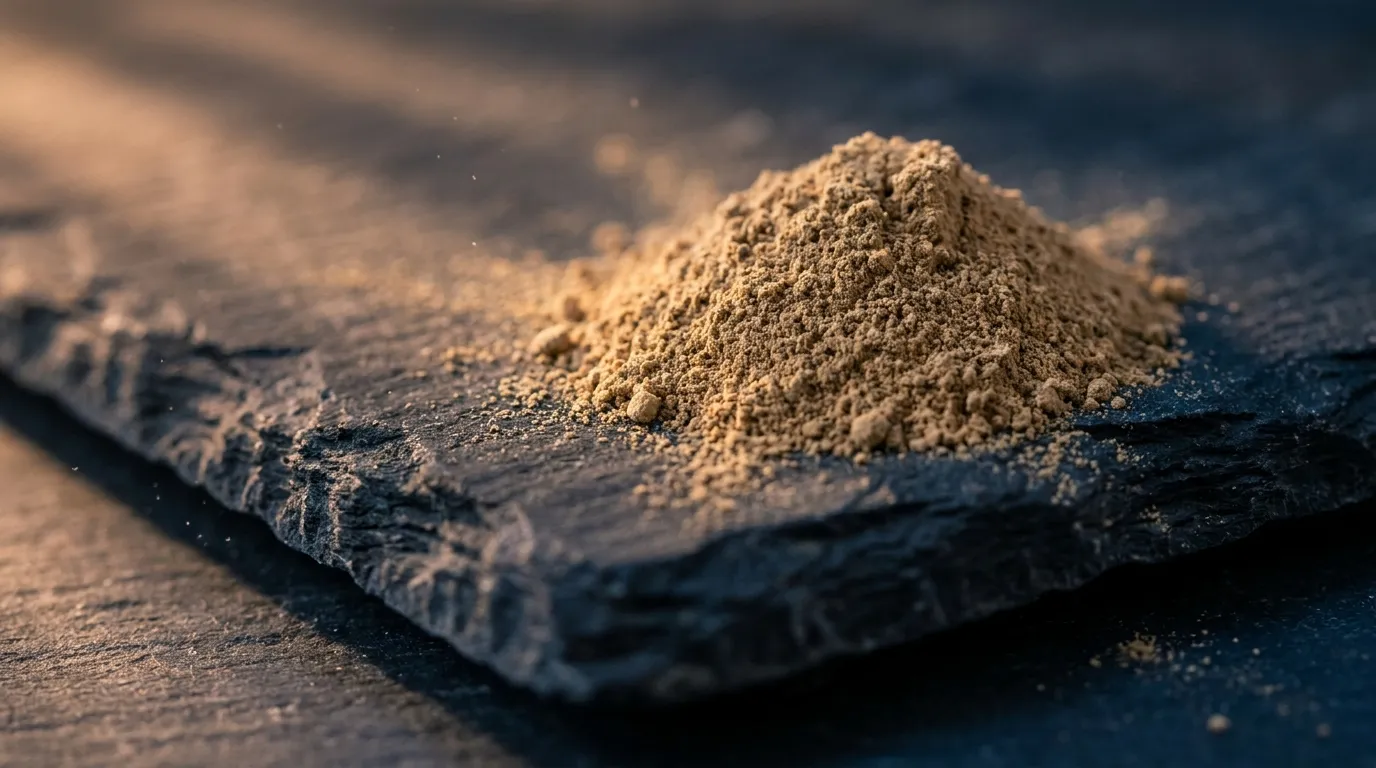
What is Calcium Bentonite?
If you are sourcing bentonite for foundry sand, drilling fluids, civil sealing, edible-oil bleaching, or a feed binder, the first question is which bentonite. Calcium bentonite and sodium bentonite are both montmorillonite clays (bentonite, CAS 1302-78-9), but their exchangeable cation changes the swelling and rheology enough to determine which jobs each one fits. This page is written for the buyer matching grade to application and writing the purchase spec. Calcium bentonite is a montmorillonite clay in which calcium is the dominant exchangeable cation. The practical consequence: it swells far less than sodium bentonite but carries a high cation exchange capacity (CEC) and strong adsorption. That low-swell, high-adsorption profile is exactly why it is the base for bleaching earth, foundry bond, and feed binders rather than for high-yield drilling mud.Calcium vs sodium bentonite: the distinction that drives selection
Sodium bentonite swells to many times its dry volume and builds high gel strength and yield, which is why it dominates water-based drilling mud and geosynthetic clay liners. Calcium bentonite swells little, gives lower yield, but adsorbs oils, color bodies, and metals well. Many “drilling-grade” products are calcium bentonite that has been soda-ash activated (alkaline activation) to convert exchangeable calcium toward sodium and raise yield. If a supplier quotes a calcium bentonite for drilling, confirm whether it is activated and ask for the yield, because raw calcium bentonite will not meet API yield on its own.Composition and what to verify
The performance comes from montmorillonite content and exchangeable cations. Alongside montmorillonite, you will see silica, alumina, iron, and magnesium, plus accessory minerals (quartz, calcite, feldspar) that dilute the active clay. The single most useful purchase spec is montmorillonite content (often estimated by methylene blue value, MBV), because accessory-mineral dilution directly lowers adsorption and bond strength.Formation and Sourcing Geography
Calcium bentonite forms from the diagenesis of volcanic ash: ash beds settle in marine or freshwater basins and alter to montmorillonite over geologic time, with the local water chemistry setting whether the result is calcium- or sodium-dominant. The practical point for procurement is that deposit chemistry varies by location, so two “calcium bentonite” sources can differ in montmorillonite content, accessory minerals, and color.Where it is mined
Significant deposits sit in the United States (including the Gulf Coast states such as Texas, Mississippi, and Alabama), the Mediterranean (Greece, Italy), India and China, and Australia. Deposit-to-deposit variation in mineralogy and trace impurities means qualifying a source on its own CoA matters more than the country of origin. For bleaching or feed use in particular, trace-element profile (for example arsenic, lead, dioxins) is part of the spec, not an afterthought.Physical and Chemical Properties
Calcium bentonite is fine-grained, typically light gray to pale green depending on iron and accessory minerals, and forms a gel when wetted. The properties that belong on a spec sheet:The numbers to order against
- Montmorillonite content / methylene blue value: the proxy for active clay and adsorption capacity.
- Swelling index: low for calcium bentonite versus sodium; this is the property that separates the two grades.
- Cation exchange capacity (CEC): typically reported in meq/100 g; drives adsorption and bond strength.
- Moisture: commonly held to roughly 8-12% for industrial grades; high moisture reduces effective active content per ton.
- Particle size / mesh: 200 mesh is common for many industrial grades; bleaching earth and foundry bond have their own sizing targets.
- pH: aqueous slurry pH commonly falls in the slightly alkaline range; confirm against your process.
Why it differs from sodium bentonite in use
Sodium bentonite is the choice where high swelling, gel strength, and water retention are required (drilling mud, clay liners). Calcium bentonite is preferred where strong adsorption with controlled, low swelling is the requirement (bleaching, foundry green sand, feed binders, granular adsorbents). Pick by the property your process needs, not by the generic name.Industrial Applications
Foundry green-sand bonding
Bentonite is the binder in green-sand molding, holding sand grains so the mold keeps its shape and resists thermal shock during pour. Calcium and activated bentonites are used by foundries depending on the bond strength, hot/dry compressive strength, and durability the molding line needs. Spec by green and dry compression strength, not by clay type alone.Bleaching earth for oils and fuels
Acid-activated calcium bentonite (bleaching earth, sometimes called fuller’s earth) adsorbs pigments, phospholipids, trace metals, and oxidation products in edible-oil refining and in some fuel and lubricant treating. Activation level and surface area drive bleaching efficiency, traded off against oil retention (oil lost in the spent cake). Higher activity often means higher oil retention, so the economic optimum is a balance, not a maximum.Civil engineering and sealing
Bentonite is used in slurry walls, cut-off barriers, and pond and canal lining to control seepage and groundwater flow. Sodium or sodium-activated bentonite is typically specified where maximum swell and low permeability are the goal; raw calcium bentonite gives a more stable but less impermeable barrier. Match the grade to the permeability target.Drilling fluids (with a caveat)
In water-based drilling mud, bentonite viscosifies the fluid, builds filter cake to control fluid loss, and suspends cuttings. High-yield drilling grades are predominantly sodium or soda-ash-activated bentonite meeting API 13A; raw calcium bentonite gives low yield and is generally activated before use. If drilling is your application, specify API 13A grade and yield rather than ordering raw calcium bentonite.Water and effluent treatment
Bentonite is used as a coagulant aid and adsorbent to bind suspended solids and some dissolved contaminants in water and wastewater treatment, supporting coagulation and flocculation. Performance is application-specific; jar-test the actual effluent rather than assuming a fixed dose.Agricultural and Animal-Feed Use
Feed binder and anticaking agent
Bentonite is authorized in the EU as a technological feed additive for binding, anticaking, and pelleting (functional group identifier 1m558i) for all animal species under Regulation (EC) No 1831/2003. These are documented uses with defined conditions; order to feed-additive grade and confirm the authorization status and trace-element limits for your region.Mycotoxin (aflatoxin) adsorbent
Bentonite is also authorized in the EU as a substance for reduction of feed contamination by mycotoxins (identifier 1m558), where the grade must demonstrate aflatoxin B1 binding capacity above 90% and meet defined mineralogical criteria. This is a regulated additive function, not a general claim: if you are buying for aflatoxin mitigation, require the authorized grade with the binding-capacity documentation.Soil amendment
Bentonite is used to improve water retention and cation exchange in sandy soils. Over-application can reduce permeability and cause compaction, so dose to the soil and crop rather than maximizing addition.Trade-offs to Weigh
Calcium bentonite is a low-swell, high-adsorption clay, and the limitations follow directly:- Low yield for drilling and lining: where high swell is the requirement, sodium or activated grades win; raw calcium bentonite underperforms.
- Source variability: montmorillonite content and trace impurities vary by deposit, so qualify by CoA and keep a single qualified source where consistency matters.
- Activation economics: acid or soda-ash activation adds cost and, for bleaching earth, raises oil retention; the optimum is a balance.
- Dust and sensitization: dry bentonite generates respirable dust and is regarded as a skin and respiratory sensitizer; handle per the SDS with appropriate dust control and PPE.
Handling and Storage
Dry bentonite powder generates fine dust. Handle in well-ventilated areas with appropriate respiratory protection and dust control, since bentonite is regarded as a skin and respiratory sensitizer; follow the SDS for your specific product. Store in sealed containers in dry, temperature-stable conditions, because absorbed humidity causes clumping and lowers effective active-clay content per ton. Keep stock away from strong acids and alkalis unless acid activation is the intended process. Always consult the current SDS before handling, storage, or disposal.Sourcing Calcium Bentonite at Volume
For bulk procurement, put the application and the defining specs on the inquiry: grade and intended use (foundry, bleaching, drilling, feed, civil), montmorillonite content or MBV, swelling index, CEC, moisture, mesh, and any regulatory grade (feed-additive authorization, API 13A) your use requires. Confirm each against the lot CoA, which governs over typical datasheet values. Regulatory status, suitability, and safe handling for your application and jurisdiction are the buyer’s responsibility. Send your application and target specs, and RawSource can quote calcium or sodium bentonite, raw or activated, against your spec.FAQs About Calcium Bentonite
What is calcium bentonite used for?
Adsorption and binding duty, mainly. The volume outlets are acid-activated bleaching earth for edible-oil refining, foundry green-sand bond, feed binding and EU-authorized mycotoxin adsorption, absorbent granules, and sealing work where moderate swell is acceptable. In US food processing, FDA affirms bentonite as generally recognized as safe (GRAS) when used as a processing aid under 21 CFR 184.1155; if that is your use, order food-grade material and confirm the status for your application and jurisdiction on the lot CoA. Spec by the property the job needs (low swell, high adsorption), not the umbrella name.
What is bentonite mostly used for?
Absorbents and drilling mud. USGS estimates 48% of US bentonite went to pet waste absorbents and 22% to drilling mud in 2025, the two largest domestic end uses (Mineral Commodity Summaries, February 2026). The rest spreads across the duties covered on this page: foundry bond, bleaching earth, sealing, water treatment, and feed. Calcium grades hold little of the drilling share, since high-yield mud grades are sodium or soda-ash activated; their weight sits in bleaching earth, foundry bond, feed, and absorbents.
Is calcium bentonite the same as diatomaceous earth?
No. Bentonite is a montmorillonite clay, described in FDA’s food regulations (21 CFR 184.1155) as “principally a colloidal hydrated aluminum silicate.” Diatomite, sold as diatomaceous earth, forms “from an accumulation of amorphous hydrous silica cell walls of dead diatoms,” per the USGS Mineral Commodity Summaries (February 2026). Different chemistry, different job: bentonite is bought to bind and adsorb, while roughly 60% of US diatomite went to filtration in 2025 (USGS). The two meet in blended absorbent and feed products, which is where the mix-up starts. On a blend, require each component and its own spec on the CoA.
What is the difference between calcium and sodium bentonite?
Both are montmorillonite clays, but the dominant exchangeable cation differs. Sodium bentonite swells to many times its dry volume and builds high gel strength and yield (drilling mud, clay liners). Calcium bentonite swells little but adsorbs oils, color bodies, and metals well, which suits bleaching earth, foundry bond, and feed binders.
Reviewed and updated July 2026 by the RawSource technical team.
Viscosity is only half of a mud program: density control comes from weighting agents such as barite, run in the same water-based system.
Can calcium bentonite be used as drilling mud?
Raw calcium bentonite gives low yield in water-based mud. High-yield drilling grades are predominantly sodium or soda-ash-activated bentonite meeting API 13A. If drilling is your use, specify API 13A grade and yield rather than ordering raw calcium bentonite.
What specs should I order calcium bentonite against?
Order against montmorillonite content (or methylene blue value), swelling index, cation exchange capacity, moisture, particle size/mesh, and any regulatory grade your use requires (feed-additive authorization, API 13A). Confirm each on the lot CoA, since material labeled simply “calcium bentonite” varies in montmorillonite content and CEC.
What color is calcium bentonite?
It typically ranges from light gray to pale green, with the exact shade set by iron content and accessory minerals. Color is an indicator of mineralogy and impurity, not a primary performance spec.
Is bentonite approved as an animal-feed additive?
In the EU, bentonite is authorized as a technological feed additive (binder/anticaking, 1m558i) for all species, and as a mycotoxin-reduction additive (1m558) requiring aflatoxin B1 binding capacity above 90%, under Regulation (EC) No 1831/2003. Order to the authorized grade and confirm the documentation and trace-element limits for your region.
Where does calcium bentonite come from?
It is mined from natural deposits formed by the alteration of volcanic ash to montmorillonite over geologic time. Major sources include the US Gulf Coast, the Mediterranean (Greece, Italy), India, China, and Australia. Mineralogy varies by deposit, so qualify a source on its CoA.
Search 1,300+ industrial chemicals by name or CAS, or send us your spec — we quote by the drum, tote, or container.
Browse the Chemical Index → Request a Quote