
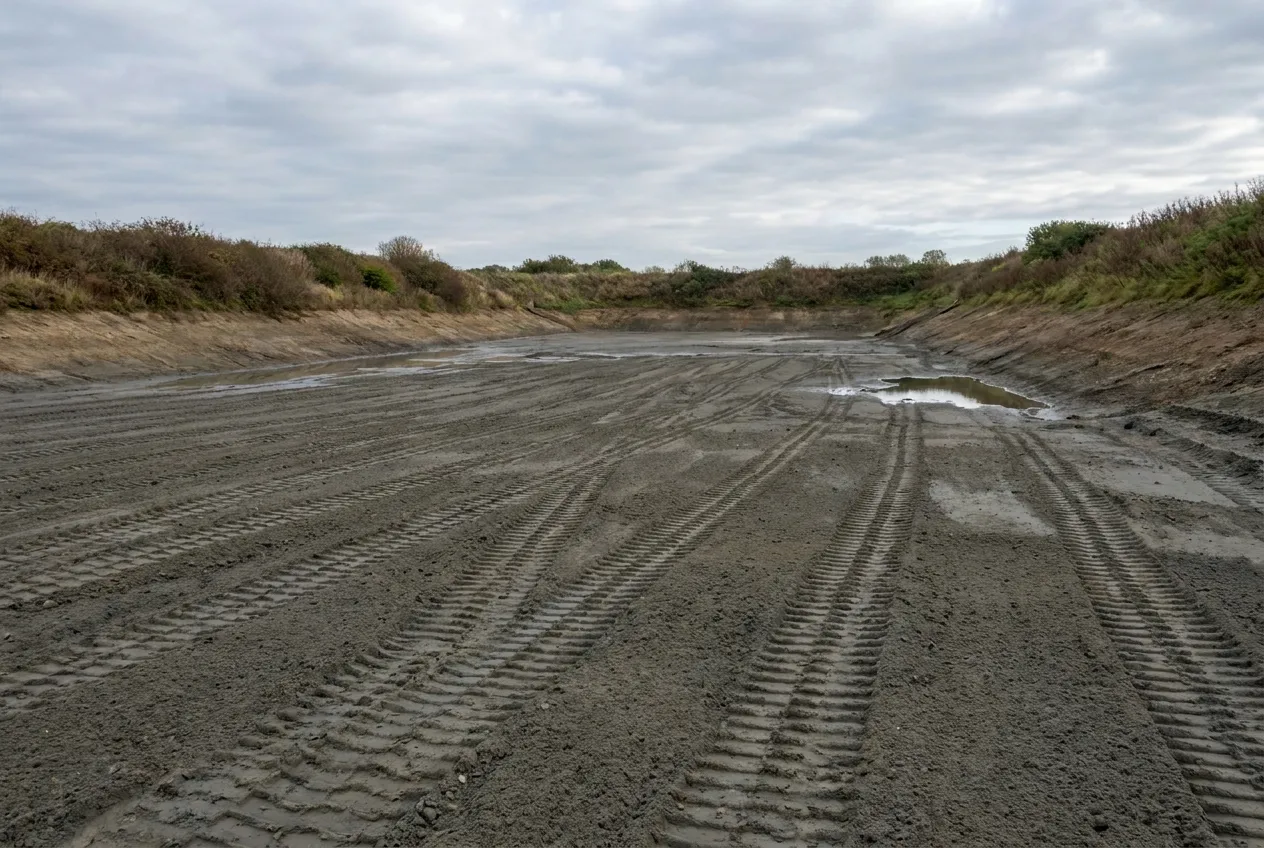
A pond that won’t hold water is almost always a permeability problem, not a structural one, and sodium bentonite is the standard fix: spread it over the bed, and the clay swells on contact with water to form a low-permeability seal. The method below works the same at any scale, from a quarter-acre stock pond to a multi-acre containment basin. What changes with scale is the grade you buy and how you buy it, which is where most of the cost and most of the mistakes live.
Reviewed and updated July 2026 by the RawSource technical team.
If you came here to seal a backyard pond, the steps and the dose are right below. If you are sealing by the ton, read on to the grade and sourcing section, since buying the wrong bentonite by the truckload is an expensive way to learn that pond-sealing is a sodium-clay job.
The one thing that decides whether it works: use sodium bentonite
Bentonite splits into sodium and calcium grades, and only sodium bentonite swells enough to seal. Sodium clay takes up many times its dry volume in water; that swell is what closes the pore space in the pond bed. Calcium bentonite barely swells and will not form a barrier, no matter how much you apply. “Sodium-activated” grades (calcium clay ion-exchanged to behave like sodium) also work. Recommendation: specify *sodium* (or sodium-activated) bentonite on the order and confirm it on the certificate, the way you would on any bentonite buy. A cheaper calcium grade is not a saving here; it is a pond that still leaks.
How to seal a pond with bentonite: the procedure
Step 1: Assess the leak
Find where the water is going: visible seeps, a dropping level, sandy or gravelly zones. The leak pattern decides the method (a uniform slow loss vs. a localized seep). Recommendation: if you can drain and inspect, do; a dry bed is far easier to seal correctly than a wet one.
Step 2: Calculate the dose
The working figure is roughly 1–3 lb of sodium bentonite per square foot of surface to be sealed, toward the higher end on sandy or gravelly soil that holds less clay. Recommendation: measure the actual area to be treated (bed + sides), not the surface acreage, and add margin for coarse soils. The dose table below is the quick reference.
Step 3: Prepare the bed
Drain where possible, then clear debris, rocks, and vegetation and lightly scarify the surface so the clay keys into the soil rather than sitting on top. The cleaner and rougher the bed, the better the bond.
Step 4: Apply, by method
| Method | How | Best for | Trade-off |
|---|---|---|---|
| Blanket | Spread a uniform bentonite layer over bed and sides, cover with 2–4 in of soil, compact | Extensive or whole-pond leakage | Most material, most reliable seal |
| Mixed blanket | Mix bentonite into the top 2–4 in of soil at ~1:5 (bentonite:soil), compact | Moderate, diffuse leakage | Less material; needs even mixing |
| Sprinkle | Broadcast bentonite over the water at suspected leak zones; it sinks and swells into the gaps | Ponds that cannot be drained | Least reliable; hard to target |
Dose quick reference
| Soil / situation | Sodium bentonite | Method |
|---|---|---|
| Loam, moderate seep | ~1–1.5 lb/ft² | mixed blanket |
| Sandy / gravelly bed | ~2–3 lb/ft² | blanket + soil cover |
| Cannot drain | by leak area, higher margin | sprinkle (expect touch-ups) |
The trade-off worth stating plainly
Bentonite sealing is forgiving on a small clean pond and unforgiving at scale. The sprinkle method is convenient and the least dependable — it cannot guarantee the clay reaches every leak. And the same swell that seals the pond is suppressed by salty or very hard water: a sodium grade qualified on clean water can under-seal where the source water is brackish. For large or engineered jobs (lagoons, regulated containment), a geosynthetic clay liner (GCL) — sodium bentonite sandwiched in geotextile — gives a tested, specified barrier where a hand-spread seal would be a guess. There is no universal dose; there is the grade and the method matched to your pond’s soil, water, and size.
Buying bentonite for a pond by the ton
At backyard scale you buy bags; at pond scale you buy bulk sodium bentonite by the pallet or truckload, and two things matter: the grade (sodium / sodium-activated, the right particle size for spreading) and the certificate (so you know the clay will swell as specified). A multi-acre seal can run several tons, so a small price-per-ton difference is real money, and the wrong grade is the whole job.
How RawSource helps
Request a quote with your pond area and soil type, and ask for the CoA with it.
Buying bentonite by the ton? The bulk bentonite supplier page covers sodium versus calcium grades, API 13A drilling grade, packaging, and what to specify on a purchase order.
Frequently asked questions
Does bentonite clay work to seal a pond?
Yes, on the right soil and with the right grade. The practice is standard enough that USDA-NRCS publishes Conservation Practice Standard 521C for it, covering dose, liner thickness, and soil suitability. The mechanism is swell: hydrated Wyoming-type sodium bentonite expands to as much as 16 times its original size, per the Wyoming State Geological Survey, and that expansion closes the pore space in the pond bed. NRCS lists silts, silty and clayey sands, and silty and clayey gravels (ML, SM, SC, GM, GC) as soils where bentonite seals effectively; clean sands, gravels, and fractured rock may need finer soil blended in first.
How long does it take bentonite to seal a pond?
NRCS Standard 521C sets no wait time. Sodium bentonite starts hydrating and swelling as soon as it wets out, so a compacted soil-bentonite blanket is working from the first fill. The standard treats drying as the enemy: its liner-protection criteria require protection against desiccation cracking, and it advises filling the pond with water after construction to prevent it. Sprinkle applications over a full pond take longer, since the granules must settle into the leak paths, and often need repeat passes. Judge the seal by the seepage trend after refill, not by a fixed waiting period.
How thick does bentonite need to be to seal a pond?
Thickness is set by water depth. USDA-NRCS Standard 521C specifies a finished compacted soil-bentonite liner of at least 6 inches for water depths of 8 feet or less, then 12 inches for 8.1 to 16 feet, 18 inches for 16.1 to 24 feet, and 24 inches for 24.1 to 30 feet. Thicker liners go down in compacted layers of no more than 6 inches each, and NRCS advises a protective soil cover of at least 6 inches over the finished liner for ponds.
What is the best thing to seal a pond with?
It depends on the soil, the water depth, and what the pond must hold. Where the bed has enough fines, a compacted soil-bentonite liner is an established fix with its own USDA-NRCS practice standard. Depth is the cleanest dividing line: NRCS 521C advises considering a flexible membrane liner for sites with water depths greater than 24 feet, and engineered or regulated containment is usually specified around a geosynthetic barrier by the engineer of record. For a stock or irrigation pond on suitable soil, sodium bentonite remains the working default.
How much bentonite do I need to seal a pond? Roughly 1–3 lb of sodium bentonite per square foot of the area you are sealing, toward the higher end on sandy or gravelly soil. Calculate from the measured bed-and-sides area, not the surface acreage, and add margin for coarse soils.
Can I use calcium bentonite to seal a pond? No. Sealing needs the swelling that only sodium (or sodium-activated) bentonite provides. Calcium bentonite barely swells and will not form a barrier.
Can I seal a pond without draining it? Yes, with the sprinkle method: broadcast bentonite over the leak zones and let it sink and swell, though it is the least reliable method and usually needs touch-ups. Draining and using the blanket or mixed-blanket method gives a far more dependable seal.
Search 1,300+ industrial chemicals by name or CAS, or send us your spec — we quote by the drum, tote, or container.
Browse the Chemical Index → Request a Quote