

Potassium hydroxide (KOH), the strong alkali also called caustic potash, earns its place in oilfield chemistry for two jobs at once: it raises and holds pH in water-based fluids, and it delivers the potassium ion (K+) that keeps reactive shales from swelling. That combination is why a drilling-fluids engineer will reach for KOH instead of sodium hydroxide on certain wells. Across the well lifecycle, caustic potash shows up in alkalinity and buffering control, potassium-based “inhibitive” mud systems, sour-gas and H2S scrubbing, saponification of organic mud additives, and completion- and cement-fluid pH management. This article walks through each role the way a formulator actually uses it, compares KOH against NaOH, covers the commercial forms, and is honest about the handling hazards.
How is potassium hydroxide used in oil and gas?
In short: potassium hydroxide is used to control pH and alkalinity in water-based drilling and completion fluids, to supply potassium ions that inhibit clay and shale swelling in “potassium mud” systems, to neutralize acidic gases such as hydrogen sulfide and carbon dioxide in caustic scrubbers, and to saponify fatty additives in some fluid formulations. It is chosen over sodium hydroxide when the well needs both alkalinity and a potassium-ion source in one product.

Table of Contents
- pH, Alkalinity Control & Buffering in Water-Based Muds
- Potassium-Ion Shale & Clay Inhibition (Potassium Muds)
- H2S & Acid-Gas Neutralization (Caustic Potash Scrubbing)
- Saponification & Emulsion Chemistry
- Completion & Cement Fluid pH
- Why KOH Is Sometimes Chosen Over NaOH
- Forms, Bulk Handling & Safety
- Frequently Asked Questions
pH, Alkalinity Control & Buffering in Water-Based Muds
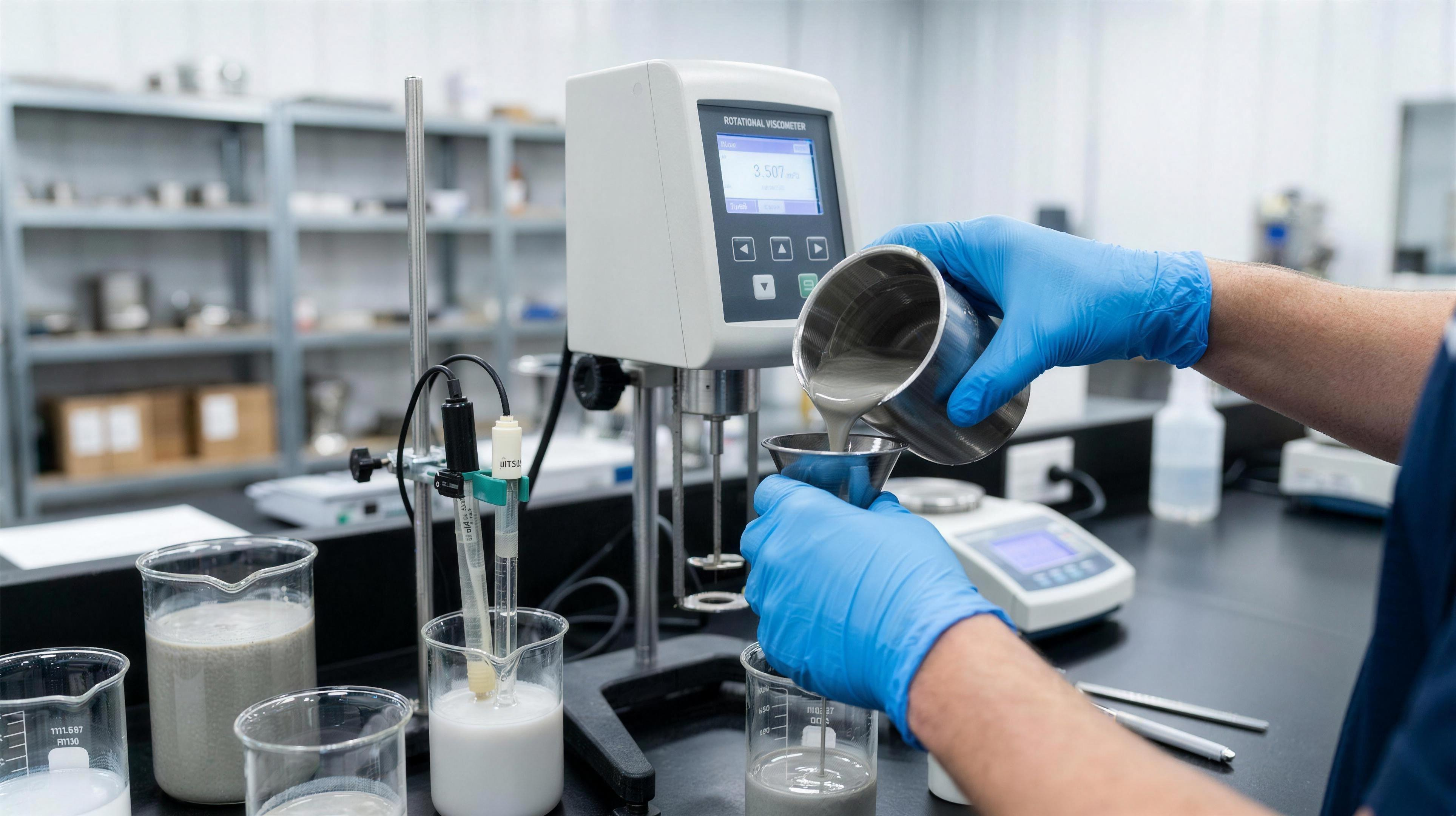
A water-based mud has to stay alkaline, usually in the pH 9 to 11 band, to keep bentonite hydrated, protect steel from corrosion, and let pH-sensitive thinners and polymers work. Potassium hydroxide is one of the two standard hydroxyl-ion (OH−) sources used to set that pH, the other being sodium hydroxide. It dissolves fast and pushes alkalinity up with a small addition.
The engineer does not just chase a pH meter reading. Mud alkalinity is tracked through the Pf and Mf titrations on the filtrate: when Pf and Mf sit close together, hydroxyl ions dominate the alkalinity, which is what you want from a fresh caustic addition; a low Pf with a high Mf flags bicarbonate contamination that caustic alone will not fix. The practical recommendation is to treat with KOH against the titration trend, not a single spot reading, and to add it slowly into the high-shear hopper so it disperses before it can build a localized hot, corrosive zone. KOH buffers the system, but it is not a cure for carbonate or bicarbonate ingress; that needs lime or a carbonate-specific treatment alongside it.
Potassium-Ion Shale & Clay Inhibition (Potassium Muds)
This is where caustic potash does something sodium-based chemistry cannot. Potassium muds are the most widely accepted water-based system for drilling water-sensitive, hard, brittle shales. The potassium cation is small and fits neatly between clay platelets; it exchanges onto the clay surface, collapses the interlayer, and holds the structure together so the shale resists hydration and the cuttings resist dispersing into fines. The result is a more stable wellbore and cleaner solids removal at the shakers.
Most potassium muds get their K+ from potassium chloride, and on many wells Potassium Chloride (KCl) is the workhorse for exactly this reason. KOH is one of several alternative potassium sources, along with potassium carbonate and potassium acetate, and it carries an extra benefit the salts do not: it raises pH and supplies potassium in a single additive, so a chloride-restricted or environmentally sensitive program can lean on it. Beyond simple ion exchange, hydroxide chemistry can react with clay surfaces in the presence of potassium to give longer-lasting inhibition than a transient salt treatment. The trade-off to weigh: KOH is far more corrosive and reactive to handle than KCl, so it is dosed for alkalinity and supplemental K+, not as the bulk potassium loading. Most systems pair the two.
H2S & Acid-Gas Neutralization (Caustic Potash Scrubbing)
Sour gas carries hydrogen sulfide (H2S) and carbon dioxide (CO2), both acidic and both removable in a caustic scrubber. Caustic potash is one of the alkaline media used: the high-pH solution drives the acid gas out of the gas stream and into the liquid, where H2S reacts to form potassium hydrosulfide and CO2 forms potassium carbonate. Caustic scrubbing is a proven, cost-effective route for H2S removal from refinery and field gas streams, and the same neutralizing chemistry is what makes KOH a useful H2S scavenger and pH buffer in muds drilling through sour formations, where keeping the system alkaline shifts dissolved sulfide to the less volatile, less dangerous ionized form.
One real limitation to plan around: a hydroxide scrubber does not discriminate between H2S and CO2. When CO2 is abundant, it consumes caustic without preference, which drives up reagent use and leaves a spent solution that must be neutralized before disposal. For high-CO2, regenerable duty an amine unit is usually the better fit; non-regenerable caustic scrubbing wins where the H2S load is the target and simplicity and capital cost matter more than reagent economy.
Saponification & Emulsion Chemistry
Strong alkalis convert fats and fatty acids into soaps, the reaction known as saponification, and KOH soaps are softer and more soluble than the sodium soaps NaOH makes. In fluid formulation that matters when a system uses fatty-acid-derived lubricants, tall-oil products, or natural-ester additives: a controlled dose of caustic potash can saponify those organics in situ to generate emulsifiers and lubricity agents, helping stabilize the emulsion and reduce torque and drag. The practical caution is dose control. Excess free alkali can over-saponify or react with other mud chemicals, so this is a measured, formulation-specific treatment rather than a blanket addition, and it is one reason mud chemists watch free-caustic alkalinity rather than only bulk pH.
Completion & Cement Fluid pH
The alkalinity job does not stop at the drilling mud. Completion and workover brines need pH held in a window that keeps polymer viscosifiers stable and protects tubulars, and a small caustic potash addition trims that pH while contributing potassium ions compatible with a KCl- or potassium-brine completion. On the cementing side, Portland cement slurries are intensely alkaline by nature, and hydroxide additions support the high-pH environment cement chemistry depends on. KOH is not the primary cement set controller — retarders and accelerators own that role — but it sits in the same alkaline toolkit used to manage fluid pH across completion and cementing operations. The recommendation here is compatibility-first: confirm the caustic addition does not crash a polymer or shift a brine’s density before it goes downhole.
Why KOH Is Sometimes Chosen Over NaOH
Sodium hydroxide is cheaper per pound and more common, so it remains the default alkali for plain pH control. KOH earns the premium when the well wants potassium in the chemistry. The potassium ion is a stronger shale inhibitor than sodium, so a single KOH addition raises pH and improves inhibition at the same time, where NaOH would actually add the dispersive sodium ion you are trying to avoid in a reactive shale. Potassium brines and solutions also tend toward lower freeze points and high solubility, which helps in cold-climate logistics and in keeping a heavily treated system pumpable.
| Property | Potassium Hydroxide (KOH) | Sodium Hydroxide (NaOH) |
|---|---|---|
| Cation contributed | K+ — strong shale/clay inhibitor | Na+ — dispersive to reactive clays |
| Primary oilfield value | pH control plus inhibition in one additive | pH control / alkalinity only |
| Relative cost | Higher | Lower |
| Best fit | Potassium muds, reactive shales, K-compatible brines | General alkalinity where Na+ is acceptable |
| Hazard class | Corrosive, exothermic in water | Corrosive, exothermic in water |
The honest trade-off: if the formation is not shale-sensitive and sodium does no harm, NaOH is the economical choice and KOH is over-spending. The decision is well-specific, which is why drilling programs spell out the alkali in the fluid recipe rather than treating the two as interchangeable.
Forms, Bulk Handling & Safety
Caustic potash is supplied in several forms, and the right one depends on how a site doses and stores it.
| Form | Typical assay | Where it fits |
|---|---|---|
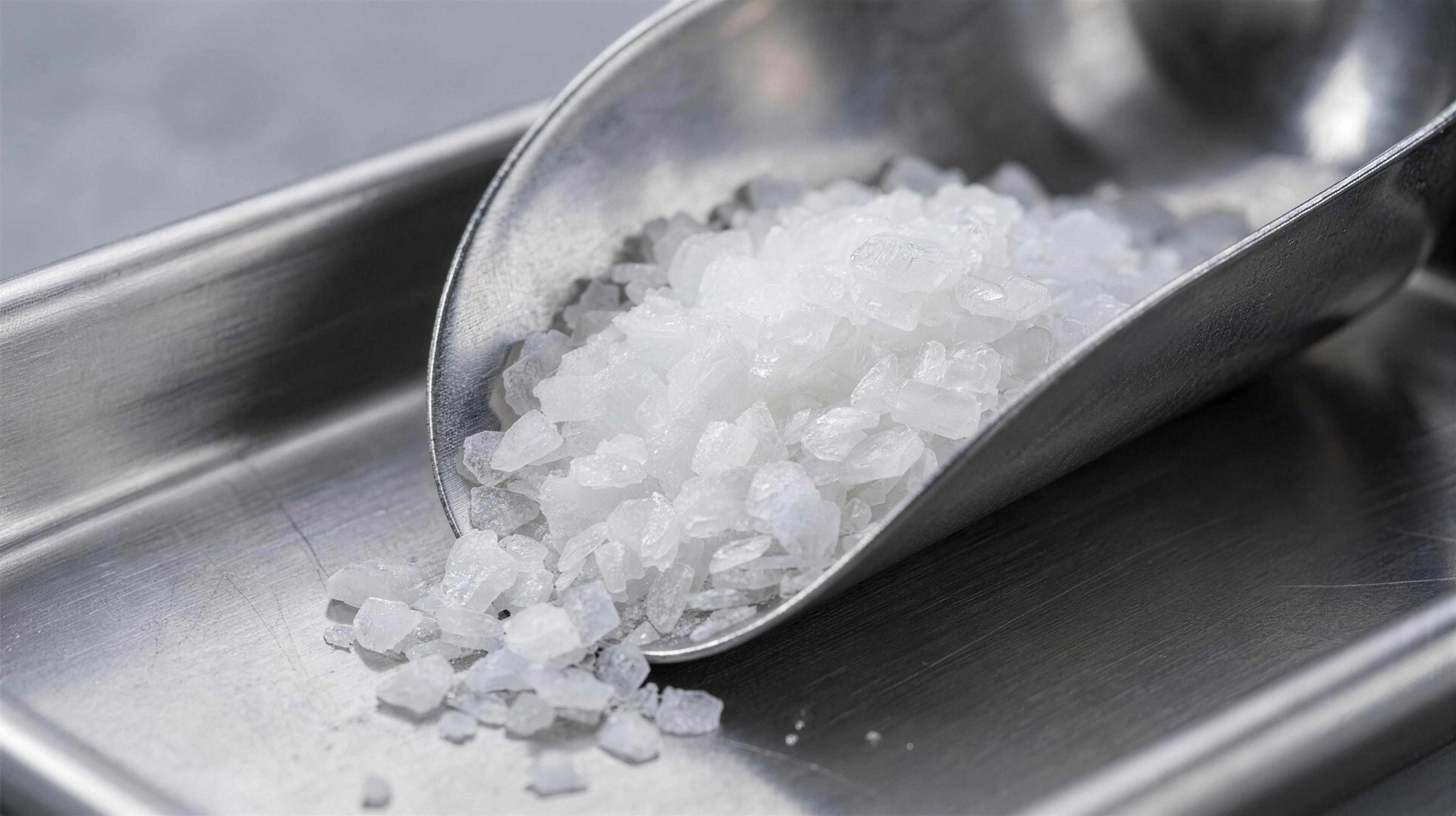
| Flake | ~90% (anhydrous) | Most common dry form; dissolves readily at the rig hopper |
| Powder | ~90% (anhydrous) | Faster dissolution; more dust — handle with control |
| Pellet | ~90% (anhydrous) | Low-dust dry handling and metered dosing |
| Liquid solution | ~45–50% KOH | Ready-to-meter; avoids on-site dissolution heat and dust |
Bulk dry KOH typically moves in 25 kg bags, super-sacks, and totes; liquid moves in IBCs, drums, and bulk tankers. Whatever the form, the hazards are real and must be respected. Potassium hydroxide is classified as corrosive: it causes severe skin burns and eye damage (GHS H314), is corrosive to metals (H290), and is harmful if swallowed (H302). Dissolving it is strongly exothermic — adding dry caustic to water at the rig releases a great deal of heat and produces a highly corrosive solution. The standing rule is to add caustic slowly to water with constant agitation, never water to caustic, using lukewarm (not hot or cold) water to avoid violent boiling, mists, or splashing. Required PPE includes chemical splash goggles, a face shield, and chemical-resistant gloves and clothing. We do not make any “safe” or “non-hazardous” claim about KOH; it is an effective alkali precisely because it is a strong, reactive base, and it has to be handled that way.
Methodology and sources
Identity and property context for Potassium Hydroxide (KOH, Caustic Potash) (CAS 1310-58-3) in this guide is anchored to the compound's PubChem record. Hazard-communication framing follows OSHA's Hazard Communication Standard, 29 CFR 1910.1200. Always defer to the supplier's current SDS and CoA for the specific grade and lot you handle.
Frequently Asked Questions
Is potassium hydroxide the same as caustic potash?
Yes. “Caustic potash” is the common industrial name for potassium hydroxide (KOH). It is the potassium analog of caustic soda (sodium hydroxide, NaOH).
Why use potassium hydroxide instead of sodium hydroxide in drilling fluids?
Because KOH supplies the potassium ion, which inhibits clay and shale swelling, while also controlling pH. NaOH only controls pH and adds dispersive sodium, so KOH is preferred when drilling reactive, water-sensitive shales.
How does caustic potash remove H2S from gas?
In a caustic scrubber the high-pH KOH solution absorbs acidic hydrogen sulfide out of the gas stream, reacting to form potassium hydrosulfide. It also reacts with CO2, which raises reagent consumption when CO2 levels are high.
What forms and concentrations of potassium hydroxide are available?
Dry flake, powder, and pellet at roughly 90% assay, and liquid solution at about 45–50% KOH. Dry forms ship in bags, super-sacks, and totes; liquid ships in IBCs, drums, and tankers.
Is potassium hydroxide hazardous to handle?
Yes. It is corrosive (GHS H314), causes severe skin and eye burns, and dissolves exothermically. Always add caustic to water with agitation, never the reverse, and use full chemical PPE.
Request a Quote
See the Potassium Hydroxide product page. Tell us your grade, form, concentration, and volume, and we will source it. Request a quote.
Search 1,300+ industrial chemicals by name or CAS, or send us your spec — we quote by the drum, tote, or container.
Browse the Chemical Index → Request a Quote