
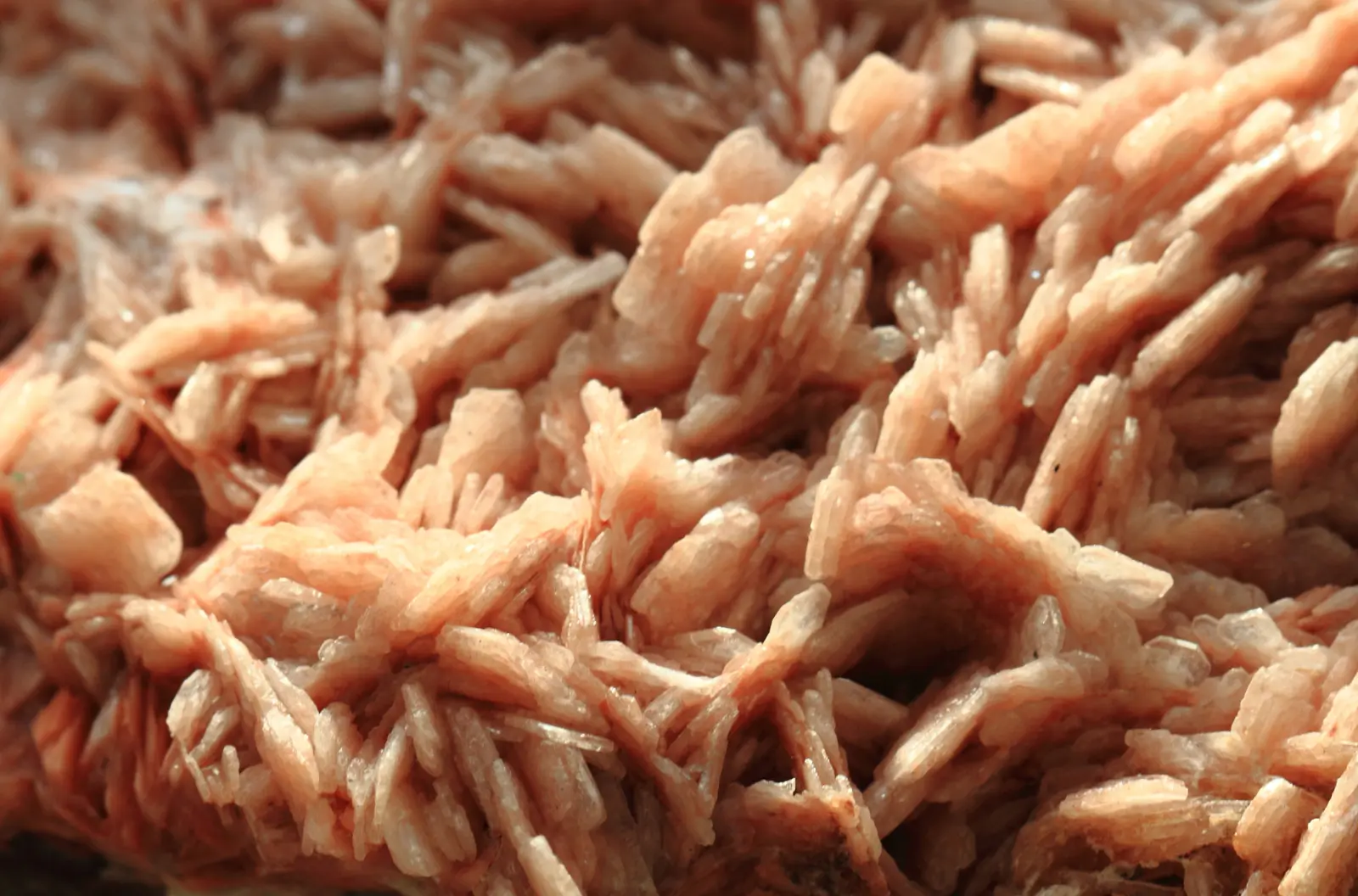
What is Barite?
Barite is a barium sulfate (BaSO₄) mineral prized for its high specific gravity (~4.5) and chemical inertness — its dominant use is as a weighting agent in oil and gas drilling fluids. Also spelled baryte, it is one of the heaviest non-metallic minerals; the name comes from the Greek barys (“heavy”). That density, combined with the fact that barite does not readily react with other chemicals, is exactly why drillers add it to drilling mud: it raises the fluid’s weight enough to hold back formation pressure and prevent blowouts. The same two traits — heavy and inert — drive its secondary roles as a low-cost, high-density filler in paints and plastics, in radiation-shielding concrete, and in friction products such as brake pads.
Barite occurs in sedimentary rocks, hydrothermal veins, and as a byproduct of mining other metals. It is usually colorless to white but can appear blue, yellow, red, or brown depending on impurities, with crystals ranging from tabular to prismatic. See the Barium sulfate (barite) product page.
Barite vs Barium Sulfate: What’s the Difference?
The terms are often used interchangeably, but they describe two forms of the same compound, BaSO₄:
- Barite (baryte) is the natural mineral — barium sulfate as it is mined, then crushed, washed, dried, and milled. Ore-grade barite often runs below 90% BaSO₄ and is the workhorse for high-volume, density-driven uses like drilling mud and filler.
- Barium sulfate is the chemical compound itself (CAS 7727-43-7). It can be the natural mineral or it can be synthesized as precipitated barium sulfate — known as blanc fixe (“permanent white”) — produced by a controlled reaction to reach purities up to ~99% with a finer, more uniform particle size for optical-grade paints, coatings, and plastics.
In short: all barite is barium sulfate, but not all barium sulfate is barite. When a buyer needs raw density and tonnage, they specify barite; when they need purity, brightness, and tight particle control, they specify precipitated barium sulfate / blanc fixe.
Barite Uses by Sector
Barite earns its place across industries for three reasons: high density (raises mass without adding volume), chemical inertness (won’t react, dissolve, or off-gas), and low cost per unit weight. The table below maps the major uses to the property that makes barite the right material.
| Use | Why barite | Sector |
|---|---|---|
| Weighting agent in drilling fluids (the #1 use) | High specific gravity densifies the mud to control wellbore pressure and prevent blowouts | Oil & gas drilling |
| Filler / extender | Adds density, brightness, and corrosion resistance; chemically inert and cheap | Paint, plastics, rubber |
| Radiation shielding | High density attenuates X-rays and gamma rays in high-density concrete | Medical, nuclear, industrial |
| Friction products | Density and thermal stability improve brake pad and clutch performance | Automotive |
| Flux and filler | Lowers melting temperature in glass; adds strength in ceramics | Glass & ceramics |
| Barium chemical feedstock | High-purity source for barium carbonate, chloride, and hydroxide | Chemical manufacturing |
| Oil-well cement additive | Increases slurry density for downhole cementing | Oil & gas completion |
Why barite is used in drilling fluid
The most significant use of barite is as a weighting agent in drilling mud. As a well is drilled, the mud column must exert enough hydrostatic pressure to balance the pressure of the formation being penetrated; too little and the well can kick or blow out, too much and the formation can fracture. Because barite is dense and inert, drillers can dial in mud weight precisely without changing the fluid’s chemistry or volume — making it the standard primary weighting material worldwide.
Properties of Barite
Barite’s value comes down to a short list of physical and chemical properties:
- Chemical formula: BaSO₄ (barium sulfate), CAS 7727-43-7.
- Specific gravity: approximately 4.5 for the mineral — among the highest of any non-metallic mineral.
- Mohs hardness: 3 to 3.5 (relatively soft).
- Crystal structure: orthorhombic, typically tabular or prismatic crystals.
- Color: colorless to white, sometimes blue, yellow, red, or brown from impurities; vitreous to resinous luster.
- Solubility: insoluble in water and only slightly soluble in acids — this inertness is central to its industrial use.
Barite is chemically stable and, in its insoluble sulfate form, does not dissolve in the body — which is why barium sulfate is the form used as a radiocontrast agent in medical imaging, whereas soluble barium compounds are handled very differently. Always consult the current Safety Data Sheet for handling and exposure guidance.
Grades of Barite
Barite is sold by grade, defined by density and purity for the job:
- API drilling grade: the most demanding spec for oil and gas. Per API 13A, drilling-grade barite must meet a minimum specific gravity of 4.2, typically with BaSO₄ content of 90%+, roughly 97% passing a 200-mesh (75-micron) screen, and a suspension pH around 8–9.5. These limits keep mud weight consistent and protect downhole equipment.
- Filler / paint and coating grade: selected for fine particle size and high whiteness/brightness rather than maximum density, used as an extender in paints, coatings, and plastics.
- Chemical grade: high-purity, low-contaminant barite used as feedstock for barium chemicals.
How is Barite Formed?
Barite forms through several geological pathways, which is why it shows up in so many settings:
- Sedimentary precipitation: in marine environments, barium ions combine with dissolved sulfate to crystallize barite, building up layers within sedimentary rock.
- Hydrothermal processes: hot, mineral-rich fluids deposit barite in veins and cavities, often near volcanic activity, producing well-formed, high-purity crystals.
- Residual deposits: as barium-bearing rocks weather, barite resists breakdown and concentrates in the overlying soil and regolith.
- Biogenic and evaporative processes: some marine microorganisms mediate barite precipitation, and in evaporative settings like salt flats, concentrating brines leave barite behind.
The mineral is mined worldwide, with major deposits in China, India, the United States, Morocco, and Mexico.
Source Barite in Bulk from RawSource
FAQs about Barite
How much does a ton of barite cost?
Ground barite sold in the United States averaged an estimated $210 per metric ton ex-works in 2025, and annual averages ranged from $145 to $218 per metric ton across 2021 to 2025, per the USGS Mineral Commodity Summaries (February 2026). Landed cost is a different number.
Reviewed and updated July 2026 by the RawSource technical team.
Grade (API drilling versus paint or chemical grade), mesh, packaging, and freight all move the delivered price; USGS notes that ocean freight is enough cheaper than rail and truck that drilling operations outside the central and western United States primarily run on imported barite. Under normal trade relations, the base import duty is minor: as of December 31, 2025, ground barite (HTS 2511.10.1000) enters duty-free, while crude barite (2511.10.5000) carries $1.25 per metric ton.
Where is barite most commonly found?
India and China dominate mine supply. USGS estimates 2025 world production at 8.7 million metric tons (excluding withheld U.S. output), with India at an estimated 3.0 million metric tons, China at 2.2 million, Morocco at 1.0 million, and Kazakhstan at 700,000, per the USGS Mineral Commodity Summaries (February 2026).
U.S. production came from three companies mining at four Nevada operations in 2025, and crushers and grinders in nine states sold an estimated 2.3 million tons of barite (from domestic production and imports). Origin concentration is worth tracking in sourcing plans: net imports covered more than 75% of apparent U.S. consumption in each year from 2021 through 2025, and India (39%), China (21%), Morocco (19%), and Mexico (14%) supplied most imports from 2021 through 2024.
What is barite?
Barite is a naturally occurring barium sulfate (BaSO₄) mineral known for its high specific gravity of about 4.5 and its chemical inertness. It is one of the heaviest non-metallic minerals and is mined, then milled, for industrial use.
What is barite used for?
Barite is used mainly as a weighting agent in oil and gas drilling fluids, where its density controls wellbore pressure and helps prevent blowouts. It is also used as a filler in paints, plastics, and rubber, in high-density radiation-shielding concrete, in brake pads and other friction products, and as feedstock for barium chemicals.
Is barite the same as barium sulfate?
Barite is the natural mineral form of barium sulfate (BaSO₄). All barite is barium sulfate, but barium sulfate can also be made synthetically as precipitated barium sulfate, or “blanc fixe,” which is higher in purity and finer in particle size than mined barite.
Why is barite used in drilling fluid?
Barite is used in drilling fluid because it is dense and chemically inert. Adding it to drilling mud raises the fluid weight enough to balance formation pressure and prevent blowouts, without changing the mud chemistry or volume. API 13A drilling-grade barite must meet a minimum specific gravity of 4.2.
What is the specific gravity of barite?
The specific gravity of barite is approximately 4.5, making it one of the heaviest non-metallic minerals. API drilling-grade barite must meet a minimum specific gravity of 4.2.
What is the chemical formula and hardness of barite?
The chemical formula of barite is BaSO₄ (barium sulfate, CAS 7727-43-7). It has a Mohs hardness of 3 to 3.5 and an orthorhombic crystal structure, and is insoluble in water.
Search 1,300+ industrial chemicals by name or CAS, or send us your spec — we quote by the drum, tote, or container.
Browse the Chemical Index → Request a Quote