Most digital procurement platforms are not built for bulk chemical buying. The tools that deliver ROI are spend analytics layers, ERP-native modules, and commodity price intelligence feeds. The tools that don’t are AI supplier discovery, automated negotiation, and full enterprise platforms deployed before the data foundation is clean.
Procurement software vendors have spent a decade arguing that every category benefits from digitisation. For most categories, the argument holds. For bulk chemical procurement, the pitch rarely survives contact with operational reality, and the sourcing managers who deployed these platforms first often have abandoned implementations and six-figure consulting invoices to show for it.
As a bulk chemical supplier operating at container-load scale across industrial chemical categories, Raw Source works alongside procurement teams running the full spectrum: enterprise platforms, mid-market SRM systems, and Excel spreadsheets that would end a software sales conversation on the spot. What follows is a functional evaluation of where digital tools actually deliver ROI in chemical procurement, and where they don’t.
What Bulk Chemical Procurement Actually Needs from Software
General procurement platforms are designed for volume discounts on predictable indirect categories. Bulk chemical procurement violates almost every assumption built into that design.
A useful digital tool for chemical buying must handle specific requirements that most platforms treat as edge cases. COA and compliance document workflows sit at the top: every container-load shipment generates a Certificate of Analysis, MSDS/SDS, certificate of origin, and sometimes BIS or FSSAI certificates depending on import market. Tracking these across 15 active suppliers and 60 annual shipments, including expiry management and revision control, is not a SharePoint folder problem.
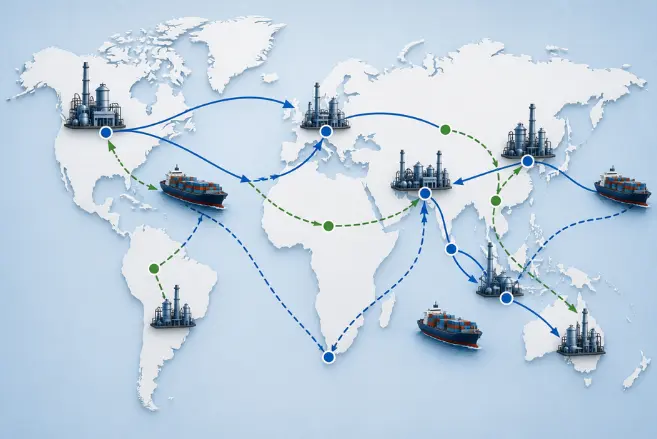
Multi-origin price comparison requires Incoterm normalisation before any comparison is meaningful. A FOB Mundra offer from an Indian manufacturer and a CFR Singapore offer from a Chinese producer are not comparable without adding freight, insurance, port charges, and import duty. No general procurement platform performs this calculation natively for chemicals.
Commodity price volatility tracking exposes the third gap. When TiO2 prices move 15% in six weeks because of Chinese production curtailments, your ERP still shows the rate from last quarter’s contract. The spread between your committed rate and current spot price is your negotiation leverage, and most procurement platforms cannot surface it without custom configuration that costs more than the original platform subscription.
Supplier qualification scoring for chemical categories is also structurally different from rating service vendors. Approving a new caustic soda supplier requires QA sign-off on CoA parameters, logistics validation of port capability and Incoterms flexibility, and credit term assessment across multiple currencies. The 5-star vendor rating frameworks built for indirect categories do not map onto this workflow without significant modification.
The Tool Categories: An Honest Assessment
Spend Analytics Platforms
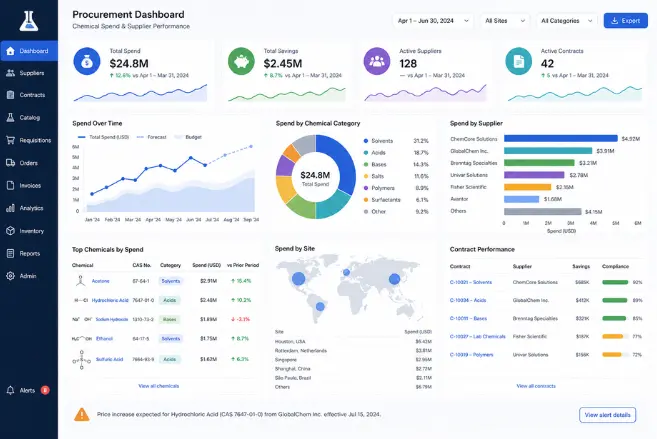
Spend analytics is where chemical procurement teams see ROI fastest, and where the investment case is most defensible. A spend analytics layer, whether a dedicated platform like Coupa Spend Guard, Ivalua Analytics, or a well-structured Power BI implementation connected to ERP data, lets you answer questions your finance team is already asking: where is chemical spend concentrated, which suppliers show pricing drift year-over-year, and which categories carry single-source exposure.
For a company buying $10M annually in commodity chemicals across 8 suppliers, spend analytics typically surfaces 8-12% in addressable savings within 90 days, primarily through volume consolidation opportunities that manual reporting misses. The ROI case is clear. The limitation is data quality: if your ERP captures chemical purchases as undifferentiated line items without consistent material codes, the analytics layer produces noise. Cleaning that data is 60-70% of the actual implementation effort, and most vendors understate it.
Supplier Management (SRM) Systems
SRM platforms deliver value for chemical teams managing more than 20 active suppliers across multiple geographies. The features that matter: structured onboarding workflows, document expiry tracking for MSDS renewal cycles and quality certification dates, and performance scorecarding against delivery, quality, and pricing KPIs. Platforms like Jaggaer, GEP, and Ivalua handle these functions competently.
The chemical-specific gap is commodity price integration. Most SRM systems do not connect to ICIS or Platts feeds, so pricing intelligence still lives in email threads and spreadsheets alongside the platform. Before evaluating SRM platforms, review the chemical supplier audit checklist to map exactly which supplier data points you need to capture before building a platform configuration around requirements you haven’t fully defined. Below 20 active suppliers, a well-designed Airtable or Excel database delivers equivalent functionality without $80K-$300K in annual licensing.
E-Sourcing and RFQ Automation
E-sourcing tools add genuine value for chemical buyers running competitive RFQs across multiple origins for well-specified commodities. Running a reverse auction for a standard-grade sodium hydroxide requirement, where multiple suppliers compete on a normalised landed-cost basis, has documented impact on commodity chemical pricing for buyers with sufficient volume to attract competition.
The practical limitation is specification complexity. Chemical RFQs require free-text specification attachments, multi-parameter evaluation beyond price, and landed-cost comparison that most platforms handle poorly without customisation. Platforms handle simple price auctions well and complex, multi-variable chemical evaluations poorly. Customisation costs routinely offset the platform savings for anything beyond straightforward commodity categories.
ERP-Native Procurement Modules
For companies already running SAP MM, Oracle Procurement Cloud, or Microsoft Dynamics 365, the native procurement module is often the highest-ROI digital investment available. Data is already structured, integration overhead is eliminated, and the team already operates within the system. These modules handle purchase order management, three-way matching (PO, goods receipt, invoice), and basic supplier master management competently.
They do not replace specialised spend analytics or SRM tools, but they provide the data foundation every other tool requires to function. Companies that evaluate standalone platforms before fully utilising their ERP’s native procurement functionality are sequencing their investments backwards. The ERP is where chemical procurement data should live and should be clean before any additional layer is added.
AI-Powered Price Intelligence
AI-driven commodity price forecasting for chemicals is commercially available and credible for high-spend categories. Providers including ICIS’s forecasting modules and specialised platforms that analyse production capacity data, feedstock cost trends, and historical trade flow patterns generate forward price signals that are increasingly useful for procurement timing decisions.
The math is straightforward: a team that uses price intelligence to delay a caustic soda contract by 6 weeks and captures a $30/MT decline on 500 MT of annual volume recovers $15,000 per avoided price peak. At $500-$2,000/month per category subscription, the investment case works for categories where timing flexibility exists and price volatility is material. For fixed-specification, long-lead-time categories with limited spot market access, the value is substantially lower and harder to demonstrate.
Where AI Is Genuinely Useful in Chemical Procurement
Three specific applications deliver measurable value today, not in vendor marketing materials.
Spend anomaly detection: AI flags when invoiced pricing drifts from contracted rates across a supplier portfolio, when category spend velocity signals a production issue downstream, or when freight costs on a trade lane are trending outside historical norms. These are pattern recognition tasks that currently require hours of manual reporting per week and that AI performs reliably at scale.
Supplier risk monitoring: Several SRM platforms now include AI-driven risk signals that monitor supplier financial health, regulatory filings, shipping data, and news coverage to surface supply disruption risk before it becomes a production emergency. For chemical teams carrying single-source dependencies on critical raw materials, early warning of a supplier’s operational or financial stress is worth the platform cost on its own.
Contract versus spot optimisation: AI tools that model optimal contract coverage against spot exposure, given volume forecasts and price volatility inputs, are moving from theoretical to commercially viable for teams managing $5M or more in annual spend per category. The optimisation output is a recommended coverage ratio, not a fully automated execution, but it provides a quantitative framework that most procurement teams currently build manually in spreadsheets.
Where AI Is Still Hype for Chemical Buyers
Automated supplier discovery: AI supplier discovery platforms work well for indirect categories with hundreds of vetted vendors. For specialty chemicals with 5-8 credible global manufacturers, the discovery problem is not a data problem. Procurement managers already know who makes it, who is qualified, and who has the export capability for their import market. An algorithm adds no value here.
Automated negotiation: No platform is negotiating your next 500 MT caustic soda contract. The negotiation involves Incoterm flexibility, quality specification trade-offs, payment term structures, and relationship history that are not reducible to an algorithm. Vendors demonstrating AI negotiation capabilities are doing so on indirect categories and MRO spend, not on commodity chemicals bought in container loads.
Quality prediction from historical CoA data: Several platforms claim to predict batch quality issues from supplier CoA trend analysis. The transaction volume per supplier that predictive models require to produce reliable signals is higher than most chemical procurement teams generate within a 2-3 year data window. This remains a research-stage capability for most real-world procurement contexts.
The Build vs Buy vs Adapt Decision
The honest framework by annual chemical spend:
Annual Chemical Spend | Recommended Digital Investment |
Under $2M | ERP native module + structured Excel + clean data discipline |
$2M to $10M | Spend analytics layer (Power BI or dedicated tool) + ERP + supplier database |
$10M to $50M | Dedicated spend analytics + SRM system + commodity price feed subscription |
$50M+ | Full enterprise platform (Coupa, SAP Ariba, Ivalua) with chemical-specific configuration |
The consistent failure mode at every tier is buying upward: a $5M chemical spend team running a $200K/year enterprise platform before the data is clean, the internal processes are standardised, and the team has bandwidth for adoption alongside day-to-day sourcing. The technology accelerates what exists. Applied to a broken process, it accelerates the chaos.
For the negotiation mechanics that determine how much leverage your spend volume actually gives you at each tier, see volume tier negotiation with chemical suppliers for a framework that applies before and after any platform deployment.
Companies that consistently extract ROI from procurement technology invest three times more in process design than in software licensing. The tool is a multiplier on an effective process, not a replacement for one.
How Raw Source Supports Chemical Procurement Teams Navigating Digital Tools
Procurement teams deploying digital tools face a structural challenge that no software platform resolves independently: the quality of your sourcing intelligence is constrained by the depth of your supplier relationships and market access, not by the capability of your analytics dashboard.
A spend analytics platform will tell you that TiO2 costs increased 12% year-over-year. What it cannot tell you is whether that increase reflects a genuine market-wide movement or a supplier capturing margin against a single-source dependency. That distinction determines whether you push back in negotiation or accelerate a supplier diversification project, and it requires market-level visibility that comes from sourcing partners actively operating across multiple origins and supply channels, not from data sitting inside your ERP.
As a bulk chemical supplier operating in container-load quantities across industrial chemical categories, Raw Source provides the sourcing intelligence layer that digital platforms reference but cannot generate. Pricing context, supply availability signals, and supplier qualification experience are the inputs that make spend analytics meaningful. They start with sourcing relationships that surface real market data, and those relationships cannot be purchased as a software subscription.
What procurement teams working with Raw Source gain in a digital procurement context:
For teams running formal RFQ processes through e-sourcing platforms, Raw Source provides documentation-complete quotations as standard: CoA, MSDS/SDS, certificate of origin, packing lists, and Incoterm flexibility from FOB to DDP. This applies across product categories such as DHA (dihydroxyacetone) used in personal care, where documentation completeness directly impacts supplier selection timelines. This means RFQ responses feed directly into procurement evaluation matrices without requiring manual data cleanup or document follow-up. Most e-procurement teams identify the gap between RFQ close and supplier selection as their single biggest process bottleneck. Documentation completeness at the quotation stage is where that gap closes.
Pricing structure that integrates with digital procurement systems: All Raw Source pricing is structured per MT on standard Incoterms, mapping directly into spend analytics platforms tracking chemical costs on a normalised landed-cost basis. Procurement teams can incorporate Raw Source’s pricing data into their ERP and analytics layers without conversion or normalisation work, which means the data actually enters the platform consistently rather than being manually adjusted per shipment.
Document workflow support at container-load scale: Raw Source provides full documentation packages as standard with every container-load transaction, covering CoA, MSDS/SDS, certificates of origin, and packing lists. For procurement teams whose SRM platforms include document management modules, this documentation is delivered in structured format, reducing manual entry and compliance tracking overhead. Document expiry management for annual supply relationships is handled as part of the ongoing supply partnership, not as an ad-hoc request process.
Market intelligence that sits above the dashboard: When a spend analytics platform flags a chemical category for investigation, Raw Source can provide the market context that converts a data point into a decision: which production origins are adding or reducing capacity, what the freight differential looks like between Asian and European sources on a CFR basis for your specific import port, and what a realistic procurement strategy looks like for container-load quantities over a 12-month contract horizon. This is the intelligence layer that procurement software is designed to process but cannot generate.
The goal is not to be the technology layer in your procurement stack. The goal is to be the sourcing partner whose market access, documentation discipline, and volume capability makes your existing technology layer more useful.
Request a bulk quote to discuss what a sourcing partnership looks like for your chemical categories at container-load volumes.
Frequently Asked Questions
What annual chemical spend justifies a dedicated procurement management platform?
The realistic ROI threshold for a dedicated spend analytics or SRM platform in bulk chemical procurement is $5M to $10M in annual chemical spend. Below that level, a well-structured ERP native module combined with a purpose-built supplier database in Excel or Airtable typically delivers better ROI, because implementation overhead does not scale down proportionally for smaller teams. The $5M threshold assumes clean ERP data and standardised procurement processes are already in place before platform evaluation begins.
Can general procurement platforms handle COA and chemical compliance document management?
Most general procurement platforms do not natively handle the document types specific to chemical sourcing: CoA, MSDS/SDS, BIS certificates, phytosanitary certificates, and certificates of origin. Some SRM platforms include document management modules that can be configured for these document types through custom field mapping and workflow design, but configuration scope is typically underestimated in implementation proposals. Dedicated QMS or document management systems sometimes provide better out-of-the-box chemical compliance functionality than procurement platforms at meaningfully lower cost.
Do AI-powered procurement tools deliver ROI for bulk chemical buying?
AI tools deliver measurable ROI in specific applications: spend anomaly detection, supplier risk monitoring, and contract versus spot optimisation at significant spend levels. They do not add meaningful value in supplier discovery for specialty chemicals where the supplier universe is small and known, automated negotiation where Incoterm and quality trade-offs require human judgment, or quality prediction from CoA trend data where transaction volumes are insufficient to train reliable models. Evaluate AI procurement tools against specific use cases rather than general platform capability claims.
How do I integrate commodity chemical price data into my procurement platform?
ICIS, S&P Global Commodity Insights (Platts), and Fastmarkets are the primary commodity price data providers for industrial chemicals. Most offer API access that feeds into ERP systems or spend analytics platforms. Direct integration typically requires technical configuration and subscription costs starting at $15,000 to $50,000 annually per category coverage set. For procurement teams below $20M in annual chemical spend, tracking relevant price indices through published data services is a practical alternative to direct API integration.
When does Excel still outperform dedicated procurement software for chemical buying?
Excel outperforms dedicated platforms when: the team manages fewer than 20 active chemical suppliers, internal procurement processes are not yet standardised enough to benefit from workflow automation, ERP data quality is insufficient to produce reliable analytics, or annual chemical spend is below $5M. Excel also wins when the implementation and change management cost of a new platform would require more than 18 months to recover through the platform's stated ROI. Many mid-market chemical procurement teams operate effectively on well-designed spreadsheet systems combined with a reliable ERP, and this remains a legitimate operating model for companies at that scale.