
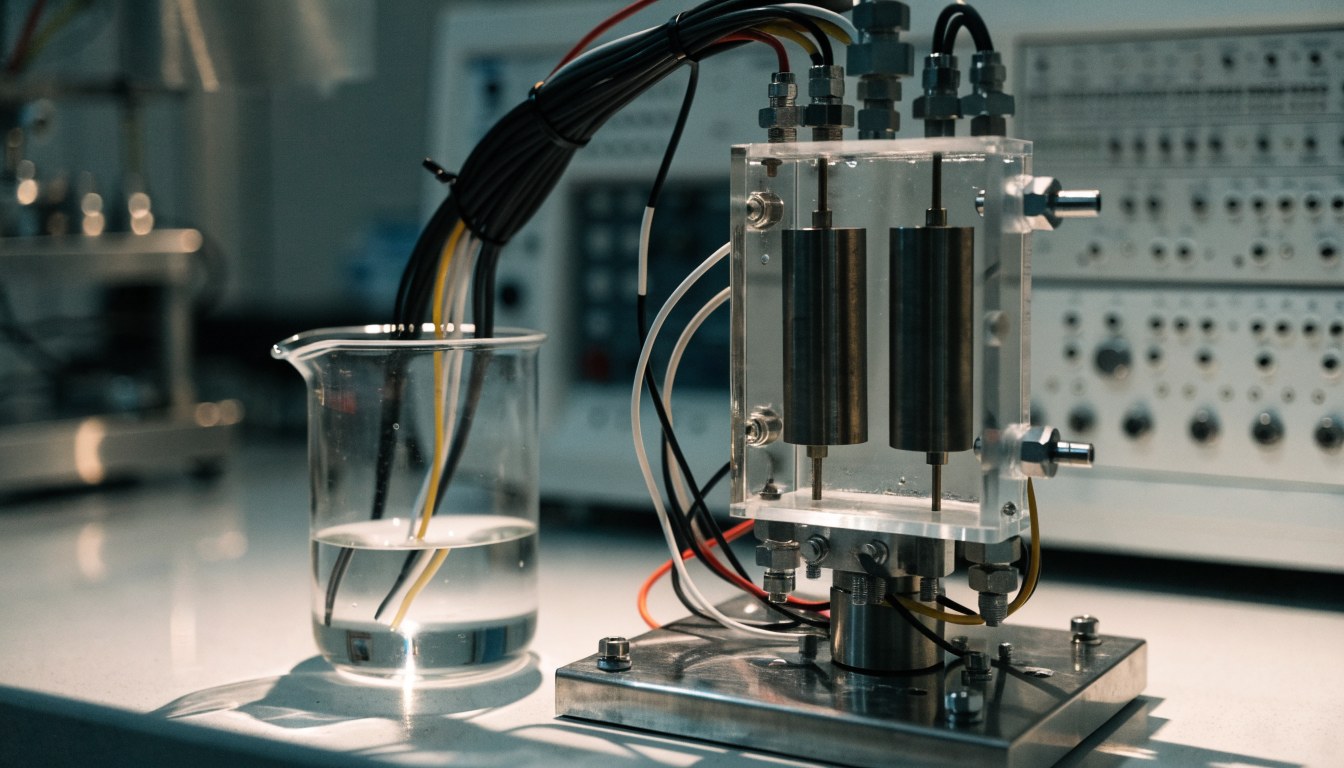
Your maintenance team needs fluid to top up a silicone-filled distribution transformer, and the requisition reads “50 cSt PDMS dielectric fluid.” Three quotes come back. All three say polydimethylsiloxane, two print different CAS numbers, and one attaches a data sheet listing a molecular weight of 236.53 g/mol. None of it tells you whether the fluid in the drums will insulate and cool the way the transformer’s designer assumed.
The name and the CAS number identify a chemical family. Unless the purchase order names the properties, methods and limits, the certificate of analysis (CoA) has no reason to report them. Two further checks happen after delivery, and no data sheet carries either of them: a water and breakdown re-test on the delivered fluid, and a blend test before any top-up.
What do the name and the CAS number fix?
Polydimethylsiloxane is a chain of alternating silicon and oxygen atoms with two methyl groups on each silicon, written as the repeat unit (C2H6OSi)n. In a dielectric fluid the chain ends are capped with trimethylsilyl groups, and ECHA lists the name “Dimethyl polysiloxane, bis(trimethylsilyl)-terminated” for CAS 9006-65-9. The chain length behind that n is what sets viscosity. The same chemistry trades as dimethicone, dimethyl silicone, dimethylpolysiloxane, silicone oil and silicone fluid, so a new name on a quote is no evidence of a new fluid.
In its 2026 record, FDA’s Global Substance Registration System (GSRS) codes CAS 9006-65-9 as “GENERIC (FAMILY)”, not as a single substance. It defines dimethicone as a mixture whose component may be any one of eight viscosity-named grades: dimethicone 20, 100, 200, 350, 410, 500, 1000 and 12500. There is no 50 on that list.
The record does carry a viscosity property of 50 cSt to 1,000 cSt, but marks it as non-defining and unreferenced. A 50 cSt dielectric fluid sits at the bottom edge of a range the registry does not use to define the substance, so the number on your purchase order is the only definition it has.
The CAS number also reaches down to the volatile end of the series. ECHA’s name list for 9006-65-9 includes hexamethyldisiloxane, the smallest trimethylsilyl-capped member. Of 62 PubChem depositor records for the number, 25 standardize to hexamethyldisiloxane (CID 24764) and 12 to octamethyltrisiloxane (CID 24705). That is how a dimethicone data sheet ends up printing the formula C8H24O2Si3 and 236.53 g/mol: both describe a three-silicon molecule, not the polymer in your drum.
Going the other way, the EU CosIng inventory (2023 record) lists the ingredient name DIMETHICONE against three CAS numbers, among them 63148-62-9 and 9006-65-9. Two quotes with different CAS numbers can describe the same chemistry, and two with the same number can describe fluids that behave differently in a transformer. Neither number says anything about water, breakdown strength or fire point.
Which test properties belong on the purchase order?
Unused silicone insulating liquid has its own published specifications, among them IEC 60836 for unused silicone insulating liquids and ASTM D4652 for silicone fluid used for electrical insulation. Name the one your transformer maker or your internal standard calls for, and require every lot to be reported against it with the test method beside each result. The acceptance limits come from that specification and the equipment maker, not from a typical-values data sheet.
| Property | What it tells you | What to write on the purchase order |
|---|---|---|
| Identity | Linear, trimethylsilyl-capped polydimethylsiloxane, not a cyclic or functional silicone | Chemical name, the CAS number on the supplier’s documents, and a statement that the fluid is unused |
| Kinematic viscosity | How the fluid moves through windings and radiators, and so the cooling the thermal design assumed | 50 cSt nominal at a stated temperature, an agreed acceptance band, method named |
| Water content | Dissolved water lowers breakdown strength | A maximum by Karl Fischer titration, reported for each lot |
| Dielectric breakdown voltage | Insulating strength of the sample as tested | A minimum, with electrode shape, gap and method named |
| Dissipation factor and volume resistivity | Polar and ionic contamination that a viscosity test cannot see | Results at a stated temperature, method named |
| Flash point and fire point | Fire behavior, which a heavy light fraction pulls down | Minimums, with the method named |
| Volatile content | The size of that light fraction | A limit and the method |
| Density and refractive index | Quick identity cross-checks | Values agreed with the supplier, checked on the delivered lot |
| Appearance | Particles, haze and sediment | Clear and free of visible particles on receipt |
One trap sits inside the viscosity line. Kinematic viscosity is reported in cSt and dynamic viscosity in cP or Pa·s, and the Cosmetic Ingredient Review’s 2022 amended safety assessment notes that this ingredient class is reported both ways. Converting kinematic to dynamic means multiplying by the fluid’s relative density and dividing by 1000 to reach Pa·s. A quote that answers a 50 cSt requirement with a figure in cP has not answered it until the density and the temperature come with it.
Why does the light end of the fluid matter more than the label?
Light siloxanes, linear or cyclic, are the volatile end of the same chemistry, and they can remain in a polymer fluid unless the producer strips them out. Decamethylcyclopentasiloxane (CAS 541-02-6), a five-silicon ring, shows how volatile that end can be: PubChem lists a boiling point of 210 °C and a closed-cup flash point of 73 °C. Hexamethyldisiloxane, the two-silicon molecule inside the 9006-65-9 name list, is lighter still.
A lot that carries more of this light fraction can show a lower flash point, a lower fire point and a higher volatile loss than a stripped lot, even at the same nominal viscosity. Fire behavior is one of the reasons silicone fluid goes into transformers at all, so a heavy light end undercuts the reason it was chosen. Treat flash point, fire point and volatile content as acceptance tests on every lot. A typical value describes a product line. A lot result describes your drums.
What does a certificate prove once the drums leave the plant?
A breakdown voltage on a CoA describes one sample, in the producer’s test cell, on the day it was run. Water can enter each time a drum is opened, a transfer hose is connected or a sample bottle stands uncapped, and silicone fluid takes up moisture from humid air even though it does not mix with liquid water. Because dissolved water lowers breakdown strength, the CoA result is a starting point, not a measurement of what reaches the tank.
Two receiving checks close that gap. First, draw a sample from the delivered drums and run water and breakdown voltage by the methods the purchase order names, before the fluid goes into any unit. Second, confirm that the lot numbers on the drums match the lot numbers on the CoA, because a certificate for a different lot proves nothing about this one. If a receipt result misses its limit, drying and filtering on site is an engineering decision, not a reason to waive the test.
Is a top-up with a different lot a purchasing decision or an engineering one?
An engineering one. Shared chemistry makes mixing two 50 cSt polydimethylsiloxane fluids plausible; it does not make the mix proven for your unit. The fluid already in service has spent years in the transformer and may carry water and particles the new lot does not, and the new lot may differ in its light fraction. A matching viscosity figure on two data sheets settles none of that.
Before a top-up with a different lot, or with fluid from a different producer, mix new and in-service fluid in the ratio the top-up will create and run water, breakdown voltage and dissipation factor on the blend. Check the results against the transformer maker’s fluid requirement, and record which lots went into which unit so a later fault can be traced. Topping up a silicone-filled unit with mineral oil or an ester fluid is a different question and sits outside this specification.
What should go out with the request for quotation?
-
The fluid: unused, linear polydimethylsiloxane (dimethicone) for electrical insulation, and the specification your equipment calls for.
-
Kinematic viscosity of 50 cSt nominal at a stated temperature, with an acceptance band and the test method.
-
A CoA for every lot reporting water, breakdown voltage with electrode and gap, dissipation factor, volume resistivity, flash point, fire point and volatile content, each with its method.
-
Lot numbers on every drum that match the CoA.
-
A receipt test plan: water and breakdown voltage on a sample from the delivered drums before filling.
-
For any top-up, a blend test of new and in-service fluid before the lots are mixed.
-
The current Safety Data Sheet (SDS), read for its hazard statements before anyone handles the fluid.
Methodology: identity and registry data are from FDA’s GSRS (2026 record), the EU CosIng inventory (2023 record), ECHA CHEM and PubChem; the viscosity conversion is from the Cosmetic Ingredient Review’s 2022 amended safety assessment. The property list is qualitative, and acceptance limits come from the specification your transformer maker names.
Frequently asked questions
Does a silicone-filled unit need flushing before a top-up with another producer’s 50 cSt fluid?
Why does the molecular weight on a dimethicone data sheet look so low?
Will a supplier’s breakdown voltage match the result from your own test set?
Does a food or pharmacopeial grade dimethicone certificate qualify a fluid for transformer use?
Sources & methodology
Figures are RawSource sourcing data unless attributed to a named source. Regulatory citations are current as of publication. Chemical identities verified by CAS number against the RawSource catalog.
Search 1,300+ industrial chemicals by name or CAS, or send us your spec — we quote by the drum, tote, or container.
Browse the Chemical Index → Request a Quote