
Is Lauryldimethylamine Oxide the Same Chemical as Lauramine Oxide?
Two technical data sheets land on the desk the same week. One reads “Lauryldimethylamine Oxide.” The other reads “Lauramine Oxide.” The CAS number on both is 1643-20-5. The molecular formula on both is C₁₄H₃₁NO. The molecular weight is 229.40 g/mol (PubChem CID 15433). They are the same molecule, a tertiary amine oxide formed by oxidation of the amino group of dodecyldimethylamine (ChEBI, via PubChem). The IUPAC name is N,N-dimethyldodecan-1-amine oxide.
CAS 1643-20-5 is TSCA-active (EPA Substance Registry Services) and REACH-registered under EC 216-700-6 (ECHA). The danger is not the chemistry. The danger is that a buyer who does not anchor to the CAS number orders both, doubles inventory, and runs a qualification cycle on a material already approved.
Regulatory status: one molecule, two inventory systems, and a documentation trap
U.S. (TSCA). EPA’s Substance Registry Services lists 1-Dodecanamine, N,N-dimethyl-, N-oxide (CAS 1643-20-5) on the TSCA Inventory with active status. It appears on both the 2020 and 2024 Chemical Data Reporting TSCA Inventory Active lists (EPA SRS). The substance is also on the United States High Production Volume Challenge Program list (EPA SRS), which means a substantial toxicological dataset exists.
For pesticide formulators: 40 CFR 180.910 exempts C10-C18-alkyl dimethyl amine oxides from the requirement of a tolerance when used as a surfactant at up to 15% by weight in pesticide formulations, applied pre- and post-harvest (eCFR, as of 2026-10-01). The EPA Pesticide Product Code is 875902.
EU (REACH). ECHA records dodecyldimethylamine oxide under EC 216-700-6 (reference ID 100.015.278) as REACH-registered. The lead dossier registers consumer uses under product categories PC 35 (washing and cleaning products) and PC 39 (cosmetics, personal care products), and professional uses under PC 21 (laboratory chemicals), PC 31 (polishes and wax blends), PC 35, and PC 39 (ECHA disseminated registrant data, 2026).
One documentation trap to watch: PubChem carries at least 13 deprecated CAS registry numbers for this substance, described as “no longer used but still met in some older references” (PubChem, via ChemIDplus). If a supplier’s CoA cites a deprecated CAS number instead of 1643-20-5, the documentation mismatch can flag the shipment at customs review. Confirm that the CoA and your import filing both state CAS 1643-20-5 and EC 216-700-6.
Cosmetics. The INCI name is “Lauramine Oxide,” assigned by the Personal Care Products Council. The Cosmetic Ingredient Review Expert Panel concluded that lauramine oxide is safe in rinse-off cosmetic products under present conditions of use and limited to a maximum of 3.7% in leave-on products (PubChem, citing CIR). The EU Cosmetics Regulation (EC) No 1223/2009 recognizes the INCI name.
How many names does CAS 1643-20-5 have?
More than a buyer should need to track. The synonym table below maps the names you will encounter on spec sheets, regulatory filings, and lab catalogs back to the single CAS number. A deprecated CAS on a CoA is a reason to stop the qualification and ask the supplier to reissue.
| Synonym | Naming Authority / Context | Where You See It |
|---|---|---|
| Lauramine Oxide | INCI (PCPC) | Cosmetic ingredient lists, formulation sheets, EU product labels |
| Lauryldimethylamine oxide | CAS preferred / common trade name | TDS, industrial spec sheets, HSDB |
| LDAO | Abbreviation (trade / lab) | Biochemistry literature, oilfield spec sheets |
| Dodecyldimethylamine oxide | ECHA EC Inventory name | REACH dossiers, EU regulatory filings |
| DDAO | Abbreviation (trade / lab) | Lab-supply catalogs, protein-solubilization protocols |
| N,N-dimethyldodecan-1-amine oxide | IUPAC | PubChem computed descriptors, academic publications |
| 1-Dodecanamine, N,N-dimethyl-, N-oxide | CAS Index name (inverted) | EPA SRS, TSCA Inventory, 40 CFR 180.910 |
The identity card:
| Property | Value | Source |
|---|---|---|
| CAS Registry Number | 1643-20-5 | CAS Common Chemistry |
| EC Number | 216-700-6 | ECHA CHEM |
| Molecular formula | C₁₄H₃₁NO | PubChem CID 15433 |
| Molecular weight | 229.40 g/mol | PubChem CID 15433 |
| IUPAC name | N,N-dimethyldodecan-1-amine oxide | PubChem CID 15433 |
| INCI name | Lauramine Oxide | PCPC / CIR |
| Structural class | Tertiary amine oxide | ChEBI via PubChem |
| Water solubility | 190,000 mg/L at 25 °C | PubChem CID 15433 |
| Melting point (dry) | 130-134 °C | ECHA REACH dossier summary |
| Vapor pressure | 6 × 10⁻⁸ mmHg | PubChem CID 15433 |
What does the molecule actually do in a formulation?
Lauramine oxide is amphoteric. Below approximately pH 3 the nitrogen protonates and the molecule behaves as a cationic surfactant. Above approximately pH 7 it functions as a nonionic. Between those regions it carries partial charge. That pH-dependent character is the reason it appears in such different formulation contexts.
Household and institutional cleaning. In dish liquids and all-purpose cleaners, lauramine oxide acts as a foam booster and viscosity builder alongside anionic surfactants such as sodium lauryl sulfate or linear alkylbenzene sulfonate. HSDB (via PubChem) lists dishwasher detergents among its established uses (HSDB, citing Kosswig, Ullmann’s Encyclopedia of Industrial Chemistry, “Surfactants”). The INCI name “Lauramine Oxide” is what appears on formulation sheets in this sector. Its high water solubility (190,000 mg/L at 25 °C, PubChem) makes it straightforward to incorporate in aqueous concentrate blends.
Industrial and oilfield applications. In high-electrolyte or hard-water systems, the nonionic behavior above pH 7 gives lauramine oxide better tolerance to divalent cations than purely anionic surfactants. Spec sheets in this sector tend to use LDAO or DDAO as the identifier, and buyers accustomed to those abbreviations may not recognize “Lauramine Oxide” on a quote. The result is a parallel qualification for a material already approved.
Personal care. The CIR safety assessment governs the use ceiling: 3.7% maximum in leave-on products (PubChem, citing CIR). Shampoos are rinse-off and have no stated percentage cap under the CIR conclusion. HSDB lists shampoos and soaps among the established applications.
The trade-off a formulator should weigh: lauramine oxide’s foam-boosting performance is pH-dependent. In an acidic system (below pH 3), it transitions to cationic behavior, and foam compatibility with anionics drops. If the formulation sits in that low-pH range, the molecule does not deliver the viscosity build that justified choosing it.
What should you check when qualifying a lot?
The commercial product is not the anhydrous solid (which melts at 130-134 °C per the REACH dossier and is highly hygroscopic). It is an aqueous solution. The grade-defining parameters on a spec sheet are narrower than the name suggests.
| Parameter | Typical Range (30% grade) | Why It Matters |
|---|---|---|
| Amine oxide (active content) | 29-31% | Below 29%, you are paying for water. Above 31%, viscosity and handling change. |
| Free amine | 1.0% maximum | Unreacted dodecyldimethylamine is an irritant and carries its own GHS classification. High free amine signals incomplete oxidation. |
| Residual peroxide | 0.25% maximum | Hydrogen peroxide is the oxidant used in manufacture. Residual peroxide degrades dyes, destabilizes fragrances, and can cause off-gassing in sealed drums. |
| pH (10% solution) | 7.0-9.0 | A lot below 7.0 may indicate acid contamination or degradation. A lot above 9.0 raises free-amine suspicion. |
(All typical values from a manufacturer technical bulletin; lot CoA governs for any shipment.)
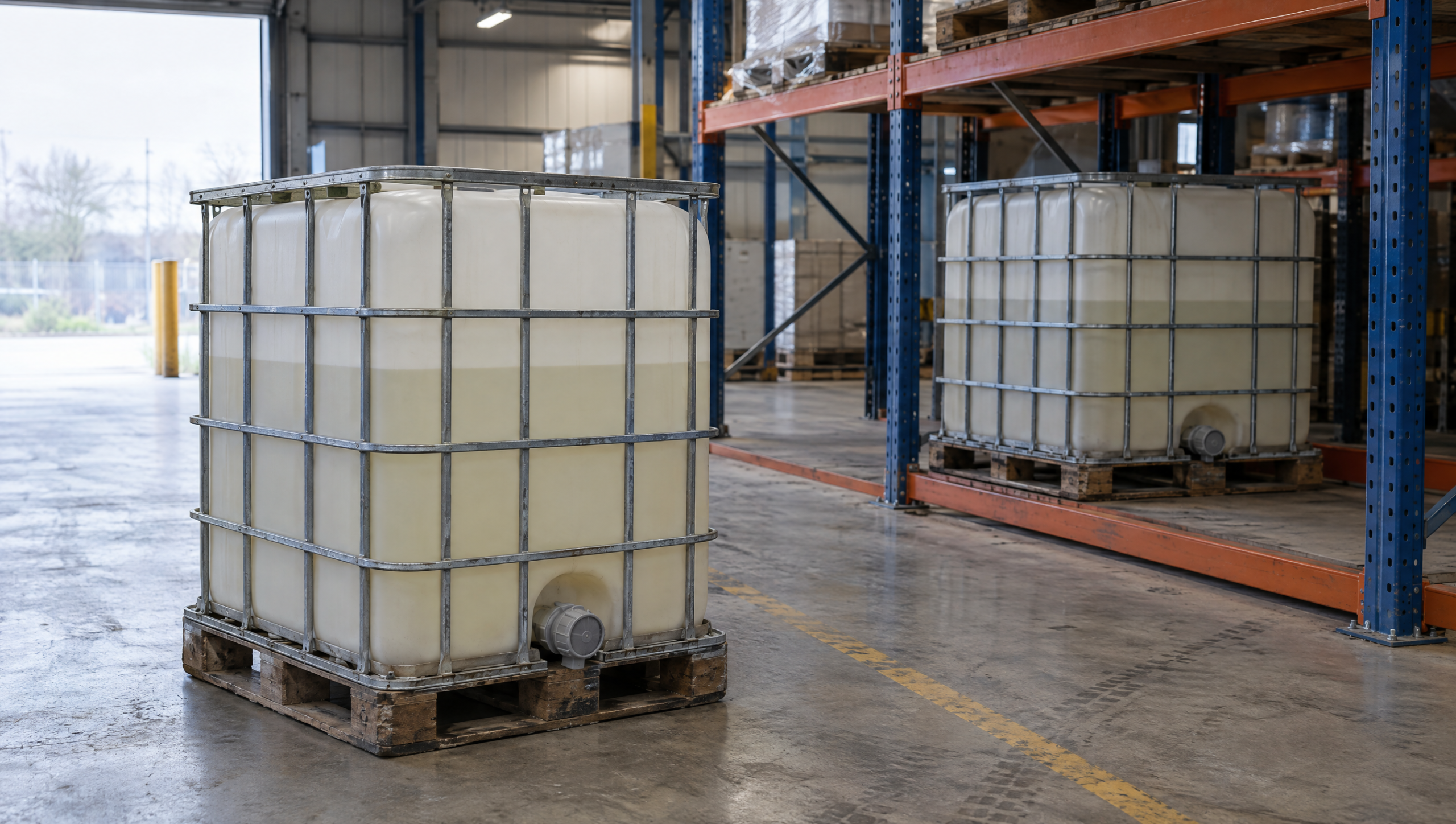
Storage. The 30% solution must be kept from freezing (manufacturer technical bulletin). Once the aqueous solution freezes and thaws, the amine oxide can precipitate or form a gel that does not fully redissolve, leaving heterogeneous active-matter distribution in the drum. If you receive a tote in winter and the product has gelled, do not accept it without retesting active content and free amine on a representative sample.
CAS verification. Every CoA and import filing should state CAS 1643-20-5. PubChem carries at least 13 deprecated CAS registry numbers for this substance (PubChem, via ChemIDplus). If the document cites any deprecated number, reject the CoA and ask for reissuance.
Second-sourcing. Because the molecule is a single defined substance (not a polymer or a natural-origin mixture), second-sourcing is straightforward. The gate is not the chemistry; it is the impurity profile. Compare at least three consecutive lot CoAs from the candidate supplier, paying attention to free amine and residual peroxide. If either drifts beyond the tolerance band on the initial sample, flag it before the qualification is complete.
The decision the synonym table is really about
A sourcing desk that writes “Lauramine Oxide” on one line of its approved-materials list and “LDAO” on another has two line items for one molecule and two sets of safety stock for one drum. The cost of that duplication is not the inventory carrying charge alone. It is the second qualification, the second supplier audit, and the second set of retained samples sitting in a QC freezer.
Anchoring CAS 1643-20-5 on the RFQ and the import filing collapses all of it to a single record. Whether the savings justify the cleanup depends on how many synonyms are embedded in your ERP, and how many times you have requalified a material you already had.
Request current pricing, availability, and a specification sheet for Lauramine Oxide (CAS 1643-20-5) by contacting the RawSource sourcing desk. Specify the active-content percentage and packaging format required so the quote matches the application.
Related on RawSource
- Lauramine Oxide product page: pricing, availability, and specification sheet for CAS 1643-20-5.
- Silicone antifoam in wastewater: silicone foam dressing: how silicone antifoams interact with surfactant-laden wastewater streams.
- Silicone antifoam chemical name reference: naming and identification guide for silicone antifoam actives.
- Silicone fluids and silicone oil antifoam: product overview for silicone-based defoamer chemistries.
- Epoxy curing agent supplier: sourcing context for reactive chemistries used alongside surfactant systems.
- Section 301 tariff update: ammonium bifluoride and hydrofluoric acid 2026: current tariff guidance relevant to specialty chemical procurement.
Frequently asked questions
What is the melting point of the dry (anhydrous) substance?
Can lauramine oxide be used as an inert ingredient in pesticide formulations?
What GHS hazard statements apply to the neat substance?
Sources & methodology
Figures are RawSource sourcing data unless attributed to a named source. Regulatory citations are current as of publication. Chemical identities verified by CAS number against the RawSource catalog.
Search 1,300+ industrial chemicals by name or CAS, or send us your spec — we quote by the drum, tote, or container.
Browse the Chemical Index → Request a Quote