
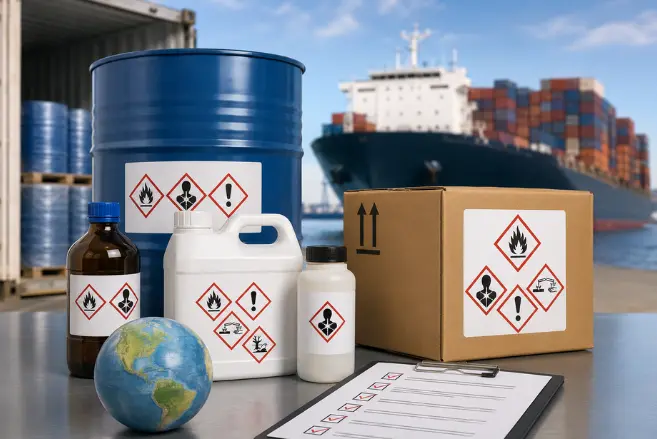
A container of an aromatic solvent clears your port of entry, lands at the warehouse, and your receiving team finds a label printed in the exporter’s language with a black-and-white pictogram and a UN transport class in place of a hazard statement. It is non-compliant under OSHA HazCom 2012, and as the importer you are now the legal author of that label. The shipment cannot move into your workplace or to your downstream customers until it carries a conforming label, and the clock on a re-labeling project that nobody scoped has already started.
This is the recurring blind spot in chemical importing: the Certificate of Analysis is right, the SDS is in hand, the Incoterms are settled, and the label is the thing that holds the container. The reason is structural. The Globally Harmonized System (GHS) was never adopted as a single global rule. Each jurisdiction implements its own version, and the moment a foreign-made chemical enters your supply chain, the responsibility for the label transfers to you. Knowing exactly what a compliant label must carry, who owns that obligation, and how the requirements diverge by destination is what separates a clean clearance from a quarantined drum.
What are the six required GHS label elements?
A GHS label must carry six elements, and a label missing any one of them is non-compliant. These are the harmonized core that OSHA HazCom 2012, EU CLP, and China’s GB 30000 series all share, even where their classification of a given hazard diverges.
- Product identifier — the name or number that ties the container to its SDS. It must match the identifier in Section 1 of the SDS exactly. For substances, this is typically the chemical name; for mixtures, the trade name plus the chemically active hazardous components.
- Signal word — either “Danger” (more severe categories) or “Warning” (less severe), and never both on the same label. When a chemical’s classifications would call for both, only “Danger” appears.
- Pictogram(s) — the standardized hazard symbols, each a black image on white inside a red diamond.
- Hazard statements (H-codes) — standardized phrases tied to each hazard class and category, e.g. H225 “Highly flammable liquid and vapour,” H314 “Causes severe skin burns and eye damage.” The text is fixed; you do not paraphrase it.
- Precautionary statements (P-codes) — prevention, response, storage, and disposal guidance, e.g. P280 “Wear protective gloves/eye protection.”
- Supplier identification — name, address, and telephone number of the manufacturer, importer, or other responsible party. On an import this is where the obligation visibly shifts to you.
Note what is not on this list: the CAS number, batch or lot number, molecular formula, and purity are best-practice additions, not GHS requirements. UN numbers and transport hazard classes belong to transport rules (DOT 49 CFR, IMDG), not to the workplace hazard-communication label, though both often appear on the same drum.
Who is responsible for the label once a chemical is imported?
The short answer: you are. Under OSHA HazCom 2012, the obligation to provide a compliant label falls on the chemical manufacturer, importer, or distributor that introduces the chemical into the US workplace. A foreign manufacturer is outside OSHA’s jurisdiction, so the US importer inherits the role of “responsible party” and, with it, the duty to ensure every container carries a conforming label before it moves downstream.
That has two practical consequences. First, if the foreign supplier’s label is wrong, incomplete, or in the wrong language, you must relabel it, and you cannot simply pass it through. Second, you may not remove or deface the existing label unless the container is being immediately marked with the required information. The EU framework works the same way under CLP Regulation (EC) 1272/2008: the importer placing a substance or mixture on the EU market is the legal supplier and carries full labeling responsibility, including registration-linked obligations under REACH.
Get the chemistry behind the label right at the source by confirming it against the documentation you already receive, our guide on how to read a chemical technical data sheet walks through reconciling identifiers and hazard data across paperwork.
Supplier label vs. workplace label: what’s the difference?
GHS recognizes two label types, and conflating them is a common compliance gap. The supplier (or shipped-container) label is the full six-element GHS label that must appear on every container as it enters commerce. This is the label your importer obligation attaches to.
The workplace label is what you may use on containers into which you transfer or decant the chemical inside your own facility, for in-plant use. OSHA allows workplace labels to be less prescriptive: they can use the full GHS label, or an alternative system (such as words, pictures, or symbols) that conveys the same hazard information and is consistent with HazCom, provided employees have ready access to the specific hazard details via the SDS. The key constraint: a workplace label is for material that stays in your facility. The moment a container ships to another employer or customer, it needs the full supplier label again. Importers who relabel decanted product with an abbreviated in-plant label, then ship it, create a non-compliant outbound shipment.
Why must pictograms have a red border, and what else trips inspections?
The red border is not cosmetic. GHS specifies that each hazard pictogram is a black symbol on a white background framed by a red diamond (a square set on a point) with sufficiently wide borders to be clearly visible. OSHA explicitly prohibits the black-bordered diamonds that some foreign suppliers print to save on color printing, an unfilled or black-bordered pictogram is treated as a missing pictogram.
This is one of the most frequently cited label defects on imported chemicals, alongside a few others worth pre-checking on every inbound container:
- Black or square pictogram borders instead of the red diamond.
- Both “Danger” and “Warning” printed together, which is never compliant.
- Paraphrased hazard statements rather than the exact standardized H-statement text.
- Wrong-language labels for the destination market.
- Transport-only marking (UN number, DOT class) used in place of the hazard-communication label.
- A product identifier that does not match the SDS, breaking the link between container and safety documentation.
Build these into receiving inspection the same way you check CoA values against spec. If you treat label conformity as a documentation problem rather than a physical-inspection problem, it surfaces only when an OSHA inspector or a customer’s EHS team finds it.
What language must the label be in?
The label must be in the official language of the market where the chemical is placed. OSHA HazCom 2012 requires English in the United States (additional languages are permitted but English is mandatory). EU CLP requires the official language(s) of every member state where the product is marketed, which for a pan-European importer can mean a single label carrying many languages, or market-specific label runs. China’s GB 30000 series requires Mandarin Chinese. India requires English.
A foreign exporter that prints one-language labels for global shipment is, by definition, shipping labels that are non-compliant in most destination markets. Language non-conformity is among the most common causes of GHS-related customs holds at European ports, and it is fully your problem to fix once the goods are yours. Specify the destination language requirement in your purchase documentation and verify it on a label proof before the container ships, relabeling after arrival is the expensive path. For more on coordinating these requirements into your buying process, see our overview of how to source bulk chemicals.
Why isn’t GHS the same everywhere? US vs. EU vs. China
GHS is built on a “building-block” approach: the UN GHS document (the “purple book,” with jurisdictions adopting specific revisions) is a menu, and each country selects which hazard classes, categories, and revisions to adopt. The result is that the same chemical can carry a different signal word, different pictograms, and different H-statements depending on where it lands. A label compliant in Shanghai is not automatically compliant in Houston or Hamburg.
| Element | US (OSHA HazCom 2012) | EU (CLP) | China (GB 30000) |
|---|---|---|---|
| Legal basis | 29 CFR 1910.1200 | Regulation (EC) 1272/2008 | GB 30000.2–.29 series |
| GHS revision aligned to | GHS Rev 7 (per the 2024 HazCom update) | Evolving; ATPs adopt newer revisions over time | GHS Rev 4 baseline, updating |
| Mandatory language | English | Official language(s) of each market state | Mandarin Chinese |
| Responsible party on import | Importer / distributor | Importer (also REACH registrant duties) | Importer / domestic agent |
| Notable divergences | No environmental-hazard pictogram required by OSHA (allowed, not mandated) | Environmental hazards labeled; additional EUH supplemental statements | Country-specific hazard categories and required statements |
| Six core elements required | Yes | Yes | Yes |
The practical takeaway: treat the destination jurisdiction’s implementation as the controlling spec, not the UN GHS in the abstract. The six core elements are shared, but the classification feeding them, and the supplemental requirements layered on top, are not. Reconciling hazard data across the SDS, label, and transport paperwork is where most errors hide; our breakdown of TDS vs. SDS differences is a useful companion when you audit these documents against one another.
How is GHS labeling enforced on imports?
Enforcement comes from two directions, and importers tend to anticipate only one. OSHA enforces the hazard-communication standard inside the workplace: an inspector finding non-compliant labels on hazardous chemicals can issue citations, with HazCom consistently among OSHA’s most-cited standards year after year. Their lever is the workplace, so the exposure is on the chemical you have already received and are handling or distributing.
US Customs and Border Protection, working with EPA and the broader regulatory framework, can hold or deny entry to shipments that fail import requirements, and labeling/documentation deficiencies are part of that screen. The two agencies create a pincer: CBP can stop the container at the border, and OSHA can cite you once it is inside. Because the importer is the responsible party, neither agency’s action is something you can push back onto the foreign manufacturer. The defensible posture is to verify label conformity before the container ships, inspect physically on receipt, and keep relabeling capability in-house as a standing capability, not a fire drill.
Methodology and sources
Regulatory framing in this guide comes from primary OSHA materials: OSHA\’s Hazard Communication overview, the full text of 29 CFR 1910.1200, and the OSHA Brief “Hazard Communication Standard: Safety Data Sheets”. Requirements evolve — confirm against the current standard text and your legal counsel for compliance-critical decisions.
Frequently Asked Questions
What is the difference between GHS labeling and an SDS?
A GHS label appears on the chemical container and communicates hazard information at the point of handling, covering the six mandatory elements: product identifier, signal word, hazard statements, precautionary statements, pictograms, and supplier identification. An SDS (Safety Data Sheet) is a 16-section document providing comprehensive hazard, handling, storage, and emergency response information for workplace use. Both are required for industrial chemical imports, but the label travels with the container and the SDS is retained in the workplace safety documentation system.
The same document discipline applies on the performance side: a technical data sheet specifies what the product does, while the SDS governs safe handling. Our TDS vs SDS breakdown explains where each fits in an import file.
Are GHS labels required for all chemicals imported into the US?
Under OSHA HazCom 2012 (29 CFR 1910.1200), GHS-compliant labels are required on all hazardous chemicals introduced into the US workplace. The determination of whether a chemical is hazardous is made by the chemical manufacturer or importer using GHS classification criteria. Non-hazardous chemicals are not subject to GHS labeling requirements, but standard product identification labeling still applies. Importers bear responsibility for ensuring all incoming hazardous chemical shipments carry compliant labels before distribution into the US supply chain.
Most industrial commodities fall squarely in scope: caustic soda and sulfuric acid, for example, carry the GHS05 corrosion pictogram and require the full six label elements on every imported container.
Which elements are not required on a GHS label?
The six required elements are: product identifier, signal word, hazard statements, precautionary statements, pictograms, and supplier identification. Elements commonly included as best practice but not required by GHS include: CAS number (though the product identifier must allow chemical identification), batch or lot number, molecular formula, and purity percentage. Shipping UN numbers and transport hazard classifications are separate requirements under IMDG/DOT transport regulations; they appear on transport labels, which are distinct from GHS hazard communication labels.
Do GHS labels need to be in the language of the destination country?
Yes, for all major GHS-implementing jurisdictions. EU CLP requires labels in the official language(s) of the member state(s) where the chemical is placed on the market. OSHA HazCom 2012 requires English-language labels in the US. India’s requirements specify English. China’s GB 30000 series requires Mandarin Chinese. A supplier producing one-language labels for global export is producing labels that are non-compliant in most of its destination markets. Language non-compliance is among the most common causes of GHS-related customs holds at European ports.
What is the difference between a Danger and Warning signal word on a GHS label?
“Danger” indicates a more severe hazard within a given hazard class; it is assigned to the highest-severity categories (typically Category 1 and 2). “Warning” applies to less severe but still significant hazard categories (typically Category 3 and 4 within a class). A chemical may have multiple hazard classifications, some warranting “Danger” and others “Warning”; in that case, only “Danger” appears on the label. A label bearing both signal words simultaneously is non-compliant under every GHS implementation.
Search 1,300+ industrial chemicals by name or CAS, or send us your spec — we quote by the drum, tote, or container.
Browse the Chemical Index → Request a Quote