
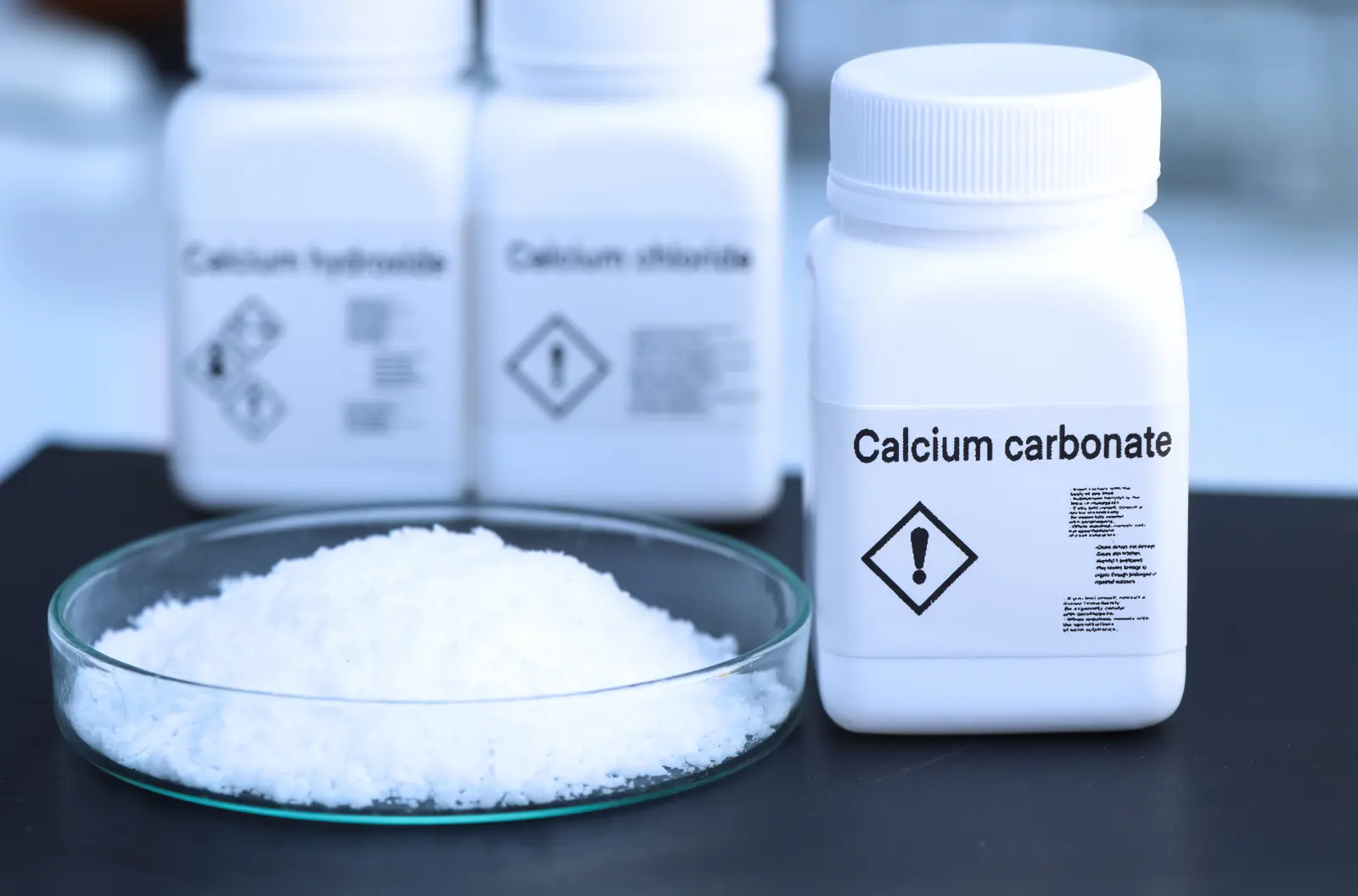
Calcium carbonate (CaCO3, CAS 471-34-1) is a white, naturally occurring mineral salt with a molar mass of 100.09 g/mol, sold industrially in two forms: ground calcium carbonate (GCC), milled from limestone, marble, or chalk, and precipitated calcium carbonate (PCC), synthesized for finer, more controlled particle size. It is one of the highest-volume mineral fillers and extenders on the market, used to add bulk, brightness, and stiffness to plastics, paints and coatings, paper, rubber, adhesives and sealants, and construction materials, and to supply calcium in agriculture (ag-lime) and animal feed.
What is calcium carbonate?
Calcium carbonate is the carbonate salt of calcium, formula CaCO3. Each formula unit holds five atoms across three elements: one calcium, one carbon, and three oxygen. By mass it is roughly 40% elemental calcium, 12% carbon, and 48% oxygen, which is why it doubles as a high-purity calcium source in feed and soil applications.
It occurs throughout nature as the rock-forming minerals calcite and aragonite. Limestone, marble, and chalk are all predominantly calcium carbonate, and the compound also makes up eggshells, coral, and the shells of marine organisms. For industrial buyers the relevant distinction is not where it formed but how it was produced and classified: a 3-micron coating-grade GCC and a 40-mesh ag-lime are the same chemical doing very different jobs.
Key properties of calcium carbonate
Calcium carbonate is a stable, near-insoluble white solid at room temperature. It is practically insoluble in plain water but reacts readily with acids, releasing carbon dioxide. Heated past roughly 825 degrees C it calcines, decomposing into calcium oxide (CaO, quicklime) and CO2 gas. The table below summarizes the reference properties formulators most often need at the spec stage.
| Property | Typical value |
|---|---|
| Chemical formula | CaCO3 |
| CAS number | 471-34-1 |
| Molar mass | 100.09 g/mol |
| Appearance | White powder or crystalline solid |
| Density | ~2.71 g/cm3 (calcite); ~2.83 g/cm3 (aragonite) |
| Mohs hardness | ~3 (calcite) |
| Decomposition temperature | ~825 degrees C to CaO + CO2 |
| Water solubility | Practically insoluble (~0.013 g/L at 25 degrees C) |
| pH of slurry | ~9 (mildly alkaline) |
| Elemental calcium content | ~40% by mass |
The mild alkalinity matters in formulation: a calcium carbonate slurry buffers around pH 9, which is why GCC is a workhorse acid-neutralizer and filler in paper and why it must be paired carefully with acid-sensitive resins. One genuine trade-off to plan for: because it is so cheap per ton, calcium carbonate tempts formulators to over-load it, but past a system’s critical pigment volume concentration the same filler that added stiffness starts to cost you gloss, tensile strength, and impact resistance.
GCC vs PCC: ground vs precipitated calcium carbonate
The single most consequential purchasing decision is GCC versus PCC. Ground calcium carbonate is mined rock crushed and milled to grade. Precipitated calcium carbonate is rebuilt chemically (calcine limestone to lime, slake it, then carbonate the milk of lime with recovered CO2), which lets the producer control particle size, shape, and surface. PCC runs finer and brighter and commands a higher price; GCC is cheaper and the default for high-loading filler duty.
| Attribute | GCC (ground) | PCC (precipitated) |
|---|---|---|
| Source | Milled limestone, marble, chalk | Synthesized from lime + CO2 |
| Typical particle size | ~0.5-100 microns | ~0.03-3 microns (sub-micron available) |
| Particle shape | Irregular, rhombohedral | Engineered (scalenohedral, prismatic, etc.) |
| Brightness | ~85-96% (source-dependent) | ~95-98% |
| Relative cost | Lower | Higher |
| Typical uses | Plastics, paint, sealants, construction, paper filler | Premium paper coating, high-gloss paint, food/pharma grades, specialty plastics |
For most high-volume filler applications GCC is the right starting point; reach for PCC only when you genuinely need the finer particle size, higher brightness, or controlled morphology, since you pay for it.
Calcium carbonate grades and specifications
Beyond GCC vs PCC, calcium carbonate is sold against grade specs that govern purity, whiteness, and fineness. Industrial filler grade prioritizes cost and consistency; technical and coating grades tighten brightness and top-cut; food, USP, and FCC grades hold the highest purity with controlled heavy-metal limits. Pick the grade your application and jurisdiction actually require, then confirm it against the Certificate of Analysis (CoA) for the lot.
| Grade | Typical CaCO3 purity | Whiteness / brightness | Typical fineness | Representative use |
|---|---|---|---|---|
| Industrial filler grade | ~95-98% | ~85-92% | ~325 mesh (~44 micron) and finer | Plastics, sealants, ag-lime base |
| Technical / coating grade | ~98-99% | ~92-96% | ~3-10 micron (coated options) | Paint, paper, premium polymer filler |
| Food / USP / FCC grade | >=98% (controlled metals) | ~95-98% | Fine, low-grit | Food, supplement, and regulated formulations |
Grade language is not standardized across every supplier, so a “filler grade” CoA from one mill is not interchangeable with another’s. Always match purity, brightness, and top-cut to your spec, and confirm any regulatory status (food, USP, FCC) against the CoA and the requirements of your application and jurisdiction.
Calcium carbonate applications by industry
Calcium carbonate earns its volume because the same low-cost mineral solves different problems across sectors. In plastics it is the dominant filler in PVC pipe, profiles, and masterbatch, where it cuts resin cost, raises stiffness and heat-deflection, and improves dimensional stability; loadings of 10-40% are routine, with coated grades aiding dispersion. In paints and coatings it functions as an extender pigment and matting agent, replacing pricier titanium dioxide on a volume basis while controlling sheen and rheology.
In paper it serves as both filler and coating, with PCC delivering the high brightness and opacity that mills want in alkaline papermaking. In rubber it is a low-cost reinforcing and semi-reinforcing filler, and in adhesives and sealants (silicones, polyurethanes, acrylics) it is the standard rheology builder and extender. In construction it goes into ready-mix, mortars, plasters, and as a feedstock for cement and lime. In agriculture, ag-lime raises soil pH and supplies calcium, and in animal feed it is a primary calcium source for poultry and livestock. Calcium carbonate also appears in food as a permitted additive and calcium source; this page is informational only and makes no health or medical claims.
Calcium Carbonate Supplier — Bulk Supply from RawSource
See the Calcium Carbonate USP Powder product page.
Start with the calcium carbonate USP powder product page to request a quote, and see our comprehensive guide to chemical procurement for how to structure a bulk chemical RFQ. See the Calcium oxide (quicklime) product page.
Methodology and sources
Identity and property context for Calcium Carbonate (CAS 471-34-1) in this guide is anchored to the compound's PubChem record. Hazard-communication framing follows OSHA's Hazard Communication Standard, 29 CFR 1910.1200. Always defer to the supplier's current SDS and CoA for the specific grade and lot you handle.
Frequently Asked Questions About Calcium Carbonate
What is the molar mass of calcium carbonate (CaCO3)?
The molar mass of calcium carbonate is 100.09 g/mol. It is calculated from the atomic masses of one calcium atom (40.08), one carbon atom (12.01), and three oxygen atoms (3 x 16.00 = 48.00), which sum to 100.09 grams per mole. This value is used for stoichiometry and dosing in feed, agricultural, and industrial calculations.
What is the chemical formula for calcium carbonate?
The chemical formula for calcium carbonate is CaCO3. It represents one calcium cation (Ca2+) bonded to one carbonate anion (CO32-). The CAS registry number for the compound is 471-34-1, which is the identifier you should reference on purchase orders, SDS requests, and a Certificate of Analysis.
How many atoms are in calcium carbonate?
One formula unit of calcium carbonate (CaCO3) contains five atoms across three elements: one calcium atom, one carbon atom, and three oxygen atoms. The carbon and the three oxygens together form the carbonate group (CO32-), which carries a 2- charge balanced by the 2+ charge of the calcium ion.
How much elemental calcium is in calcium carbonate?
Calcium carbonate is about 40% elemental calcium by mass (40.08 of 100.09 g/mol). This high calcium content is why it is one of the most economical calcium sources for animal feed, soil amendment, and industrial use. For dosing, roughly 1,000 kg of pure calcium carbonate supplies about 400 kg of elemental calcium.
What are the common names for calcium carbonate?
Calcium carbonate is known by several common and mineral names depending on form: limestone, marble, and chalk are all rock forms, while calcite and aragonite are the crystalline mineral names. In industry it is sold as ground calcium carbonate (GCC), precipitated calcium carbonate (PCC), whiting, and agricultural lime (ag-lime). All share the formula CaCO3.
What is the pH of calcium carbonate?
A calcium carbonate slurry or suspension is mildly alkaline, typically around pH 9 (commonly cited in the 9 to 10 range depending on concentration and CO2 exposure). This basicity is why calcium carbonate is used as an acid neutralizer, an alkaline filler in paper, and a soil-pH amendment that counteracts acidic soils.
What is the difference between GCC and PCC?
Ground calcium carbonate (GCC) is mined limestone, marble, or chalk milled to size; precipitated calcium carbonate (PCC) is synthesized from lime and CO2, giving finer, brighter, particle-size-controlled product at a higher price. GCC is the default for high-loading filler duty; PCC is chosen when you need sub-micron particle size, higher brightness, or engineered particle shape.
What happens when calcium carbonate is heated?
When heated above roughly 825 degrees C, calcium carbonate undergoes calcination, decomposing into calcium oxide (CaO, known as quicklime) and carbon dioxide gas (CO2). This reaction is the basis of the lime and cement industries. Calcium carbonate is otherwise thermally stable at the processing temperatures of most plastics and coatings.
Where is calcium carbonate mined and sourced?
Calcium carbonate is quarried from limestone, marble, and chalk deposits, which occur on every continent, then crushed and milled into GCC; PCC is manufactured in chemical plants from quarried lime. As a naturally abundant mineral it is one of the most widely available industrial minerals.
Disclaimer: This article is provided for general industrial and informational reference only and is compiled from authoritative public sources. Property values are typical and not a guaranteed specification; the Certificate of Analysis for the lot you purchase governs. Calcium carbonate is described here for industrial, agricultural, and professional use. Nothing on this page is a medical, health, or efficacy claim or advice. Always consult the current Safety Data Sheet (SDS) before handling, storage, or transport, and confirm grade, regulatory status, and suitability for your application and jurisdiction.
Search 1,300+ industrial chemicals by name or CAS, or send us your spec — we quote by the drum, tote, or container.
Browse the Chemical Index → Request a Quote