
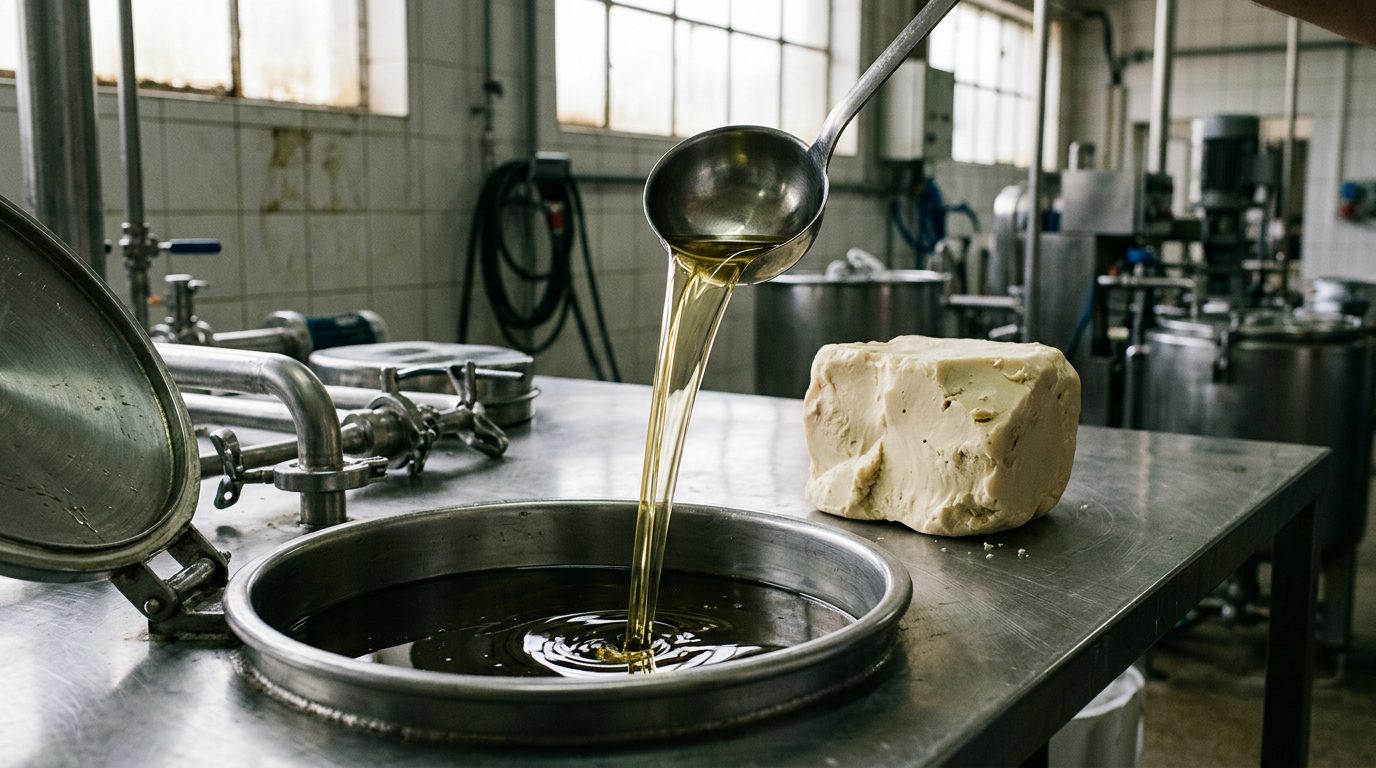
Suppose one request covers isopropyl myristate and white mineral oil. Under FDA’s OTC Monograph M016, mineral oil can be the active in a product labeled as an over-the-counter (OTC) skin protectant, at 50-100%; the ester cannot. Before comparing emollient suppliers, put four things on every line: INCI name, class, the claim the product will make, and the use level.
How do the emollients compare on safety finding, use level and US status?
Every emollient here that the Cosmetic Ingredient Review (CIR) lists in its December 2025 Quick Reference Table carries a safe finding; many alkyl esters and dicaprylyl carbonate carry the qualifier “when formulated to be non-irritating”. Reported leave-on use runs from 3% (hexyl laurate) to 95.6% (caprylic/capric triglyceride). Only mineral oil and lanolin here are OTC skin-protectant actives.
A CIR finding describes the ingredient, never a lot; where the table and the CIR report behind a use level disagree, the row carries a dagger. A reported use level is what industry surveys found between 2008 and 2016, so size a formula on your own data.
Ester emollients: IPM, IPP, CCT, ethylhexyl palmitate and C12-15 alkyl benzoate
Ester use levels spread widely in CIR’s alkyl esters report (2012 survey data), from 3% for hexyl laurate to 78% for ethylhexyl palmitate, with isopropyl myristate (IPM) at 77.3%, so the same class covers a main oil phase and an additive. Caprylic/capric triglyceride (CCT) reached 95.6% in the 2015-2016 data in CIR’s triglycerides report. Butyl oleate had no current use reported in the 2012-2013 data. Ask your formulator to justify a specification built around it before you qualify a source.
An INCI name can describe a mixture. CIR defines isopropyl palmitate (IPP) as a mixture of isopropyl esters with a minimum 60% isopropyl palmitate. Two lots can therefore carry the same name and differ in composition. Quote on the ester content the lot certifies.
Physical form changes the plant work. Cetyl palmitate melts at 46-54 °C and myristyl myristate at 37-39 °C, so both go into a heated oil phase. Isopropyl palmitate melts at 11 °C and hexyl laurate at -3.4 °C, so both stay liquid at room temperature. Dicaprylyl carbonate is a white liquid. Sensory choice between near-equivalents is a formulation question; the emollient ester selection guide covers spreading and feel.
| Ester | CIR finding (Quick Reference Table, Dec 2025) | Highest leave-on use reported to CIR, % |
|---|---|---|
| Isopropyl Myristate (IPM) | Safe as used † | 77.3% |
| Isopropyl Palmitate (IPP) | Safe as used † | 60% |
| Isopropyl Isostearate | Safe if non-irritating | 19% |
| Caprylic/Capric Triglyceride (CCT) | Safe as used | 95.6% |
| Ethylhexyl Palmitate (Octyl Palmitate) | Safe as used † | 78% |
| Ethylhexyl Isononanoate (Octyl Isononanoate) | Safe if non-irritating | 75% |
| Isononyl Isononanoate | Safe if non-irritating | 53% |
| Cetearyl Isononanoate | Safe if non-irritating | 40% |
| Ethylhexyl Stearate (Octyl Stearate) | Safe if non-irritating | 38% |
| Cetyl Ethylhexanoate (Cetyl Octanoate) | Safe if non-irritating | 52% |
| Cetearyl Ethylhexanoate (Cetearyl Octanoate) | Safe if non-irritating | 35% |
| Isocetyl Stearate | Safe if non-irritating | 34% |
| Hexyldecyl Stearate | Safe if non-irritating | 13% |
| Hexyl Laurate | Safe if non-irritating | 3% |
| Decyl Oleate | Safe if non-irritating | 4% |
| Butyl Stearate | Safe if non-irritating | 12% |
| Butyl Oleate | Safe if non-irritating | No current use reported |
| Cetyl Palmitate | Safe as used † | 11% |
| Myristyl Myristate | Safe as used † | 17% |
| Myreth-3 Myristate | Not in CIR’s Dec 2025 table | On request |
| C12-15 Alkyl Benzoate | Safe as used | On request |
| Dicaprylyl Carbonate | Safe if non-irritating | 34.5% |
| Diisopropyl Adipate | Safe as used | On request |
| Diisopropyl Sebacate | Safe as used | On request |
| Pentaerythrityl Tetracaprylate/Tetracaprate | Safe as used | 5% |
| Pentaerythrityl Tetraisostearate | Safe as used | 55% |
Ester emollient product pages (26)
Hydrocarbon emollients: mineral oil, squalane and isoparaffins
Mineral oil carries the most regulation in this class. FDA’s OTC Monograph M016 lists it as a skin-protectant active at 50-100%, and 21 CFR 172.878 defines white mineral oil as a mixture of liquid hydrocarbons, essentially paraffinic and naphthenic, obtained from petroleum.
CIR’s December 2025 Quick Reference Table has no entry for mineral oil. For food use, 21 CFR 172.878 requires white mineral oil to pass the United States Pharmacopeia (USP) XX test for readily carbonizable substances, the USP XVII test for sulfur compounds and an ultraviolet absorbance limit; put those three on the purchase order. For a cosmetic purchase no CFR section sets the specification, so the Certificate of Analysis (CoA) values you agree with the supplier are the specification.
The isoparaffins run at high loadings. In the 2010 survey in CIR’s draft final isoparaffins report, isododecane reached 90% and isohexadecane 42% in leave-on products. CIR’s polyene group report (2015) puts hydrogenated polyisobutene at 95% in lip products. At those loadings the hydrocarbon is the base of the formula, not an additive, so its specification carries the product’s.
| Hydrocarbon | CIR finding (Quick Reference Table, Dec 2025) | Highest leave-on use reported to CIR, % | OTC skin-protectant range (FDA OTC Monograph M016) |
|---|---|---|---|
| White Mineral Oil | Not in CIR’s Dec 2025 table | On request | 50-100% |
| Squalane | Safe as used | On request | Not an M016 active |
| Hydrogenated Polyisobutene | Safe as used | 95% | Not an M016 active |
| Isohexadecane (CAS 60908-77-2) | Safe as used † | 42% | Not an M016 active |
| Isododecane | Safe as used † | 90% | Not an M016 active |
Hydrocarbon emollient product pages (5)
Natural oils, butters and lanolin: shea, mango, coconut, jojoba and lanolin
Natural emollients are bought on chemistry that the INCI name leaves open: iodine, saponification and peroxide values, and the melting point. Ask for those values on every lot’s CoA. Coconut oil melts at 22-26 °C, so it can arrive liquid in August and solid in January.
Use levels in CIR’s plant-oils draft final report vary as much as in the esters. Coconut oil reached 80% in the 2008 data. In the 2010 data, sweet almond oil reached 77%, shea butter 60% as a cuticle softener, and argan kernel oil 10% in body and hand creams.
Lanolin is the only natural emollient here with an OTC skin-protectant range: 12.5-50% under FDA’s OTC Monograph M016, and 15.5% in diaper-rash combinations. If the finished label claims skin protection, the lanolin content has to sit inside the range that applies.
| Natural emollient | CIR finding (Quick Reference Table, Dec 2025) | Highest leave-on use reported to CIR, % | OTC skin-protectant range (FDA OTC Monograph M016) |
|---|---|---|---|
| Shea Butter | Safe as used | 60% | Not an M016 active |
| Mango Butter | Safe as used | On request | Not an M016 active |
| Coconut Oil (76°) | Safe as used | 80% | Not an M016 active |
| Sweet Almond Oil | Safe as used | 77% | Not an M016 active |
| Argan Oil | Safe as used | 10% | Not an M016 active |
| Golden Jojoba Oil | Safe as used | On request | Not an M016 active |
| Lanolin | Safe as used | On request | 12.5-50% |
Natural oil, butter and lanolin product pages (7)
Industries served
Cosmetics buyers specify from CIR’s findings and reported use levels; food buyers of white mineral oil and petrolatum write to 21 CFR 172.878 and 172.880.
Documents and quotes
Add these lines to every request, after the INCI name, class, claim and use level:
- For an OTC skin-protectant or a food use, the rule the use falls under (OTC Monograph M016, or 21 CFR 172.878 or 172.880) and the specification your quality team requires.
- For esters sold as mixtures, the ester content the lot certifies: CIR describes isopropyl palmitate as a mixture with a minimum of 60% isopropyl palmitate.
- For natural butters and oils, iodine, saponification and peroxide values on each lot’s CoA.
A listing here is not a statement that a lot meets a food or drug specification; the lot’s CoA settles that. Send the request from the product page, which carries the quote form.
For formulation questions, see technical support. Supplied for industrial formulation and manufacturing use, not for retail or consumer sale.
Related emollient pages
| Page | What it covers |
|---|---|
| Emollient ester selection guide | Choosing an ester by feel and function |
| Isopropyl myristate guide | IPM as emollient, solvent and spreadability aid |
| Isopropyl palmitate guide | IPP as emollient, solvent and spreadability aid |
| Caprylic/capric triglyceride guide | CCT as a workhorse emollient ester |
| Emollient esters and sensory modifiers for skin feel | Fixing poor skin feel and spreadability |
| Humectants and emollients for alcohol sanitizer bases | Emollients in hand sanitizers |
| Silicone supplier hub | Silicone fluids, which this hub does not cover |
| Surfactant supplier hub | Nonionic emulsifiers such as polysorbates and sorbitan esters |
Frequently asked questions
Which emollients can carry an OTC skin-protectant claim in the US?
FDA’s OTC Monograph M016 lists mineral oil (50-100%) and lanolin (12.5-50%) among these emollients as over-the-counter (OTC) skin-protectant actives. It also lists petrolatum and white petrolatum at 30-100%.
M016 has been a final order since March 27, 2020, carrying over the monograph codified in 21 CFR 347.10. It also allows mineral oil at 30-35% with colloidal oatmeal and lanolin at 15.5% in diaper-rash combinations. Each range governs the active in a product labeled as a skin protectant; whether a lot is suitable as an OTC drug active is for your regulatory and quality team to decide, and a listing here does not make that claim.
What does CIR’s “safe when formulated to be non-irritating” mean for an ester purchase?
CIR’s Quick Reference Table (December 2025) marks many alkyl esters SQ, safe when formulated to be non-irritating, for example isononyl isononanoate, ethylhexyl isononanoate and isocetyl stearate. The qualifier attaches to the finished formula, not to a lot.
No line on a purchase order satisfies the qualifier: a supplier cannot certify a lot as non-irritating in your product. The table codes isopropyl myristate, isopropyl palmitate, ethylhexyl palmitate, cetyl palmitate and myristyl myristate S, but CIR’s 2013 alkyl esters report lists them under the same qualifier, so formulate as if it applies. When you qualify a second supplier for one of these esters, confirm the finished formula’s irritation result with the new lot.
How much isopropyl myristate do formulators use?
Isopropyl myristate is used at up to 77.3% in leave-on products (other hair grooming aids), in 2012 survey data from CIR’s alkyl esters report. Ethylhexyl palmitate reached 78% in body and hand preparations and isopropyl palmitate 60%.
Those figures record what the survey found in products on the market; they are not a regulatory ceiling. The same report puts hexyl laurate at 3%, so a buyer sizing annual volume from a formula card should check which end of that spread the ester sits at.
Can mineral oil and petrolatum be used in food?
White mineral oil and petrolatum can be used in food under 21 CFR 172.878 and 172.880 (revised as of April 1, 2025), each under stated conditions. Section 172.880 requires petrolatum to meet the United States Pharmacopeia XX (1980) white petrolatum or National Formulary XV (1980) petrolatum specification and caps use by food category.
A listing here is not a statement that a lot meets either section. For food use, write the 21 CFR section and its specification onto the purchase order and check the lot’s Certificate of Analysis (CoA) against it before release.
How do I specify shea butter?
Shea butter’s reported iodine value is 45-77, saponification value 165-190, peroxide value 5.0 meq/kg maximum and melting point 32-46 °C (slip 28-42 °C). The ranges come from CIR’s plant-oils draft final report (CIR panel book, March 2011); use them as a reference for your own specification.
CIR collected the ranges from published data; it does not issue them as a purchase specification. Ask for each value on every lot’s CoA, and plan the melt: the butter is solid at room temperature.
Sources & methodology
Figures are RawSource sourcing data unless attributed to a named source. Regulatory citations are current as of publication. Chemical identities verified by CAS number against the RawSource catalog.
Search 1,300+ industrial chemicals by name or CAS, or send us your spec — we quote by the drum, tote, or container.
Browse the Chemical Index → Request a Quote