
By RawSource Sourcing Desk, Commercial & Sourcing Desk, RawSource
A lip balm that is flawless at 50-stick bench scale can crack in the mold, bead with oil at 35 °C in a truck trailer, or drag on the lip once you pour 10,000 units. The recipe rarely changes between the bench and the line. What changes is the wax-to-emollient ratio under real cooling conditions and the grade of each raw material feeding the kettle.
This guide breaks down what lip balm is made of, how each ingredient class earns its place, how a batch moves from weigh-up to finished stick, and where the formula trips into FDA drug territory. It is written for the formulator deciding a starting recipe and the buyer who has to specify those raw materials at container scale.
What is lip balm actually made of?
A lip balm is an anhydrous lipid system: no water, three functional phases. The first phase is the structural wax that gives the stick its shape and melt resistance. The second is the emollient pool of oils, esters and butters that carries the skin feel and most of the mass. The third is a small fraction of antioxidant, flavor and any active such as a sunscreen filter. Because there is no water phase, a standard balm needs no conventional preservative, only protection against lipid oxidation.
The table below shows the conventional architecture. Treat the share figures as starting points, not specifications; they shift with your fill format and target climate.
| Phase | Job in the stick | Typical share | Representative materials |
|---|---|---|---|
| Structural wax | Shape, hardness, melt point | ~10-25% | Carnauba wax, beeswax, cetyl alcohol, stearic acid |
| Emollient pool | Slip, payoff, occlusion, moisture | ~60-85% | White petrolatum, mineral oil, squalane, jojoba, shea butter, coconut oil |
| Actives and stabilizers | Antioxidant, flavor, SPF, color | ~1-5% | Tocopheryl acetate, flavor oils, permitted colorants |
The architecture is the design lever. Push the wax phase up and you get a harder, more travel-stable stick that drags. Push the emollient pool up and you get a glossy, cushioned feel that risks sweating in heat. Every other decision in the formula is a refinement on that balance.
How do waxes set a lip balm’s hardness and melt point?
Waxes build the crystalline network that holds the liquid oils in a solid stick, and the choice of wax sets both the melt point and the break. Carnauba wax (CAS 8015-86-9) is the hardest of the plant waxes used in lip care; a few points of it raise surface hardness and add the high gloss seen in premium sticks. Beeswax (CAS 8012-89-3) does the opposite job well: it gives a softer, flexible, adhesive film that clings to the lip and breaks cleanly.
Most formulators blend the two and then fine-tune body with fatty co-structurants. Stearic acid (CAS 57-11-4) melts near 69 °C and adds firmness and opacity; PubChem lists its density at about 0.86. Cetyl alcohol (CAS 36653-82-4), a fatty alcohol melting near 49 °C, thickens the oil phase and adds a smooth glide without the brittleness of a pure hard wax.
The real trade-off lives in the carnauba fraction. Carnauba delivers melt resistance for warm shipping lanes, but it is also prone to graining: if the molten balm cools too slowly, carnauba crystals can grow large enough to feel gritty and dull the surface. The fix is process, not chemistry. Pour hot, cool fast, then validate the crystal habit on a retained sample before you scale the lot.
There is a sourcing dimension to the same decision. Beeswax and carnauba are both natural products with lot-to-lot variation in melt behavior and color, so a wax that performed at one melt point can shift the stick’s hardness when the next lot runs a few degrees off. Lock a melt-point range into the purchase specification and require it on the certificate of analysis (CoA), instead of trusting the trade name.
Where a single hard wax is over-graining a formula, splitting the structural load between carnauba and a co-structurant such as stearic acid or cetyl palmitate often buys melt resistance with less grain risk.
Which oils and emollients control skin feel and payoff?
Emollients are where a buyer feels the difference between a cheap balm and a good one, because this phase governs slip, cushion and how long the film lasts. The esters give immediate playtime. Isopropyl myristate (CAS 110-27-0) is a light, fast-spreading ester that melts near 3 °C and disperses pigment well; PubChem notes it is soluble in castor and vegetable oils. Isopropyl palmitate (CAS 142-91-6) is slightly heavier, melts at 13.5 °C, and leaves a longer cushion.
Occlusion comes from the heavier liquids and butters. White petrolatum (CAS 8009-03-8) and white mineral oil (CAS 8042-47-5) form an inert, oxidation-resistant barrier that slows moisture loss from the lip. Lanolin (CAS 8006-54-0) is strongly occlusive and adhesive, with the caveat that a minority of users react to it, so it is a label and claims decision as much as a performance one.
For a lighter, more oxidatively stable feel, squalane (CAS 111-01-3) is a saturated hydrocarbon emollient that resists rancidity better than its unsaturated parent squalene; PubChem gives its density near 0.81. Golden jojoba oil (CAS 61789-91-1) is a liquid wax ester, not a triglyceride, which is part of why it holds up against oxidation. Triglyceride options such as shea butter (CAS 194043-92-0) and a 76 °F melt-point coconut oil (CAS 8001-31-8) add richness, with shea contributing a soft-solid body that supports the wax network.
| Material | CAS | Melting point | Density | Role in the stick |
|---|---|---|---|---|
| Stearic acid | 57-11-4 | ~69 °C | ~0.86 | Firmness, opacity, co-structurant |
| Cetyl alcohol | 36653-82-4 | ~49 °C | ~0.82 | Body, smooth glide |
| Isopropyl palmitate | 142-91-6 | 13.5 °C | ~0.85 | Medium cushion, slip |
| Isopropyl myristate | 110-27-0 | ~3 °C | ~0.85 | Light, fast slip, pigment wetting |
| Squalane | 111-01-3 | liquid (bp ~350 °C) | ~0.81 | Lightweight, oxidatively stable glide |
| Tocopheryl acetate | 58-95-7 | viscous | ~0.95 | Antioxidant, lipid protection |
Where a balm carries color, castor oil is the classic gloss and pigment-wetting base because of its polarity; if your format is tinted, plan the pigment-dispersion step around that polar carrier, not the light esters alone.
Choosing between natural and synthetic occlusives is a positioning decision as much as a technical one. Petrolatum and white mineral oil are inert, oxidatively stable and inexpensive, which makes them the workhorse occlusives for a barrier balm. Plant-derived alternatives such as shea butter and coconut oil read better on a clean-label panel but bring unsaturation, so they demand tighter incoming specifications and a working antioxidant.
The lighter esters and squalane sit between those poles: low-residue skin feel with good shelf stability. Map each emollient to the claim you are making before you fix the percentages, because a swap late in development can move melt point, hardness and oxidation rate at once.
How is a lip balm batch manufactured at scale?
Manufacture is a temperature-staged melt-and-pour. Get the sequence right and the same recipe behaves the same way at 50 sticks and 50,000.
Weigh every component to a checked formula sheet; for an anhydrous batch, weight accuracy on the wax phase matters more than on the oils.
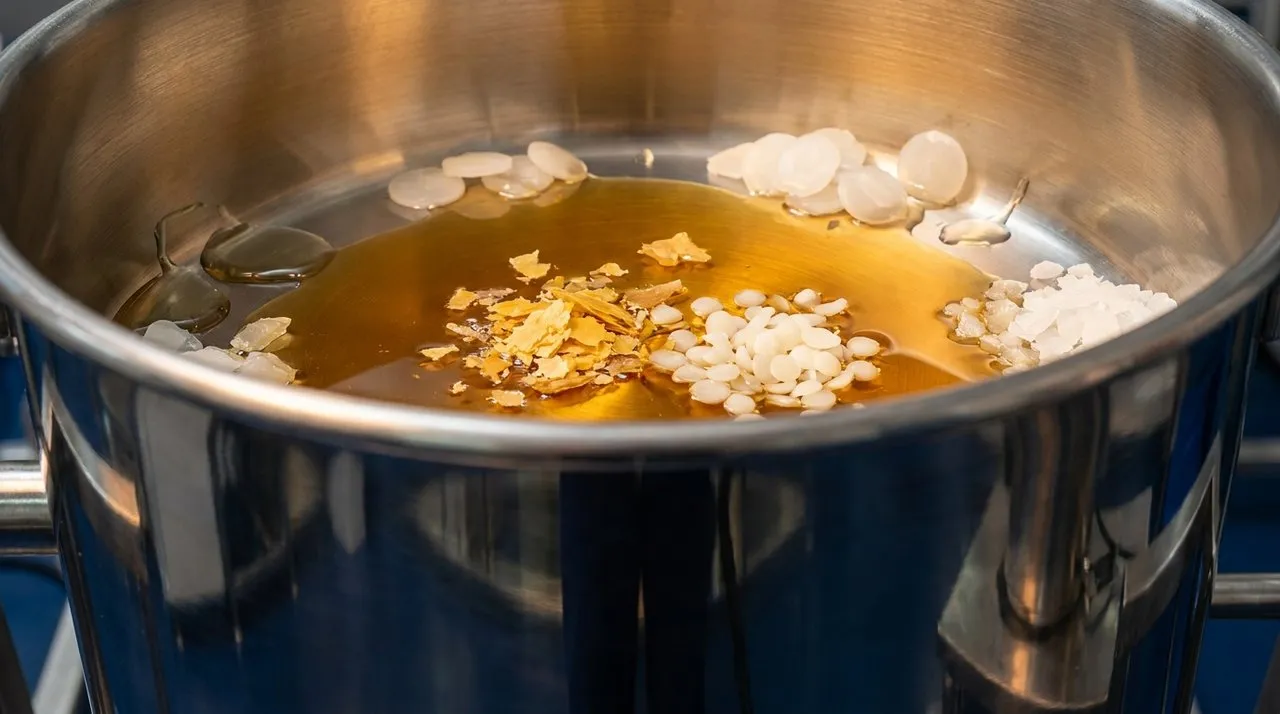
Melt the high-melt structurants first in a jacketed kettle, taking carnauba and stearic acid to roughly 80-85 °C so they fully liquefy.
Add the remaining waxes and the bulk emollient oils, holding the blend at about 70-80 °C with gentle agitation until uniform and clear.
Drop the temperature toward 60 °C, then add the heat-sensitive fraction: flavor, tocopheryl acetate and any active that degrades with heat.
Pour while the blend is still fluid and above its set point, filling sticks, jars, or trays before crystallization starts in the kettle.
Cool under control. A faster, cooler set gives a finer crystal network and a glossier surface; flame the meniscus of poured sticks if your format needs a polished top.
Hold and inspect a retained sample for graining, sweating and color before releasing the lot.
The single most common scale-up error is pouring too cool. The blend thickens in the kettle, fill weights drift and the surface goes dull. Set a pour-temperature window on the batch record and hold operators to it.
Add order matters most for the heat-sensitive fraction. Flavor oils flash off and degrade if they go in at full melt temperature, and an organic SPF filter has a defined thermal limit on its technical data sheet (TDS) that the kettle must respect. Stage those additions at the back end of the cook, after the temperature has dropped toward 60 °C, and document the exact addition temperature on the batch record so a deviation is traceable.
For tinted formats, pre-disperse pigment into a portion of the polar carrier and mill it before it meets the wax phase, or the color will streak in the poured stick.
What makes a lip balm fail QC, and how do you prevent it?
Most lip balm rejects trace back to four failure modes, and each maps to a specific formulation or process fix. Designing them out early is cheaper than reworking a finished lot.
Sweating, the appearance of oil beads on the surface, means the wax matrix cannot hold the liquid load. Lower the oil-to-wax ratio, add a co-structurant such as cetyl alcohol or stearic acid, or speed the cool-down. Graining, a gritty or hazy surface, usually comes from carnauba crystallizing slowly; pour hotter and cool faster. Cracking or a hollow core points to shrinkage during an uneven set, which a controlled, uniform cooling profile corrects.
Rancidity is the slow failure that shows up in stability testing, not at fill. Unsaturated oils and butters oxidize over shelf life and develop off-odors. An antioxidant such as tocopherol or tocopheryl acetate protects the lipid phase, but it is not a license to ignore the base oils. Specify peroxide value on the incoming CoA for any unsaturated oil, and reject lots that arrive already oxidizing.
The trade-off worth naming here is the clean-label one. Inert occlusives such as petrolatum and mineral oil resist oxidation and cost little, yet some brands exclude them for positioning reasons and then pay for it in stability work on the plant oils that replace them. Run that decision before you set the formula, not after a failed accelerated-aging study, because reformulating to recover stability usually shifts skin feel and forces a fresh round of sensory approval.
When does a lip balm cross into FDA drug territory?
The line is the claim, not the chemistry. A plain moisturizing balm is a cosmetic; the moment it carries an SPF or sun-protection claim, FDA treats it as a drug or a drug-cosmetic that must meet the sunscreen monograph and drug labeling rules. The agency’s guidance on whether a product is a cosmetic, a drug, or both is explicit that a single product can be both when it has more than one intended use, and a sunscreen lip balm is the textbook example.
Color is the other regulatory tripwire. Any colorant in a tinted lip product must appear on FDA’s list of color additives permitted for use in cosmetics, and many of those colors are subject to batch certification under 21 CFR Parts 74 and 82, meaning FDA chemists must clear the specific lot. A color cleared only for external use cannot be carried into a lip product unless the listing regulation says so. Confirm both the permitted-use status and the certification lot number before you commit a color to a lip format.
How do you scale lip balm ingredient sourcing?
The bench formula and the purchase specification are different documents, and the gap is where quality is won or lost at volume. Specify each structurant and emollient by the property that controls performance, not by name alone. For the waxes, set a melt-point range and require it on every CoA. For unsaturated oils and butters, set acid value and peroxide value limits so you catch oxidizing lots at receiving. For colored formats, lock one certified color lot across a production campaign so shade does not drift between batches.
Seasonality and supply concentration belong in the plan too. Carnauba is harvested from a palm grown in northeastern Brazil, so its availability and price track an annual crop cycle, not a steady factory output, and lean harvest years tighten supply. Beeswax is an agricultural by-product with its own regional price swings and adulteration history, which is one reason a melt-point and a purity check on each lot earn their place.
Build a safety-stock buffer on the seasonal natural waxes that you would not need on a synthetic ester, and qualify a second source for any single-origin material before it goes onto a production schedule.
A workable incoming specification for a lip balm raw material names the grade, a melt-point or congeal-point range, color or appearance, acid and peroxide value where the chemistry is unsaturated, and the heavy-metal and microbial limits appropriate to a leave-on lip product. Tie acceptance to the CoA, and pull a retain from every lot. The cost of that discipline is small against a recalled production run.
When you are ready to price these inputs at container scale, specify melt point, grade and CoA assay on each material and request bulk quotes through the relevant product pages: the structural waxes carnauba and beeswax, the emollients squalane and white petrolatum, and the tocopheryl acetate antioxidant. For the wider personal-care input list, the Beauty & Personal Care catalog and the personal-care sourcing guide cover specification and lead-time planning, and the note on isostearic acid in cosmetics covers a related emollient-ester decision.
Methodology: melting points and densities cited here are experimental values reported on the named compound’s PubChem record (stearic acid, squalane, cetyl alcohol). Phase-share percentages are conventional cosmetic-chemistry starting ranges, not fixed specifications, and should be optimized per format and climate.
Frequently asked questions
What is the basic ratio of wax to oil in a lip balm?
Why does my lip balm sweat or form beads of oil on the surface?
Does a lip balm need a preservative?
Which wax makes the hardest lip balm?
Is lip balm a cosmetic or a drug?
Sources & methodology
Regulatory citations are current as of publication. Chemical identities verified by CAS number against the RawSource catalog.
Search 1,300+ industrial chemicals by name or CAS, or send us your spec — we quote by the drum, tote, or container.
Browse the Chemical Index → Request a Quote