
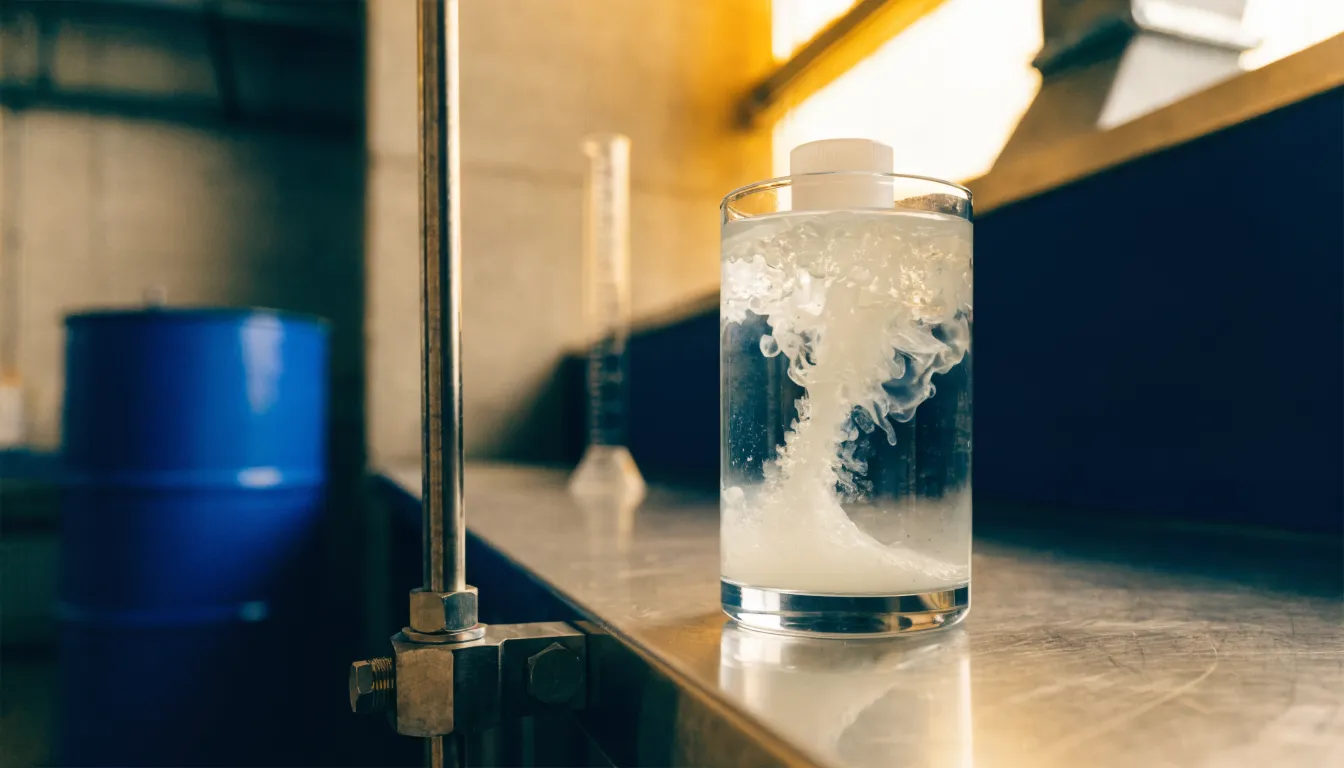
Order “silicone emulsion” from three suppliers and you can receive three different products: 35% solids, 50%, 60%, different base-fluid viscosities, different emulsifier systems. The quotes will not be comparable, and the cheapest drum may be the most expensive silicone. The solids number is what makes the quotes comparable, and 60% is the class most bulk buyers end up specifying.
The short version: a 60% silicone emulsion is polydimethylsiloxane (PDMS, CAS 63148-62-9) dispersed in water as an oil-in-water concentrate at a nominal 60% silicone solids. It is a concentrate, not a working fluid: you dilute it into cold water at the point of use. RawSource’s silicone emulsion grades RS-EM 350/60 and RS-EM 1000/60 run a typical 63% solids (QC band 61.0–64.0%), are non-ionic, and tolerate dilution water to roughly 200 ppm hardness. Selection comes down to two questions: which base-fluid viscosity, and whether your dilution water and process leave the emulsion stable.
What the 60% number means
The solids content is what remains after the water is driven off: the silicone (plus its emulsifier system) you are paying for. For the RS-EM grades the quality-control window is 61.0–64.0% solids, with recent production running 61.7–63.4% and a typical value of 63%. So a “60% emulsion” honestly delivered is slightly better than its name.
The rest of the drum is water (roughly 20–43% by the composition range) carrying a non-ionic emulsifier system. Physically it is a translucent, milky-white liquid, pH 6–8, specific gravity around 0.98, with the 350-base grade running a Brookfield viscosity of roughly 3,000–10,000 cPs. Droplet size is engineered to be low so it dilutes easily; suppliers who quote you an exact micron figure without a method behind it are decorating the datasheet. The recommendation: compare emulsions on certified solids and base-fluid viscosity, and let the CoA, not the class name, set your dosing arithmetic.
Why non-ionic is the emulsifier answer you want
An emulsion is PDMS oil held in water by surfactants, and the surfactant chemistry decides how the product behaves in your plant. If you were building one from neat silicone oil, you would be balancing emulsifier hydrophilicity yourself (the HLB method) and defending the droplets against everything your process water throws at them. (What failure looks like is covered in why emulsions separate.)
A finished non-ionic emulsion takes that work off your bench. Non-ionic surfactants carry no charge, so they do not react with the calcium and magnesium in hard water the way anionic systems can, and they stay compatible across a broad range of bath chemistries. The practical ceiling for the RS-EM system is about 200 ppm hardness in the dilution water. For calibration, the USGS classifies water above 180 mg/L as CaCO3 as “very hard”, so ordinary municipal supplies are usually fine, and it is well-water plants and scale-prone regions that should qualify softened or deionized water first.
Selecting the base fluid: 350 vs 1,000 cSt
The emulsion deposits its base fluid, so the base-fluid viscosity is the grade decision.
| Grade | Base fluid | Film character | Usual fit |
|---|---|---|---|
| RS-EM 350/60 | Neat Silicone Oil 350 cSt (PDMS) | Fast-spreading, thin, even | General mold release, textile finishing, polish bases |
| RS-EM 1000/60 | Neat Silicone Oil 1,000 cSt (PDMS) | Heavier, longer-riding | Hot or vertical tooling, more releases per application |
Both are the same 60%-class, non-ionic chemistry; only the deposited film differs. If you are replacing a competitor’s “60% emulsion” with no viscosity stated, ask for the base-fluid cSt before you match grades; two emulsions with identical solids and different base fluids are different products on the tool.
Dilution: the arithmetic and the practice
The arithmetic first. Delivered solids = typical solids ÷ (1 + parts water). At a typical 63%:
| Dilution (emulsion : water) | Delivered silicone solids |
|---|---|
| Neat concentrate | ~63% |
| 1 : 1 | ~31.5% |
| 1 : 4 | ~12.6% |
| 1 : 9 | ~6.3% |
| 1 : 19 | ~3.2% |
| 1 : 62 | ~1.0% |
The table is pure arithmetic on the typical solids value; your lot’s CoA number governs, and the right end-use level is set by your process, not by this page. (For mold-release work, typical starting points and the full application practice are in silicone emulsion for mold release.)
The practice, from the technical data sheet, is what protects the emulsion while you dilute: use cold water, the best diluent for this system; add the concentrate to the water under low shear instead of blasting it with a high-speed disperser; keep dilution water under the ~200 ppm hardness ceiling; and gently agitate standing dilutions before each use. Storage is part of dilution practice too: 5–32 °C, never above 38 °C, never frozen, and a 12-month shelf life from manufacture.
What a 60% emulsion is not
It is not a defoamer: silicone antifoam emulsions are compounded differently and sit at different actives; for foam control, see our silicone antifoam emulsion. It is not a food-grade product unless a supplier certifies that status for a specific grade, and no such status is asserted for the RS-EM grades. And it is not a finished release or finishing bath: it is the concentrate those baths are made from.
Buying a 60% silicone emulsion in bulk
See the silicone emulsion product page. Tell us your application, dilution-water hardness, and the base-fluid viscosity you run today, and request a quote at drum or tote volume.
To source the 60%-class grades in drums or totes, see the silicone emulsion supplier page: base viscosity, certified solids, dilution, and storage terms.
Frequently asked questions
What does 60% mean in a silicone emulsion?
It is the nominal silicone solids content: the non-volatile fraction left after the water is removed. In practice the class is a band: the RS-EM grades certify 61.0–64.0% solids per batch, typically about 63%, and the Certificate of Analysis states the actual value for each lot.
How do I dilute a 60% silicone emulsion?
Add the concentrate to cold water under low, gentle shear, and agitate standing dilutions before use. Delivered solids follow simple arithmetic: at 63% typical solids, 1:9 gives about 6.3% and 1:19 about 3.2%. Keep dilution water below roughly 200 ppm hardness or qualify softened/deionized water.
Does hard water break a silicone emulsion?
It can. The non-ionic RS-EM system is stable to about 200 ppm water hardness, which covers most municipal supplies (above the top of the USGS hardness scale, which starts its hardest bracket at 180 mg/L as CaCO3). Above that, hardness ions stress the emulsifier system and you risk creaming or oiling-out in the dilution tank.
What is the difference between a 35% and a 60% silicone emulsion?
Solids content, and therefore freight and dosing. A 60%-class emulsion carries nearly twice the silicone per drum of a 35% product, so it ships cheaper per silicone pound and dilutes further; a lower-solids emulsion is simply more pre-added water. Compare quotes on certified solids and base-fluid viscosity, never on drum price.
Why does the base-fluid viscosity of the emulsion matter?
Because the emulsion deposits its base fluid. A 350 cSt base (RS-EM 350/60) spreads into a thin, even, fast-wetting film; a 1,000 cSt base (RS-EM 1000/60) leaves a heavier film that lasts longer per application. Same solids class, different film on the tool or fiber.
Editorial note. This article is general technical and procurement guidance for industrial buyers. All property values (solids band, pH, specific gravity, viscosity, hardness tolerance, storage range, shelf life) are typical values for the grades described, not guaranteed specifications; the Certificate of Analysis governs the lot you purchase. Dilution levels for any end use are process-dependent and must be validated on your own system. Products are sold for industrial and professional use only; no food-contact or regulatory suitability is asserted. Always consult the current Safety Data Sheet (SDS) before handling, storage, or disposal. RawSource makes no warranty, express or implied, and assumes no liability for use of this information.
Search 1,300+ industrial chemicals by name or CAS, or send us your spec — we quote by the drum, tote, or container.
Browse the Chemical Index → Request a Quote