
A supplier tells you to add “a few ppm,” you dose the tank, and the foam gets worse. That is the most common dosing mistake in foam control, and it is avoidable. A defoamer has a starting dose, a feed point, and a ceiling above which it stops helping and starts hurting. All three change with the system. This guide puts the typical starting numbers in one place, so you can dial in from the right end.
The short version: most industrial foam is knocked down at very low dose. Chemical foam in process water responds to roughly 5 to 50 ppm of defoamer; metalworking coolant is usually dosed 0.1 to 0.5 percent tank-side; amine units run in the tens of ppm; food processing is capped at 10 ppm in finished food by FDA 21 CFR 173.340. These are starting ranges, not settings. Add at the point of highest turbulence or on the foam itself, start at the low end, and step up until the foam breaks and stays down. More is not better, and in several systems it makes the problem worse.
How to read a starting dose
Two numbers describe a defoamer dose: the active concentration of the product and the treat rate into your system. A silicone antifoam emulsion is sold by active percentage, commonly 10 to 50. The treat rate is how much of that product you add per unit of foaming liquid, expressed as ppm or percent. A 5 ppm treat rate of a 30-percent-active emulsion is not the same amount of active silicone as 5 ppm of a 10-percent product, so match the number to the grade you actually buy.
The practical move is to buy the concentrate, cut it to working strength on site, and dose by cost per pound of active, not per gallon of product. The grade-and-active decision is covered in the silicone defoamer selection guide; the reason a small dose does so much is the ppm mechanism in how silicone antifoam works.
Starting doses by system
The table below is a starting point, not a recipe. Figures are typical literature and field ranges; your water chemistry, temperature, shear, and foam type will move them. Dose from the low end and step up.
| System | Foam source | Typical starting dose | Notes |
|---|---|---|---|
| Wastewater aeration / activated sludge (chemical foam) | detergents, FOG, low-load startup sludge | ~5 to 50 ppm | for surfactant / chemical foam only; not a cure for biological foam |
| Cooling tower | biocide or chemical overfeed, oil or detergent in the sump | small temporary dose | emergency knockdown while you fix water chemistry; do not standing-dose |
| Metalworking coolant / cutting fluid | tramp oil, over-concentration, soft water, high-pressure pumps | ~0.1 to 0.5 percent tank-side | fix the engineering first (pressure, dwell, concentration); non-silicone if parts are coated downstream |
| Fermentation / brewing / distilling | yeast CO2 plus wort/mash proteins | ppm; foam-probe controlled | pre-test, then dose to control; food-grade grade required |
| Amine gas treating (MEA/MDEA) | hydrocarbon carryover, solids, degradation products | silicone ~110 to 130 ppm (fouls); polyether ~20 to 25 ppm | field-reported switch; remove the contaminant, do not just dose |
| Coatings and inks | surfactants plus high-shear mixing / application | lowest effective dose | add on the grind; ladder up; over-dose causes fisheyes and craters |
| Food processing / frying | starch, proteins, moisture flashing to steam | ppm, capped at 10 ppm finished food | FDA 21 CFR 173.340 defoaming-agent limit |
| Drilling / completion fluid | air entrainment in the mud system | ~0.02 percent by volume | compatibility with the mud system matters more than chemistry |
For the two systems buyers ask about most, the detail lives in dedicated posts: coolant foaming walks the machine-shop engineering ladder before the tank-side dose, and amine unit foaming explains why the potent silicone dose is often the wrong call. Aeration dosing, and its oxygen-transfer trade-off, is in defoamers in wastewater treatment.
Where to add it: the feed point
A defoamer only works where its droplets reach the foam film. Feed it where the liquid is most turbulent, so the dose disperses and reaches the interface, or put it directly on the foam you are trying to break. Standing-dosing into a quiet basin wastes product and, in aeration, drives the oxygen-transfer penalty for no benefit.
| System | Where to add it |
|---|---|
| Wastewater aeration | at the aeration inlet (highest turbulence), or sprayed on the foam surface; spot-dose, do not standing-dose |
| Cooling tower | into the sump; temporary only |
| Metalworking coolant | tank-side into the sump or reservoir, where the return flow mixes it |
| Fermentation | to the kettle or into the fermenter headspace; foam-probe control for continuous ferments |
| Amine unit | injected upstream of the foam (rich-amine outlet) as a bridge while you filter out the contaminant |
| Coatings | on the grind, so mill shear disperses the active uniformly |
| Frying / food process | metered into the process or oil; keep active silicone within the finished-food limit |
The bottle test: how to find your dose
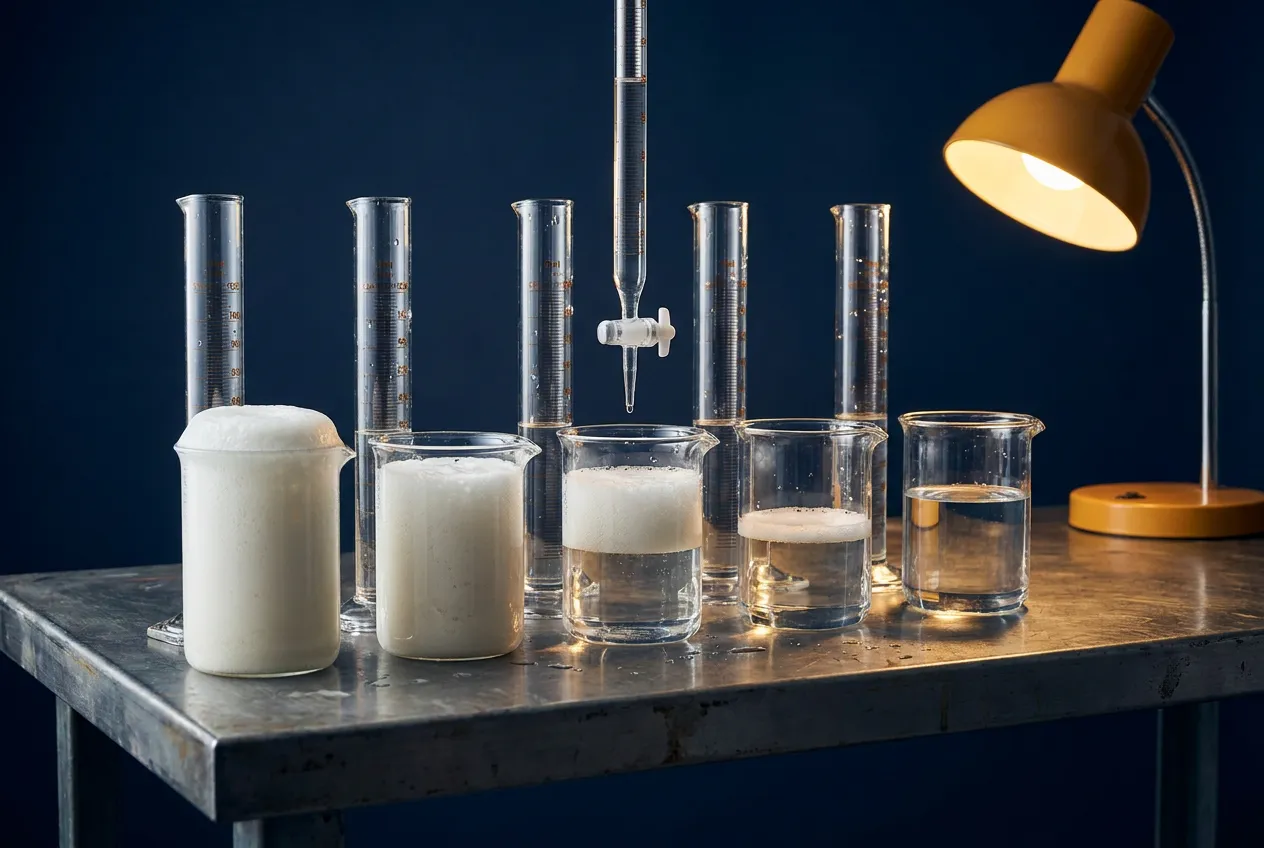
You do not guess a dose, you ladder it. A bottle test (also called a shake test or ladder study) finds the real starting dose for your system in an afternoon.
1. Sample. Take a representative sample of the actual foaming liquid, at process temperature if you can. 2. Ladder. Prepare several identical portions. Add defoamer to each at increasing treat rates that bracket the starting range for your system, for example 5, 10, 25, and 50 ppm for process water. 3. Regenerate foam. Agitate or shear each portion the same way (shake, stir, or air-sparge) to rebuild foam the way your process does. 4. Read two things. Record knockdown speed (how fast the foam collapses) and persistence (whether it stays down or rebuilds). The lowest dose that gives fast knockdown and durable control is your starting dose. 5. Confirm on-line. Scale that dose to the system, feed it at the right point, and validate for a shift or two before you set it. Reducing the dose by 10 to 20 percent from the bench figure is common once the feed point is optimized.
Run the ladder on the grade you will actually buy, since form and active percentage change the numbers. Request a sample and test it on your own foam before you commit a drum or tote.
Overdose symptoms: when more defoamer makes it worse
The single most useful thing to know about defoamer dosing is that the curve is not linear. Past the effective dose, more product stops helping and starts causing its own problems.
- Foam gets worse, not better. Emulsifiers and surfactants in an over-dosed product can re-stabilize the foam film, so the tank foams more after you add more.
- Carryover and waste. Excess defoamer is not consumed. It is carried out of the system in the product or effluent, so you pay for chemical that leaves without working.
- Aeration: insoluble silicone droplets coalesce air bubbles and can reduce oxygen-transfer efficiency in the basin, which raises energy cost and can stress the process. Dose at the foam, not into the basin.
- Amine units: over-dosed silicone fouls reboilers, exchangers, and cartridge filters, raising filtration cost and amine losses.
- Coatings: an over-dose or wrong grade causes fisheyes, craters, and recoat failure. See paint fisheyes.
- Cooling towers: sticky silicone deposits insulate and foul heat-exchanger tubes on overdose.
- Food and fermentation: over-dosing can push active silicone past the 10 ppm finished-food limit and, in fermentation, can stress yeast. See frying oil foaming and fermentation antifoam selection.
If adding more defoamer is not fixing the foam, the answer is almost never a bigger dose. It is a different feed point, a different grade, or a root cause (contamination, over-concentration, a biological problem) that no dose will cure.
Match the dose to the chemistry
Dosing discipline only works if the chemistry fits the system. Silicone (PDMS) is the most potent knockdown per drop, but it is the wrong tool in aeration, amine, on-spec road diesel, kraft brownstock, and multi-coat coatings, where a non-silicone polyether or oil-based product is the better long-run answer. The full pick-by-system logic is in the complete guide to defoamers.
See the Silicone Antifoam Emulsion (10-50% active) product page. Tell us your system, temperature, and foam type, and request a sample to run a bottle test before you set a dose.
For bulk supply, emulsion versus compound, dose logic by system, and packaging from pails to IBC totes, see the silicone antifoam supplier page.
Frequently asked questions
How much defoamer should I add?
Start small and ladder up. Chemical foam in process water typically responds to about 5 to 50 ppm, metalworking coolant to about 0.1 to 0.5 percent tank-side, and food processing is capped at 10 ppm in finished food. These are starting ranges to validate by a bottle test on your own liquid, not fixed settings.
Why does adding more defoamer make foam worse?
Past the effective dose, the emulsifiers and surfactants in the product can re-stabilize the foam film, and the excess is carried out of the system without working. If more defoamer is not helping, the fix is usually a different feed point, a different grade, or a root cause, not a bigger dose.
Where should I add defoamer?
At the point of highest turbulence so it disperses, or directly on the foam surface. For aeration that means the aeration inlet or a surface spray; for coolant, tank-side into the sump; for amine, upstream of the foam. Standing-dosing into a quiet tank wastes product.
How do I run a defoamer bottle test?
Take a representative sample of the foaming liquid, split it into equal portions, add defoamer at increasing treat rates, agitate each the same way to rebuild foam, and record knockdown speed and persistence. The lowest dose that gives fast, durable control is your starting dose; confirm it on-line for a shift.
What is the food-grade dosing limit for defoamer?
FDA 21 CFR 173.340 permits defoaming agents such as food-grade PDMS and simethicone at up to 10 ppm in finished food (listed as E900). Keep active silicone within that limit and use a grade specifically documented as food-grade.
Does a higher-active concentrate change my dose?
Yes. Active percentage sets how much silicone is in each pound of product, so a 5 ppm treat rate of a 30-percent emulsion delivers more active than 5 ppm of a 10-percent product. Match your treat rate to the grade you buy, and price by cost per pound of active.
Editorial note. This article is general guidance for industrial and professional buyers and formulators. Dose figures are typical literature and field starting ranges, system-specific and to be validated by trial, not guarantees; over-addition can worsen foam or foul equipment. Food-grade and regulatory references (21 CFR 173.340, E900) are compliance facts, not health or efficacy claims. Confirm suitability and consult the product Safety Data Sheet (SDS) before use. RawSource makes no warranty, express or implied, and assumes no liability for use of this information.
Search 1,300+ industrial chemicals by name or CAS, or send us your spec — we quote by the drum, tote, or container.
Browse the Chemical Index → Request a Quote