
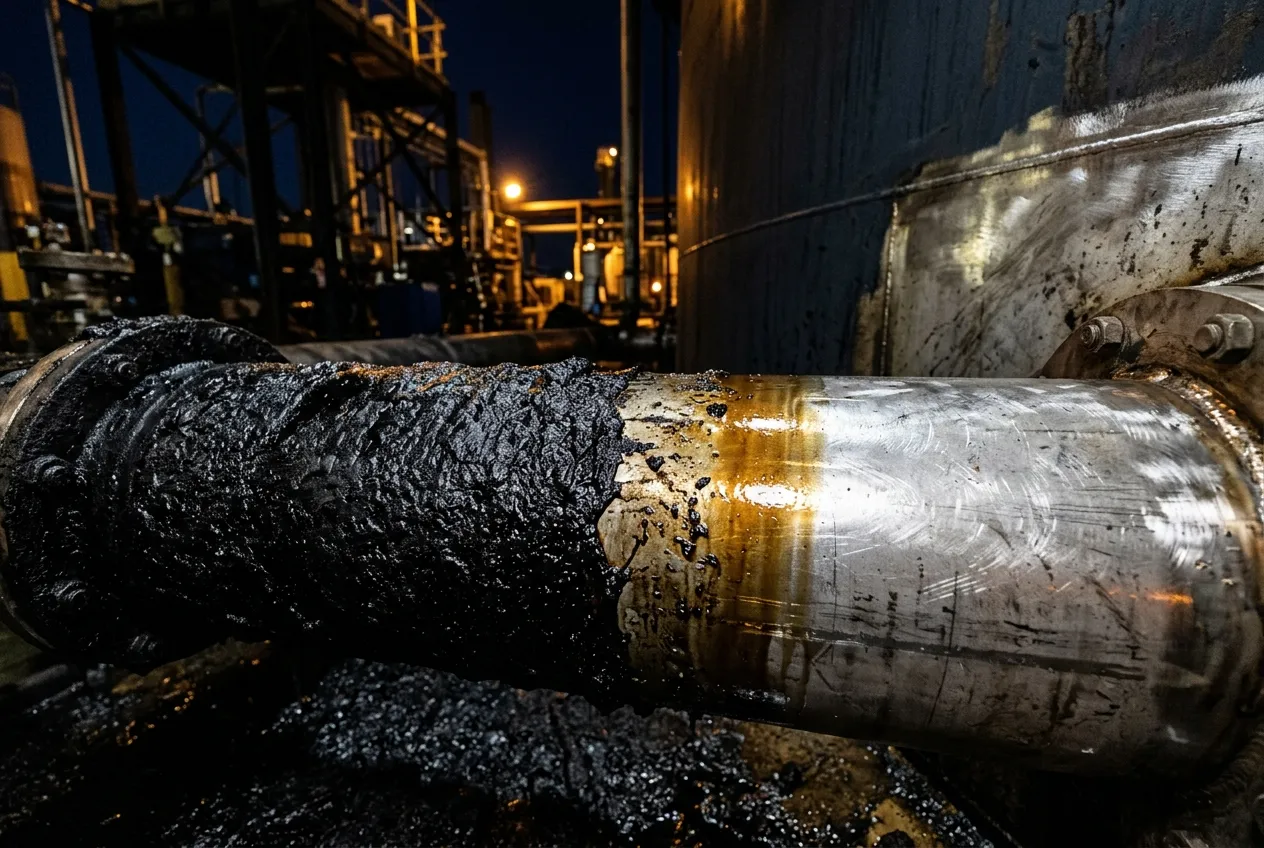
A well’s production rate slips. The tubing and flowline are choking with paraffin wax, the tank bottoms are thick with asphaltene sludge, and the usual fix is a drum of xylene or an aromatic-naphtha cutter that the EHS group keeps flagging for its BTEX content. D-limonene has become a credible alternative for both deposits, but it is not magic, and it is flammable, so it pays to understand where it fits before pumping it downhole.
The short version: d-limonene is a bio-based terpene solvent with a Kauri-Butanol value around 67, strong enough to disperse both paraffin wax and asphaltene deposits in wells, flowlines, and tank bottoms. Laboratory studies have reported high asphaltene removal, and in the field it is usually run as a soak or batch treatment, often blended with a mutual solvent and a surfactant. The trade-offs are real: it is flammable, it costs more than diesel or xylene, and it works best as part of a designed treatment, not a neat dump.
Paraffin and asphaltene are two different problems
The deposits look similar in a pipe but behave differently in chemistry, which is why solvent choice matters.
- Paraffin is long-chain saturated wax. It is non-polar and dissolves into non-polar solvents as temperature and solvency rise.
- Asphaltene is a polar, aromatic, colloidal solid that precipitates when crude destabilizes. It does not simply melt; it needs an aromatic or terpene solvent plus, often, a dispersant to keep it from re-flocculating.
A solvent that handles one does not automatically handle the other. D-limonene is useful precisely because its terpene structure addresses both.
Why d-limonene works on these deposits
D-limonene (CAS 5989-27-5, CID 440917) has a Kauri-Butanol value of about 67 by ASTM D1133, which puts its solvency well above mineral spirits and diesel and into the range that cuts heavy organics. Its cyclic terpene structure gives it affinity for both waxy paraffin and aromatic asphaltene, so a single solvent can disperse a mixed deposit.
Laboratory studies on asphaltene removal have reported high effectiveness for d-limonene, in some tests up to roughly 93% removal. Treat that as a laboratory benchmark on prepared samples, not a field guarantee; downhole results depend on contact time, temperature, deposit age, and how the treatment is placed.
How it is deployed in the field
D-limonene is rarely the whole answer by itself; it is the solvent backbone of a designed treatment.
- Soak and squeeze treatments: the solvent is spotted across the deposit, given soak time, then circulated or produced back.
- Batch and continuous treatment: for recurring paraffin, batch solvent treatments on a schedule keep tubing and flowlines open.
- Tank-bottom and vessel cleaning: d-limonene disperses sludge so it can be pumped and the vessel returned to service.
- Blended formulations: in practice it is often combined with a mutual solvent or glycol ether, a surfactant for water wetting and dispersion, and sometimes an organic acid for scale, so the package handles a mixed deposit.
The honest tradeoffs
A credible supplier names the limits. D-limonene is flammable, with a closed-cup flash point around 48 °C, so field handling needs ignition control and the usual flammable-liquid precautions, unlike a nonflammable chlorinated solvent. It costs more per barrel than diesel or xylene. It evaporates slowly. And it is classified as toxic to aquatic life, so produced fluids and rinse must be managed, not released.
Against aromatic cutters like xylene or BTEX-bearing naphtha, the upside is that d-limonene is renewable and carries no BTEX, which is increasingly the reason operators try it. The broader solvent comparison is in d-limonene vs petroleum and chlorinated solvents.
Buying d-limonene in bulk for field use
See the D-Limonene product page. Tell us your deposit type (paraffin, asphaltene, or mixed), the treatment method, and your blend or dispersant needs, and request a sample to run a dissolution test on your own deposit before a bulk order. Background on the solvent itself is in what is d-limonene.
Frequently asked questions
Does d-limonene dissolve paraffin and asphaltene?
Yes. With a Kauri-Butanol value around 67 and a terpene structure, d-limonene disperses both paraffin wax and asphaltene deposits, which is why it is used for well, flowline, and tank-bottom cleaning, often in a blended treatment.
How effective is d-limonene on asphaltene?
Laboratory studies have reported high removal, in some tests up to about 93%. That is a benchmark on prepared samples; field performance depends on contact time, temperature, deposit age, and placement, so test on your own deposit.
Is d-limonene better than xylene for paraffin removal?
It is renewable and carries no BTEX, which is its main advantage over xylene and aromatic naphtha. It is also more expensive and flammable. On solvency it is competitive for mixed deposits; validate against your specific deposit.
How is d-limonene used downhole?
Typically as a soak, squeeze, or batch treatment, frequently blended with a mutual solvent and a surfactant. It is the solvent backbone of a designed package rather than a neat solvent dumped on the deposit.
Is d-limonene safe to use in the field?
It is flammable (flash point ~48 °C), so it requires ignition control and flammable-liquid handling, and it is toxic to aquatic life, so fluids must be managed. Follow the Safety Data Sheet and your site procedures.
Editorial note. This article is general technical guidance for oil and gas and industrial professionals. D-limonene here is an industrial solvent; performance figures, including the laboratory asphaltene-removal benchmark, are typical reference values to validate on your own deposit and are not field guarantees. Flammability and aquatic-toxicity classifications are stated as facts to manage per the Safety Data Sheet and applicable regulations. The Certificate of Analysis governs the material you buy. Always consult the current SDS before handling. RawSource makes no warranty, express or implied, and assumes no liability for use of this information.
Search 1,300+ industrial chemicals by name or CAS, or send us your spec — we quote by the drum, tote, or container.
Browse the Chemical Index → Request a Quote