
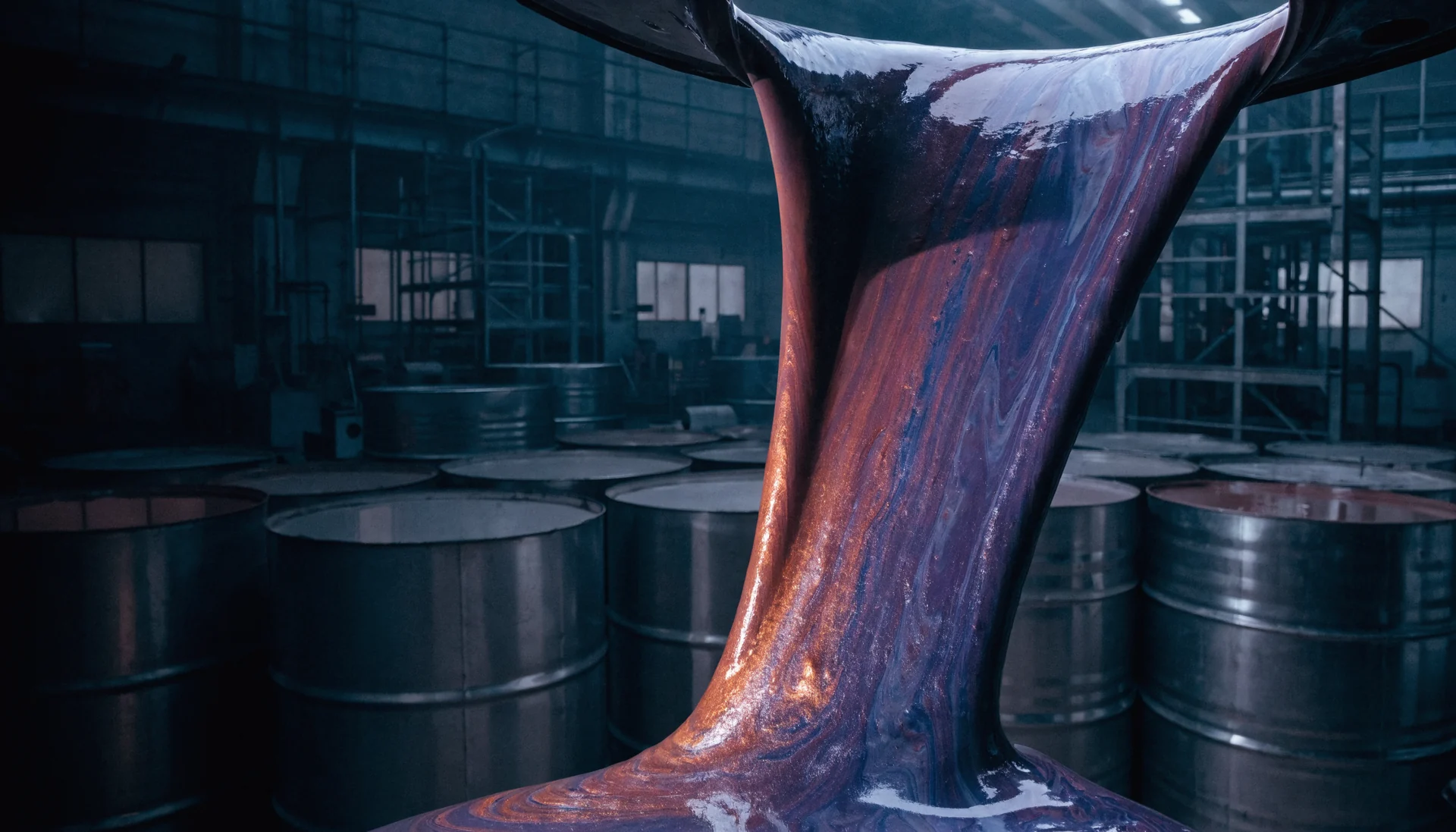
Solution Approach
RawSource supplies the base chemicals that go into these programs. We can help with product selection, grade matching, and sourcing from multiple origins for supply security.
Typical Formulation Workflow
1
System & Substrate Assessment
Define the binder system (waterborne, solventborne, UV, powder), substrate, cure, and the VOC, durability, and appearance targets.
2
Additive & Resin Selection
Match resins, pigments and fillers, dispersants, rheology modifiers, defoamers, or biocides to the formulation and compatibility window.
3
Lab Let-Down & Optimization
Dial in loading and addition order through lab let-downs, checking dispersion, rheology, film properties, and storage stability.
4
Application & Performance Testing
Validate on the real application method and substrate, tracking gloss, adhesion, sag, cure, and weathering before scale-up.
Recommended Chemistries (4)
Ethylene Glycol Monobutyl Ether
CAS 111-76-2
Glycols & Polyols
Standard coalescent for latex coatings
1993 (ETHYLENE GLYCOL MONOBUTYL ETHER) · Class Slow-evaporating glycol ether that transiently plasticizes latex particles so they fuse below MFFT, then evaporates out of the film
Melting Point: -70 °C Boiling Point: 171 °C at 743 mmHg Density: 0.902 at 20 °C
Quick view
Full Details
Diethylene Glycol Monoethyl Ether
CAS 111-90-0
Glycols & Polyols
High-boiling co-solvent
High-boiling co-solvent that stays in the wet film long enough to lower polymer Tg during the critical coalescence window
Melting Point: -78 °C Boiling Point: 202 °C at 760 mmHg Density: 0.99 at 20 °C
Quick view
Full Details
Propylene Glycol, USP/FCC Food Grade
CAS 57-55-6
Glycols & Polyols
Freeze-thaw stabilizer (lower toxicity)
Open-time/freeze-thaw co-solvent that retards water loss so particles have time to pack and deform before the film skins over
Melting Point: -60 °C Boiling Point: 188 °C at 760 mmHg Density: 1.04 at 20 °C
Quick view
Full Details
Diacetone Alcohol
CAS 123-42-2
Solvents
Ketone-alcohol co-solvent
1148 (DIACETONE ALCOHOL) · Class Ketone-alcohol with strong solvency for the polymer phase, aiding particle softening and flow during film build
Melting Point: -43 °C Boiling Point: 164 °C at 760 mmHg Density: 0.938 at 20 °C
Quick view
Full Details